
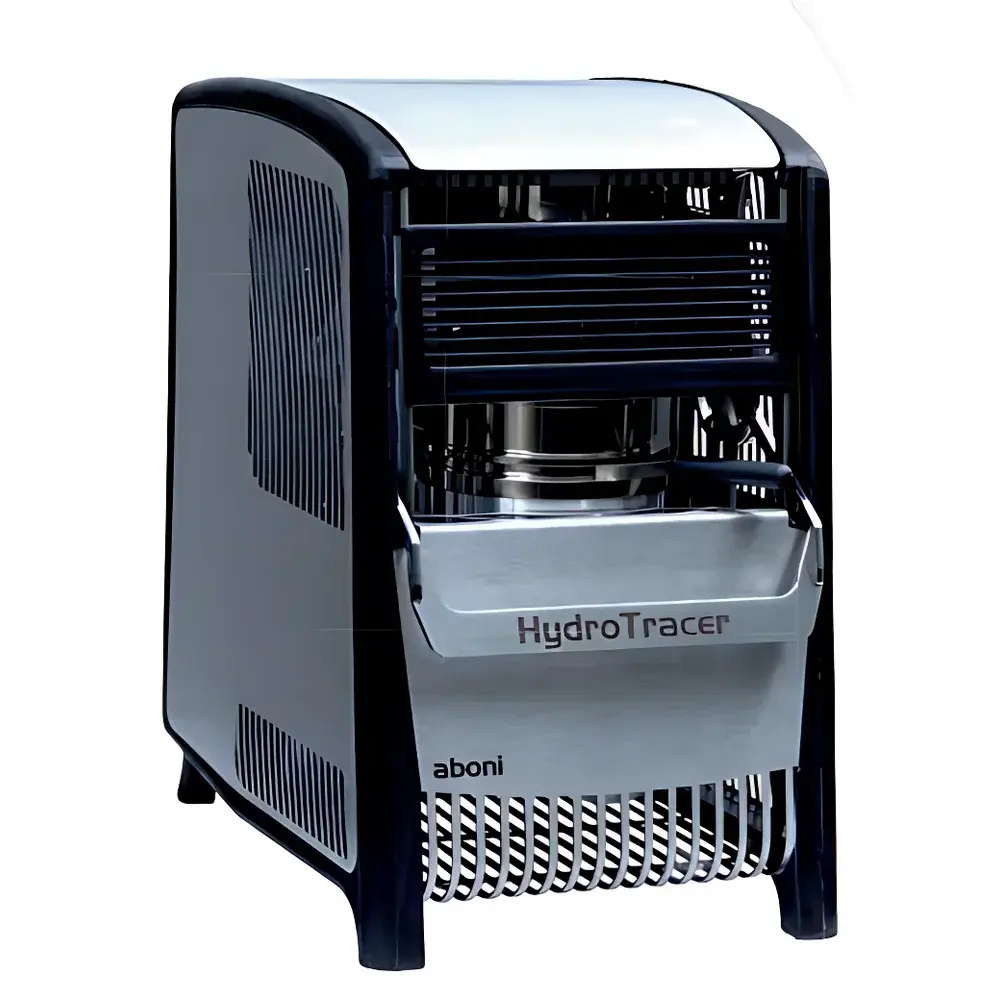
Aboni HT3 HydroTracer Plastic Pellet Moisture Analyzer
| Brand | Aboni |
|---|---|
| Origin | Germany |
| Model | HT3 |
| Measurement Principle | Calcium Hydride Reaction (Hydrogen Gas Evolution) |
| Sample Capacity | 0.01–50 g (up to 100 g depending on density & moisture content) |
| Sample Volume | ~50 mL |
| Detection Range | 0.2–30 mg H₂O |
| Resolution | ±0.1 mg H₂O (at 1 mg) to ±0.3 mg H₂O (at 20 mg) |
| Heating Temperature Range | 50–210 °C (1 °C increments) |
| Reagent | Calcium Hydride (CaH₂) powder, ~0.1 g per test |
| Environmental Monitoring | Temperature (±0.1 °C), Relative Humidity (0–100 % RH, ±0.1 %), Atmospheric Pressure (700–1100 mbar, ±0.1 mbar) |
| Power Supply | 230 VAC, 1.6 A |
| Dimensions | 285 (H) × 170 (W) × 250 (D) mm |
| Weight | 4.6 kg |
| Interface | RS232 or USB |
| Compliance | ISO 15512 |
Overview
The Aboni HT3 HydroTracer Plastic Pellet Moisture Analyzer is a precision laboratory and industrial instrument engineered for absolute moisture quantification in solid polymeric materials using the calcium hydride (CaH₂) reaction principle. Unlike thermogravimetric (TGA) or Karl Fischer titration methods, the HT3 relies on stoichiometric hydrogen gas evolution: water in the sample reacts quantitatively with CaH₂ to produce hydrogen gas (CaH₂ + 2H₂O → Ca(OH)₂ + 2H₂). The evolved H₂ volume—measured via high-stability pressure and temperature sensors—is directly proportional to the mass of water present. This chemical transduction method eliminates interference from volatile organic compounds, solvents, or decomposition gases common in thermoplastic resins, ensuring specificity and robustness across diverse polymer matrices. Designed for routine QC/QA in compounding, extrusion, and injection molding environments, the HT3 delivers trace-level moisture detection down to sub-milligram levels without calibration drift or reagent titration steps.
Key Features
- Stoichiometric moisture determination via CaH₂–H₂O reaction—no calibration required prior to analysis
- Integrated environmental compensation: real-time correction for ambient temperature, relative humidity, and barometric pressure to isolate true sample moisture content
- Wide dynamic range: measures 0.2–30 mg absolute water mass with reproducibility of ±0.1 mg at low levels (1 mg H₂O) and ±0.3 mg at higher loads (20 mg H₂O)
- Adjustable heating profile: programmable temperature ramp from 50 °C to 210 °C in 1 °C increments, optimized for thermal stability of engineering thermoplastics (e.g., PA6, PBT, PC, PET)
- Compact, lightweight chassis (4.6 kg) constructed from anodized aluminum and stainless steel—suitable for benchtop, production floor, or mobile field deployment
- Low-cost, non-toxic reagent consumption: ~0.1 g CaH₂ per test; no hazardous solvents or pyridine-based reagents required
- Dual communication interface: RS232 and USB connectivity for seamless integration with Windows-based LIMS or QA documentation systems
Sample Compatibility & Compliance
The HT3 is validated for heterogeneous solid samples including granules, pellets, powders, flakes, and foamed thermoplastics—regardless of particle size distribution or bulk density. It accommodates volumes up to 50 mL and masses from 0.01 g to 50 g (extendable to 100 g for low-density, low-moisture materials). Certified reference materials and industry-standard polymers—including ABS, PA6, PA6.6, PA12, PBT, PC, PET, PE, PP, PS, PMMA, POM, TPE, PVC, and filled compounds (e.g., PE + talcum, PP + carbon black)—have been verified per ISO 15512:2019 “Plastics — Determination of water content — Calcium hydride method”. The instrument meets fundamental requirements for GLP-compliant moisture testing in regulated manufacturing environments and supports audit-ready data traceability when paired with compliant software.
Software & Data Management
The HT3’s native Windows application (compatible with Windows 98 through Windows 10, Pentium 233 MHz minimum, 128 MB RAM recommended) provides full control over method parameters, real-time sensor monitoring, and automated calculation of both absolute moisture (mg), relative moisture (% w/w), and parts-per-million (ppm) values. All raw sensor data—pressure, temperature, humidity, and calculated H₂ yield—are timestamped and stored locally with user-defined project IDs and sample identifiers. Export functions support CSV and Excel formats for statistical process control (SPC) integration. While the base firmware does not include FDA 21 CFR Part 11 electronic signature or audit trail capabilities, the architecture permits third-party validation and extension via API-compatible middleware for GMP-aligned laboratories.
Applications
- Pre-drying verification of hygroscopic resins (e.g., nylon, PET, PC) prior to extrusion or injection molding
- Moisture release profiling during thermal aging studies of polymer blends and composites
- QC screening of incoming raw material batches against internal specifications or customer requirements
- Process troubleshooting: correlating residual moisture with surface defects (splay, silver streaking), void formation, or hydrolytic degradation in finished parts
- Research applications: evaluating desiccant efficiency, drying kinetics, and moisture diffusion coefficients in semi-crystalline polymers
- Field-based moisture assessment at supplier sites or logistics hubs where lab-grade Karl Fischer systems are impractical
FAQ
How does the HT3 differ from Karl Fischer titration?
The HT3 uses a gasometric reaction (CaH₂ + H₂O → H₂), offering inherent selectivity for water without interference from alcohols, acids, or ketones—unlike volumetric or coulometric Karl Fischer methods that require solvent compatibility and electrode maintenance.
Is ISO 15512 compliance verified by third-party certification?
Yes—the HT3’s measurement protocol, uncertainty budget, and repeatability performance align with ISO 15512:2019 Annex A validation criteria; users may perform in-house method verification per Clause 8.2 using certified moisture standards.
Can the instrument measure moisture in highly filled compounds (e.g., 40% glass fiber or mineral filler)?
Yes—provided the sample is homogeneous and representative. Fillers such as calcium carbonate, sand, or carbon black do not react with CaH₂ and therefore do not contribute to H₂ generation.
What maintenance is required for long-term accuracy?
Annual verification of pressure/temperature sensor drift and periodic replacement of the CaH₂ reagent chamber seal are recommended; no optical alignment or electrode cleaning is necessary.
Is the HT3 suitable for regulatory submissions under ICH Q5C or USP <921>?
While not a pharmacopeial apparatus per se, its ISO 15512 conformance and documented measurement uncertainty make it acceptable for supporting moisture data in polymer-based medical device packaging qualification, subject to user validation per ICH Q2(R2).






