
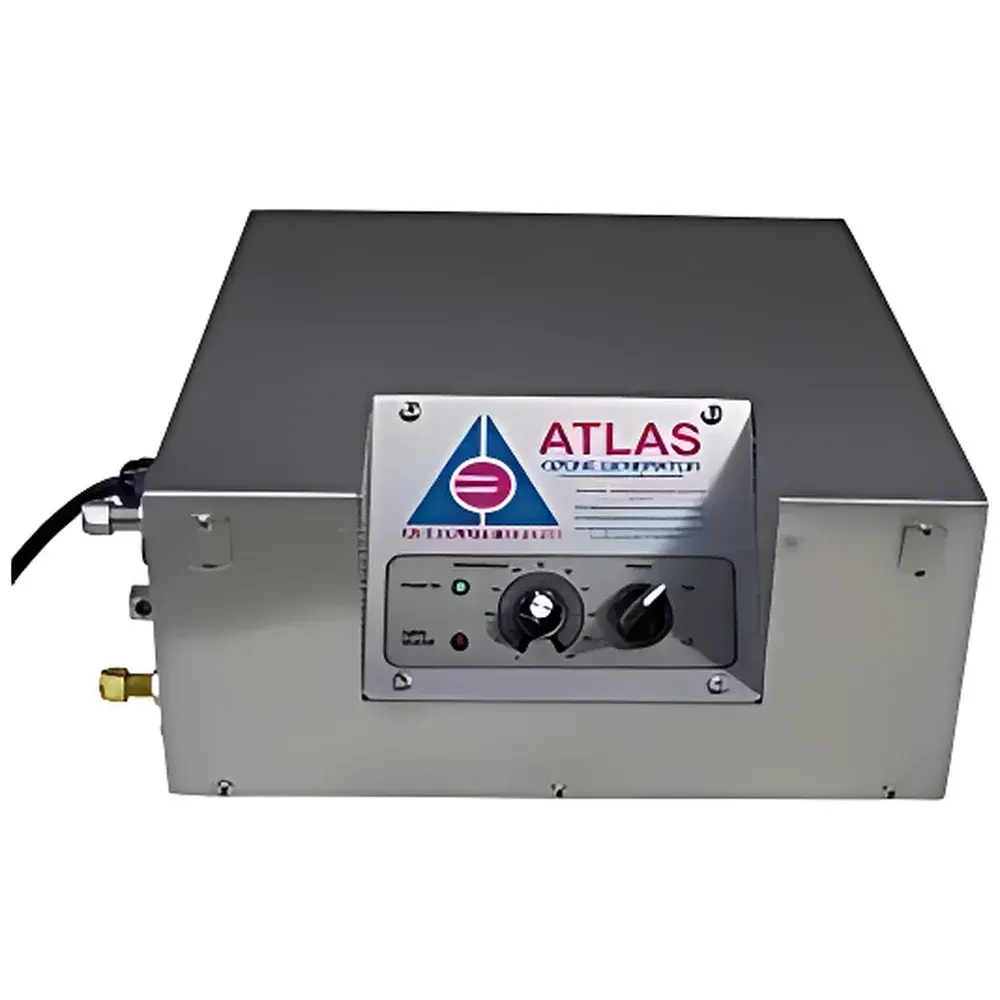
Absolute Atlas100 Industrial Ozone Generator
| Brand | ABSOLUTE OZONE |
|---|---|
| Origin | Canada |
| Model | Atlas100 |
| Ozone Output | 100 g/h (5.3 ppm·day) |
| Max Ozone Output | 113 g/h (6 ppm·day) |
| Ozone Concentration | 5–12% w/w |
| Feed Gas Flow Rate | 0.1–25 SLPM |
| Operating Pressure | 25–100 psig (standard setpoint: 25 psig) |
| Power Supply | 120 V ±10%, 50/60 Hz, single-phase, 15.0 A |
| Max Power Consumption | 950 W |
| Inlet/Outlet Fitting | 0.25-inch stainless steel compression fittings |
| Construction | Brushed stainless steel and aluminum housing |
| O₃/O₂ Conduit Materials | PTFE-lined 304 stainless steel and brass |
| Pressure Test Rating | 150 psig leak-tested |
Overview
The Absolute Atlas100 Industrial Ozone Generator is a CE-compliant, laboratory- and pilot-scale ozone production system engineered for stable, continuous output of high-purity ozone from medical- or industrial-grade oxygen feed gas. Utilizing corona discharge technology in a dry-air- or oxygen-fed configuration, the Atlas100 generates ozone via dielectric barrier discharge across precision-engineered electrode gaps—ensuring consistent dissociation of O₂ molecules and recombination into O₃ with minimal nitrogen oxide byproducts. Designed for integration into controlled environmental chambers, water treatment validation rigs, surface decontamination test benches, and accelerated oxidation studies, the unit delivers calibrated ozone mass flow rates up to 113 g/h at concentrations ranging from 5 to 12% by weight—meeting critical requirements for ASTM D1193 Type I–II water purity verification, ISO 14644 cleanroom monitoring support, and USP <1231> ozone stability assessment protocols.
Key Features
- Corona discharge ozone generation with optimized electrode geometry and thermal management for long-term output stability and low NOx carryover
- Wide-range adjustable feed gas pressure (25–100 psig) and mass flow (0.1–25 SLPM), enabling precise control over ozone concentration and delivery rate
- Dual-voltage compatibility: supports both 120 V single-phase (15.0 A) and 220 V three-phase (5.0 A) input configurations for global deployment
- Robust mechanical architecture: brushed stainless steel and aluminum housing rated to 150 psig hydrostatic pressure test; fully leak-tested prior to shipment
- Ozone-conveying wetted path constructed from PTFE-lined 304 stainless steel tubing and brass fittings—resistant to oxidative degradation and compliant with FDA 21 CFR 177.1550 for fluoropolymer contact surfaces
- Front-panel digital interface with real-time display of operating voltage, current draw, and estimated ozone output; optional 0–10 VDC or 4–20 mA analog output for PLC integration
Sample Compatibility & Compliance
The Atlas100 is intended for use with high-purity oxygen (≥90% O₂, dew point ≤ –60°C) or dried compressed air (dew point ≤ –40°C, oil-free). It is not compatible with ambient air containing volatile organic compounds (VOCs) or particulate load exceeding ISO 8573-1 Class 2:2:2. The generator conforms to IEC 61000-6-3 (EMC emission limits) and IEC 61000-6-2 (immunity standards), and its construction satisfies mechanical safety requirements per CSA C22.2 No. 61010-1. When operated within specified parameters and integrated with appropriate ozone destruct units (e.g., catalytic thermal destruct), it supports GLP-compliant experimental workflows requiring documented ozone exposure dosimetry per ISO 11137-1 Annex B.
Software & Data Management
While the Atlas100 operates as a stand-alone hardware unit without embedded firmware-based data logging, its analog outputs (0–10 VDC / 4–20 mA) are fully compatible with third-party SCADA systems, LabVIEW DAQ modules, and industrial PLCs supporting Modbus RTU via optional RS-485 interface kit. All operational parameters—including feed pressure, current draw, and estimated ozone mass flow—are traceable through external calibration records maintained under ISO/IEC 17025-accredited procedures. Audit trails for maintenance events (e.g., electrode cleaning intervals, PTFE liner inspection logs) may be incorporated into electronic lab notebooks (ELN) aligned with 21 CFR Part 11 requirements when paired with validated timestamped acquisition software.
Applications
- Validation of ozone-based sterilization cycles for Class II medical devices per ISO 14937
- Accelerated aging studies of polymer packaging materials exposed to controlled ozone atmospheres (ASTM D1149)
- Calibration and challenge testing of ozone monitors used in HVAC commissioning (ASHRAE Standard 189.1)
- Research on ozone-mediated advanced oxidation processes (AOPs) for pharmaceutical impurity degradation kinetics
- Generation of standardized ozone challenge gases for filter media efficiency testing (EN 1822-3)
- Support of microbiological efficacy testing against spore-forming pathogens (e.g., Bacillus atrophaeus) under defined CT values
FAQ
What feed gas purity is required for optimal performance and electrode longevity?
Medical- or high-purity oxygen (≥90% O₂, hydrocarbon content < 0.1 ppmv, dew point ≤ –60°C) is strongly recommended. Use of ambient air or inadequately dried gas accelerates electrode fouling and reduces ozone yield reproducibility.
Can the Atlas100 be operated continuously for extended periods?
Yes—the unit is rated for uninterrupted operation at nominal load (≤950 W) with adequate ventilation. Ambient temperature must remain between 10–35°C, and relative humidity below 70% non-condensing.
Is ozone concentration tunable in real time during operation?
Concentration is modulated indirectly via feed gas flow rate and pressure; no internal ozone sensor is included. For closed-loop concentration control, integrate an external UV photometer (e.g., 254 nm absorption) with feedback to the mass flow controller.
Does the Atlas100 include an integrated ozone destruct system?
No. A separate catalytic or thermal ozone destruct unit must be installed downstream per OSHA PEL (0.1 ppm TWA) and local occupational health regulations.
What maintenance schedule is recommended for routine operation?
Electrode inspection and cleaning every 500 operational hours; PTFE-lined conduit replacement every 2,000 hours or upon visual signs of embrittlement; annual calibration of pressure transducers and flow meters against NIST-traceable standards.



