
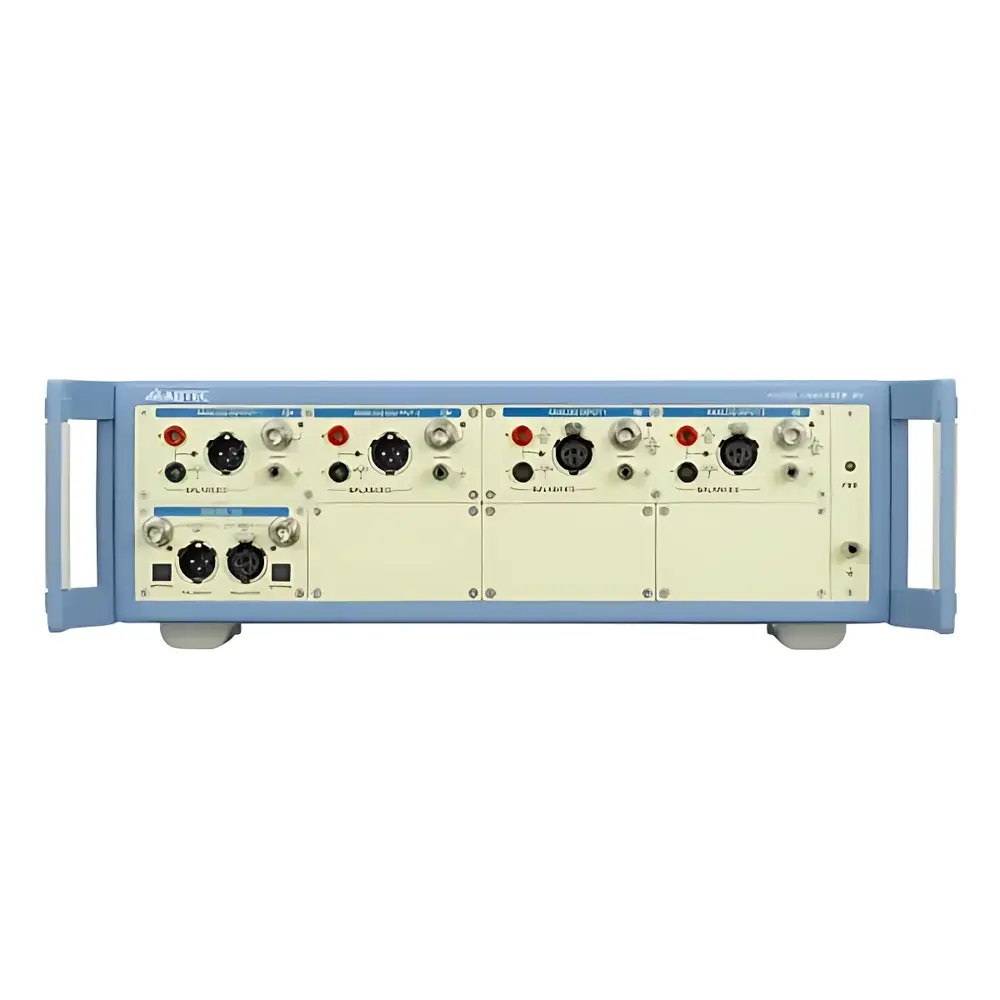
ABTEC A5 High-Performance Audio Analyzer
| Brand | ABTEC |
|---|---|
| Origin | Shenzhen, China |
| Manufacturer Type | Authorized Distributor |
| Country of Origin | China |
| Model | A5 |
| Pricing | Available Upon Request |
| THD+N (Typical) | –108 dB |
| Max Input Voltage (Balanced) | 300 Vrms |
| Analog Output Amplitude | 21 Vrms |
| Supported Bluetooth Codecs | SBC, aptX, aptX-LL, aptX-HD, AAC, LHDC (HWA) |
| Digital Interface Options | SPDIF, TOSLINK, AES/EBU, I²S, HDMI, BT, PDM (optional), DSI-O (optional, higher sample rate support) |
| Software API Support | VB.NET, C#.NET, LabVIEW |
| Measurement Capabilities | Level/Gain/Phase, Channel Balance, Frequency Response, THD+N, IMD, SNR, Noise, Crosstalk, Interchannel Phase, DC Level, Frequency Measurement, CMRR, Oscilloscope & Spectrum Monitoring, Stepped Level/Frequency Sweep, DC Level Sweep, Q-Peak Noise |
Overview
The ABTEC A5 High-Performance Audio Analyzer is a precision-engineered instrument designed for comprehensive electroacoustic and electronic audio signal characterization in R&D, production QA/QC, and compliance validation environments. Built upon a dual-domain architecture—supporting both high-fidelity analog signal processing and multi-standard digital interface analysis—the A5 implements real-time FFT-based spectral analysis, dual-channel coherent sampling, and low-noise analog front-end circuitry to deliver laboratory-grade measurement integrity. Its core measurement methodology adheres to established audio test standards including IEC 60268-3 (distortion), IEC 60268-21 (frequency response), and AES17-2015 (digital audio measurement), ensuring traceable, repeatable results across global audio product development workflows.
Key Features
- Dual-channel analog input/output with balanced 300 Vrms maximum input capability and 21 Vrms output swing—enabling safe, high-dynamic-range testing of power amplifiers, active speakers, and line-level consumer electronics.
- Native support for industry-critical Bluetooth audio codecs—including SBC, aptX, aptX-LL, aptX-HD, AAC, and LHDC (HWA)—with integrated RF link emulation and packet-level synchronization for end-to-end wireless audio path validation.
- Modular digital interface expansion via optional DSI-O (Digital Signal Interface–Optimized) and PDM (Pulse Density Modulation) modules, supporting up to 384 kHz sample rates and direct connection to MEMS microphones, DSPs, and SoCs used in modern voice-enabled devices.
- Full-featured embedded oscilloscope, real-time spectrum analyzer, and dual-channel FFT engine—providing simultaneous time-domain and frequency-domain visualization without external software dependencies.
- Zero-code automation framework with intuitive drag-and-drop test sequencing; fully programmable via native .NET APIs (VB.NET, C#.NET) and LabVIEW drivers compliant with NI-VISA and IVI-C specifications.
- Unified software platform with GLP-compliant audit trail logging, configurable report templates (PDF, CSV, PNG, HTML), and automated pass/fail decision logic based on user-defined limits per measurement parameter.
Sample Compatibility & Compliance
The A5 supports broad physical compatibility across consumer, professional, and automotive audio systems—including Bluetooth headphones, smart speakers, AV receivers, automotive infotainment units, USB-C DACs, and Class-D amplifier modules. Its analog input impedance (10 MΩ || 20 pF) and digital interface termination schemes conform to AES3, I²S, and S/PDIF electrical specifications. All measurements are traceable to NIST-traceable reference sources and comply with ISO/IEC 17025 requirements when operated within documented calibration intervals. The instrument’s firmware and software architecture incorporate secure user access controls, electronic signature support, and 21 CFR Part 11–ready audit logs for regulated environments requiring FDA or EU MDR documentation rigor.
Software & Data Management
The A5 runs on a deterministic real-time OS with a Qt-based GUI optimized for touch and keyboard navigation. The software provides one-click test execution with intelligent auto-ranging and adaptive stimulus level selection based on device under test (DUT) impedance and sensitivity profiles. All raw datasets—including time-series waveforms, FFT bins, and swept parameter traces—are stored in HDF5 format for long-term archival and third-party post-processing. Export options include IEEE-compliant CSV metadata headers, vector graphics (SVG), and annotated screenshots with measurement overlays. Remote control over LAN (TCP/IP) and USBTMC enables integration into automated test benches governed by MES or SCADA platforms.
Applications
- Verification of Bluetooth audio codec latency, bit-depth fidelity, and channel synchronization in wearable and hearable devices.
- THD+N and IMD evaluation of Class-D and GaN-based audio amplifiers under dynamic load conditions.
- Frequency response and phase coherence mapping of multi-driver loudspeaker systems using gated impulse response analysis.
- CMRR and crosstalk assessment in balanced line drivers and professional audio interfaces.
- Q-peak noise compliance testing per IEC 60268-5 for broadcast and studio equipment certification.
- Production-line go/no-go screening with statistical process control (SPC) charting and CPK calculation directly embedded in the reporting engine.
FAQ
Does the A5 support calibration traceability to national metrology institutes?
Yes—ABTEC provides optional factory calibration certificates accredited to ISO/IEC 17025, with uncertainty budgets referenced to NIST-traceable standards.
Can the A5 perform real-time analysis during Bluetooth streaming without buffer dropouts?
Yes—the instrument employs dedicated hardware-accelerated Bluetooth baseband processing and dual-buffered DMA channels to maintain uninterrupted 96 kHz/24-bit capture during sustained SBC or aptX-HD playback.
Is PDM interface support available as a field-upgradeable option?
Yes—the PDM module is delivered as a plug-in daughterboard with firmware auto-detection; installation requires no soldering or service center return.
How does the A5 ensure measurement repeatability across different operators and lab sites?
Through standardized test templates (.a5t files), encrypted user profiles with role-based permissions, and embedded calibration verification routines executed before each test sequence.
What operating systems are supported for remote control and API integration?
Windows 10/11 (x64), Windows Server 2019/2022, and Linux (Ubuntu 20.04 LTS+ via libusb and custom kernel modules).
Related Products



