
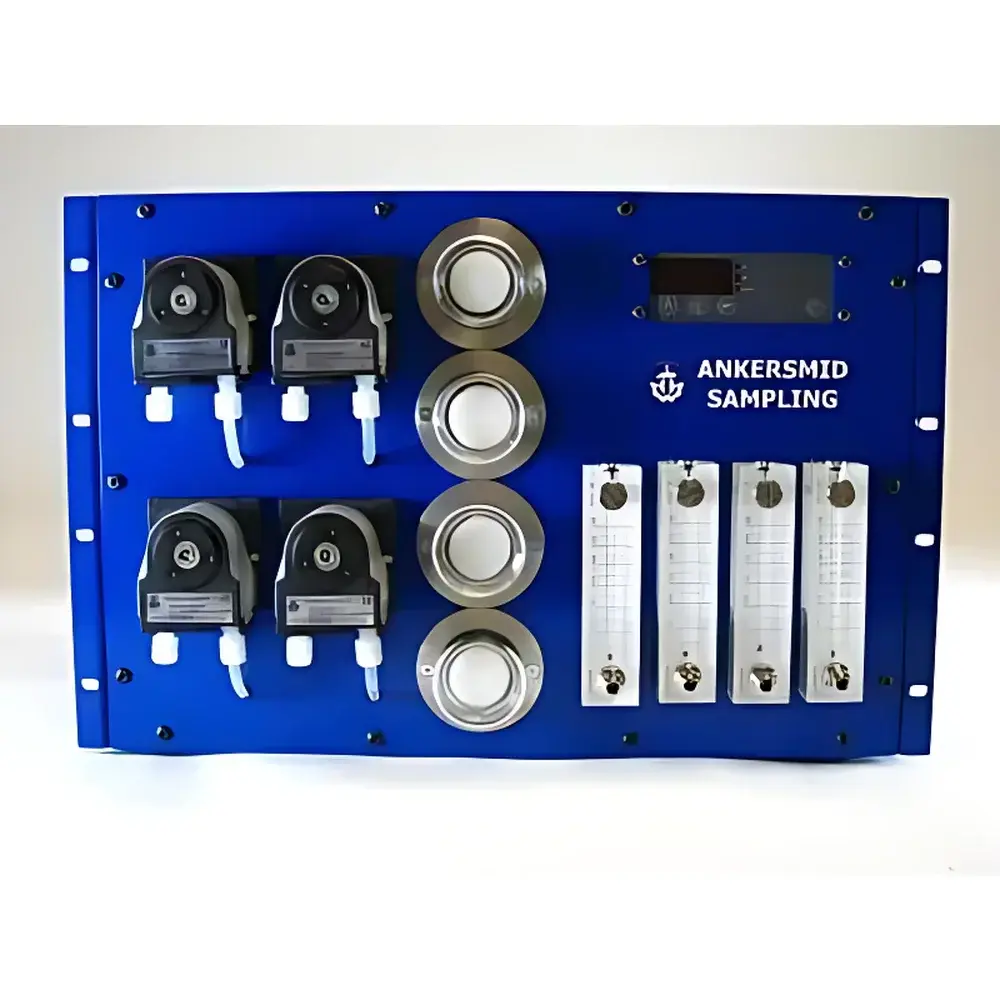
ACC Amide Compressor Cooler
| Origin | Netherlands |
|---|---|
| Manufacturer Type | Distributor |
| Origin Category | Imported |
| Model | ACC Amide Compressor Cooler |
| Pricing | Upon Request |
Overview
The ACC Amide Compressor Cooler is a precision-engineered gas sample conditioning system designed for continuous, stable pre-treatment of hot, humid process or ambient gas streams prior to analysis by online gas analyzers, GC systems, or electrochemical sensors. Operating on the principle of thermoelectric (Peltier) and/or refrigerant-based compression cooling, it achieves controlled condensation of water vapor while preserving the integrity of target analytes—including CO, CO₂, SO₂, NOₓ, VOCs, and hydrocarbons—without chemical absorption, catalytic alteration, or adsorption losses. Its core function is dew point stabilization: maintaining a consistent +4 °C outlet dew point under dynamic thermal and flow load conditions, thereby eliminating moisture-induced interference in downstream detection and ensuring long-term calibration stability across environmental monitoring, stack emission compliance, and industrial safety applications.
Key Features
- Stable +4 °C dew point control with active thermal compensation—engineered to counteract fluctuations in inlet temperature (up to 180 °C), flow rate (0.1–5 L/min), and ambient humidity (10–95% RH).
- Dual-stage separation architecture: first-stage rapid condensation via high-efficiency compressor-cooled heat exchanger; second-stage coalescing filtration to remove sub-micron aerosols and entrained liquid droplets (removal efficiency >99.9% at ≥0.3 µm).
- Corrosion-resistant wetted path constructed from electropolished 316 stainless steel and PTFE-sealed components—compatible with acidic, alkaline, and oxidizing gas matrices including flue gas, biogas, and landfill off-gas.
- Integrated pressure regulation and flow monitoring (optional analog 4–20 mA or digital Modbus RTU output) to support automated system integration and real-time diagnostics.
- Low maintenance design: no consumables (e.g., desiccants or scrubbers), sealed refrigeration circuit with >15,000-hour compressor service life, and self-draining condensate reservoir with level sensor alarm interface.
Sample Compatibility & Compliance
The ACC Amide Compressor Cooler is validated for use with EPA Method 3A, EN 15267-3, and ISO 12039-compliant gas analyzers. It meets CE marking requirements under the EU Measuring Instruments Directive (MID) and conforms to IEC 61000-6-2/6-4 for electromagnetic compatibility. Its material compatibility supports sampling of corrosive gases per ASTM D6785 (for sulfur compounds) and US EPA Method 25A (for total gaseous organic concentration). The unit operates within GLP/GMP-aligned environments when paired with audit-trail-capable data loggers and complies with traceability requirements under ISO/IEC 17025 for accredited laboratories conducting stack testing or ambient air quality monitoring.
Software & Data Management
While the ACC Amide Compressor Cooler operates as a standalone hardware conditioner, it integrates seamlessly into supervisory control systems via optional analog I/O or RS-485 Modbus RTU communication. When deployed with compatible host software (e.g., Siemens Desigo CC, Emerson DeltaV, or custom SCADA platforms), it enables remote monitoring of critical parameters—including inlet/outlet temperature, condensate level, compressor status, and dew point deviation history. All operational logs are time-stamped and exportable in CSV format for regulatory reporting, trend analysis, and preventive maintenance scheduling. Firmware updates are performed via secure USB interface, supporting version-controlled configuration management required under FDA 21 CFR Part 11 for validated environmental monitoring systems.
Applications
- Continuous emission monitoring systems (CEMS) for power plants, cement kilns, and waste incinerators—ensuring dry, particle-free sample delivery to UV-DOAS, NDIR, and paramagnetic O₂ analyzers.
- Biogas upgrading facilities requiring dew point control upstream of methane purity analyzers and H₂S electrochemical sensors.
- Indoor air quality (IAQ) networks where stable sample conditioning improves repeatability of PID and metal oxide semiconductor (MOS) sensor arrays.
- Calibration gas delivery systems for reference standard generation, where moisture-induced dilution error must be minimized below ±0.2% relative humidity uncertainty.
- Research-grade atmospheric chemistry studies involving reactive nitrogen species or volatile organic compound (VOC) speciation using GC-MS or PTR-TOF instrumentation.
FAQ
What is the maximum allowable inlet gas temperature?
The unit accepts inlet gas temperatures up to 180 °C continuously, with optional high-temp inlet filter housing available for transient spikes up to 220 °C.
Does the cooler require external drainage or condensate pump?
No—integrated gravity-drain design with automatic shutoff valve prevents backflow; condensate reservoir capacity supports 72 hours of operation at 2 L/min flow and 80% RH inlet conditions.
Can it be used with corrosive gases such as HCl or Cl₂?
Yes—the wetted path is fully compatible with HCl, Cl₂, HF, and SO₂ at concentrations typical of regulated stack emissions; optional Hastelloy C-276 contact materials available upon request.
Is the +4 °C dew point actively regulated or fixed by design?
It is actively regulated via closed-loop PID control of compressor speed and heat exchanger bypass, compensating for load changes without manual recalibration.
What certifications does the unit hold for hazardous area installation?
ATEX II 2G Ex db IIB T4 Gb and IECEx DBTA20.0035X certified for Zone 1 installations; non-sparking motor and intrinsic safety barrier options available for Zone 0 deployment.
Related Products







