
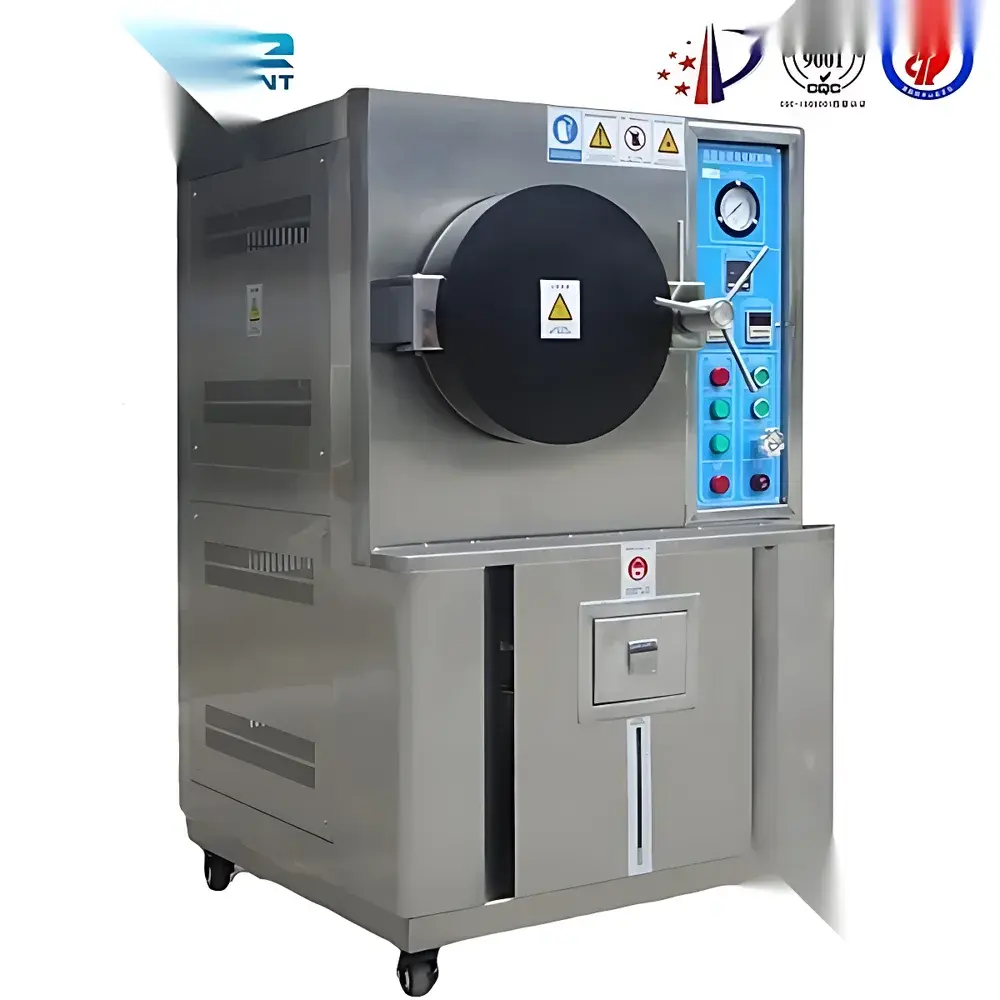
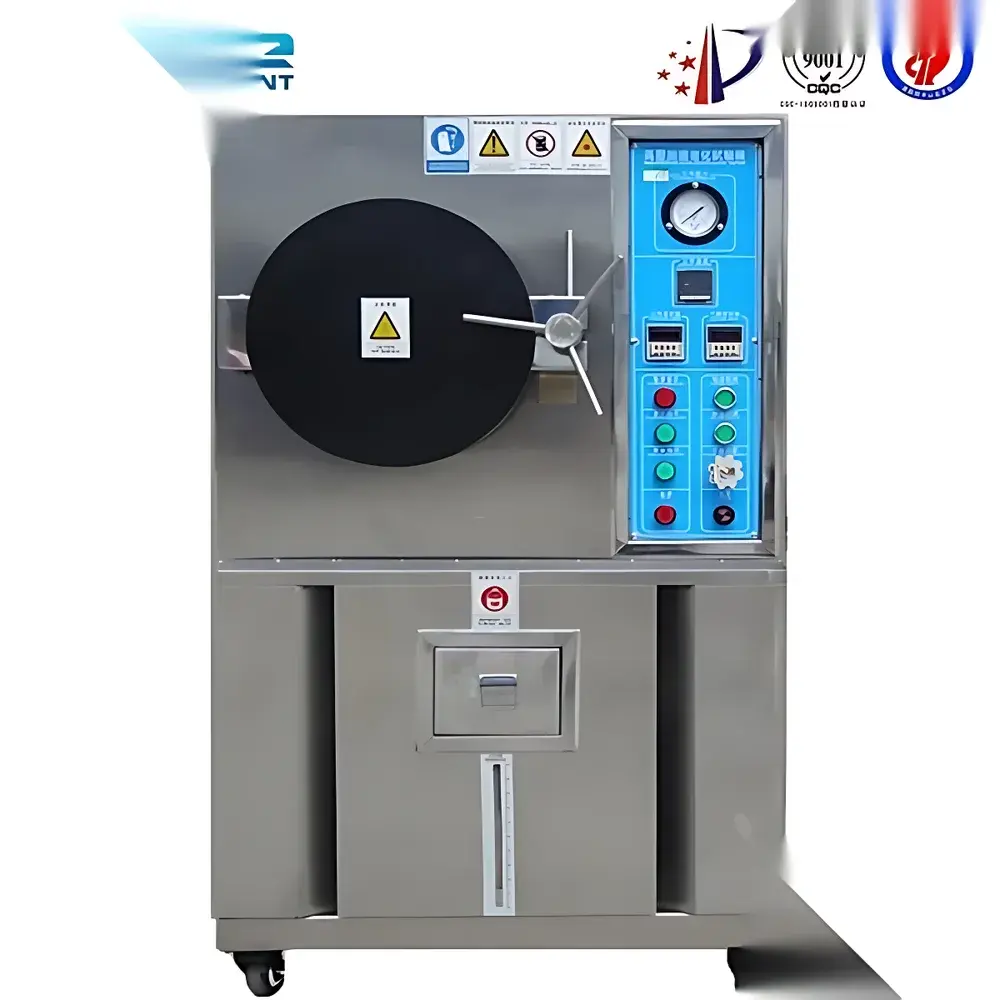
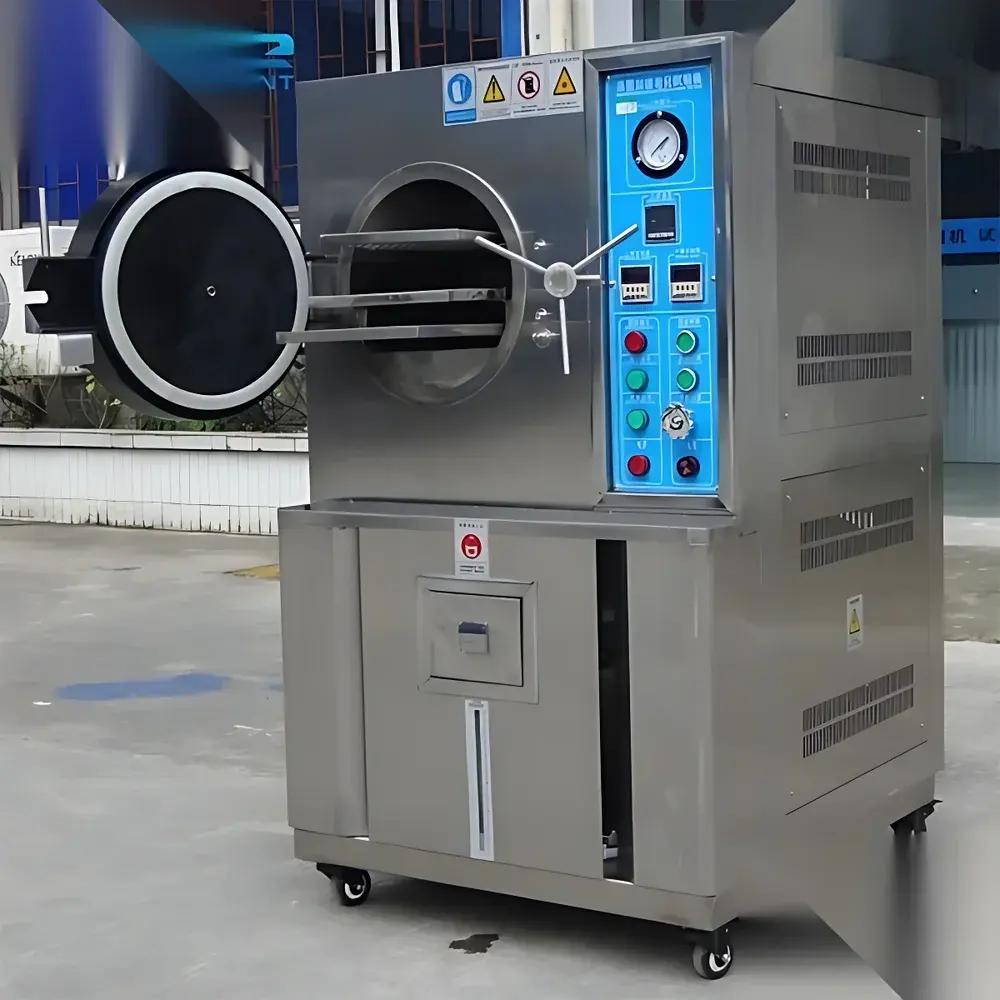
Accelerated Aging Test Chamber OK-PTC Series (Saturated Steam Pressure Type)
| Key Features | Internal Chamber Dimensions – Ø250×450 mm (OK-PTC-25) / Ø350×500 mm (OK-PTC-35) |
|---|---|
| Temperature Range | RT+10°C to 132°C |
| Humidity Range | 100% RH (saturated steam environment) |
| Pressure Range | 0.0–2.8 kg/cm² (gauge), max working pressure 3.0 kg/cm² (safety capacity: 4.0 kg/cm²) |
| Temperature Uniformity | ±1.5°C |
| Temperature Control Accuracy | ±0.5°C |
| Temperature Resolution | 0.1°C |
| Pressurization Time | ~30 min (0.0 → 2.0 kg/cm²) |
| Inner Chamber Material | SUS304 stainless steel |
| Outer Casing | SECC cold-rolled steel with electrostatic powder coating |
| Compliance | ASTM D257, DIN 50017, ISO 2231, IEC 60068-2-13, JIS Z 2243, MIL-STD-810H, NACE TM0169, UL 746C |
Overview
The OK-PTC Series Accelerated Aging Test Chamber is a saturated steam pressure-type environmental stress chamber engineered for accelerated life testing of polymeric materials, electrical insulation systems, packaging components, and corrosion-sensitive assemblies under controlled high-temperature, high-humidity, and elevated-pressure conditions. It operates on the principle of saturated steam autoclave aging—where test specimens are exposed to pressurized saturated water vapor at precisely regulated temperature and pressure profiles. This methodology significantly shortens aging cycles compared to ambient or forced-convection humidity chambers, enabling predictive failure analysis in accordance with internationally recognized accelerated stress protocols. Unlike standard humidity chambers, the OK-PTC series achieves true thermodynamic saturation (100% RH) without condensation risk through precise steam-phase equilibrium control, making it suitable for evaluating hydrolytic degradation, thermal-oxidative stability, and seal integrity under realistic service conditions.
Key Features
- Two standard configurations: OK-PTC-25 (Ø250 × 450 mm internal volume) and OK-PTC-35 (Ø350 × 500 mm), both featuring horizontal cylindrical chamber orientation for ergonomic sample loading and minimized condensate pooling.
- Microprocessor-based PID + SSR temperature control system with platinum resistance thermometer (Pt100) sensing, delivering ±0.5°C control accuracy and 0.1°C resolution across the full operating range (RT+10°C to 132°C).
- Dual-sensor pressure monitoring with analog precision gauge and digital feedback loop; safety-rated pressure vessel design certified to 4.0 kg/cm² burst capacity (ASME BPVC Section VIII compliance reference).
- Integrated vacuum-assisted air purge system removes ambient oxygen and particulates prior to steam generation, ensuring reproducible oxidative environments and preventing contamination during long-duration tests (e.g., >100 h continuous operation).
- Motor-driven magnetic-coupled circulation fan enables uniform steam convection without mechanical seals penetrating the pressure boundary—eliminating leakage paths and enhancing long-term reliability.
- Multi-stage safety architecture: automatic pressure relief, vacuum break, water replenishment, and interlocked door mechanism that physically reinforces sealing force under positive internal pressure (self-tightening ring-groove interface).
Sample Compatibility & Compliance
The chamber accommodates rigid and semi-rigid specimens—including cable jackets, printed circuit board laminates, medical device housings, automotive gaskets, and food-grade packaging films—without requiring specialized fixtures. Its cylindrical geometry minimizes thermal gradients and eliminates shadowing effects common in rectangular chambers. All operational parameters adhere to test method requirements specified in ASTM D257 (dielectric resistance), ISO 2231 (aging of elastomers), IEC 60068-2-13 (damp heat, cyclic), JIS Z 2243 (high-pressure steam sterilization simulation), and MIL-STD-810H Method 507.5 (humidity). The system supports GLP-compliant validation protocols, including IQ/OQ documentation packages, and meets foundational requirements for FDA 21 CFR Part 11 data integrity when paired with optional audit-trail-enabled controllers.
Software & Data Management
Standard configuration includes LED-based local controller with real-time display of temperature, pressure, elapsed time, and cycle phase. Optional Ethernet-enabled programmable logic controller (PLC) upgrade provides RS485/Modbus TCP connectivity, remote monitoring via web browser, and automated CSV data logging at user-defined intervals (1 s to 60 min). All logged parameters include timestamped metadata, sensor calibration IDs, and operator login traceability—supporting traceable data acquisition per ISO/IEC 17025 Clause 7.5.2. Data export complies with ASTM E2500-18 Annex A2 for electronic records retention in regulated environments.
Applications
- Evaluation of hydrolytic degradation kinetics in polyamide (PA6, PA66), polyester (PET, PBT), and polyurethane elastomers.
- Accelerated qualification of conformal coatings and potting compounds used in aerospace avionics and downhole oilfield electronics.
- Validation of shelf-life claims for sterile barrier systems per ISO 11607-1 and AAMI TIR17.
- Corrosion acceleration testing of metallic substrates under chloride-laden humid environments (NACE TM0169 Annex B).
- Thermal aging of silicone rubber insulators and EPDM gasketing materials per IEEE 930 and UL 746C.
FAQ
What standards does the OK-PTC chamber support for validation and routine testing?
It is configured to meet core requirements of ASTM D257, ISO 2231, IEC 60068-2-13, JIS Z 2243, and MIL-STD-810H Method 507.5. Full qualification documentation (IQ/OQ) is available upon request.
Can the chamber operate unattended for extended durations?
Yes—the integrated water reservoir supports up to 100 hours of continuous operation. Optional auto-refill kits enable indefinite runtime with external deionized water supply.
How is safety ensured during high-pressure operation?
The chamber employs redundant mechanical and electronic safeguards: pressure-relief valves, dual-pressure transducers, vacuum-break solenoids, and a fail-safe door lock that only disengages when internal pressure drops below 0.05 kg/cm².
Is the steam environment truly saturated, and how is condensation prevented?
Yes—by maintaining strict thermodynamic equilibrium between liquid water and vapor phase via PID-controlled jacket heating and steam-phase temperature sensing, the system sustains 100% RH without free moisture accumulation on samples or chamber walls.
Does the system support regulatory audit requirements such as 21 CFR Part 11?
With the optional PLC controller and electronic log module, full audit trail, electronic signatures, and data integrity controls compliant with 21 CFR Part 11 Subpart B are achievable.



