
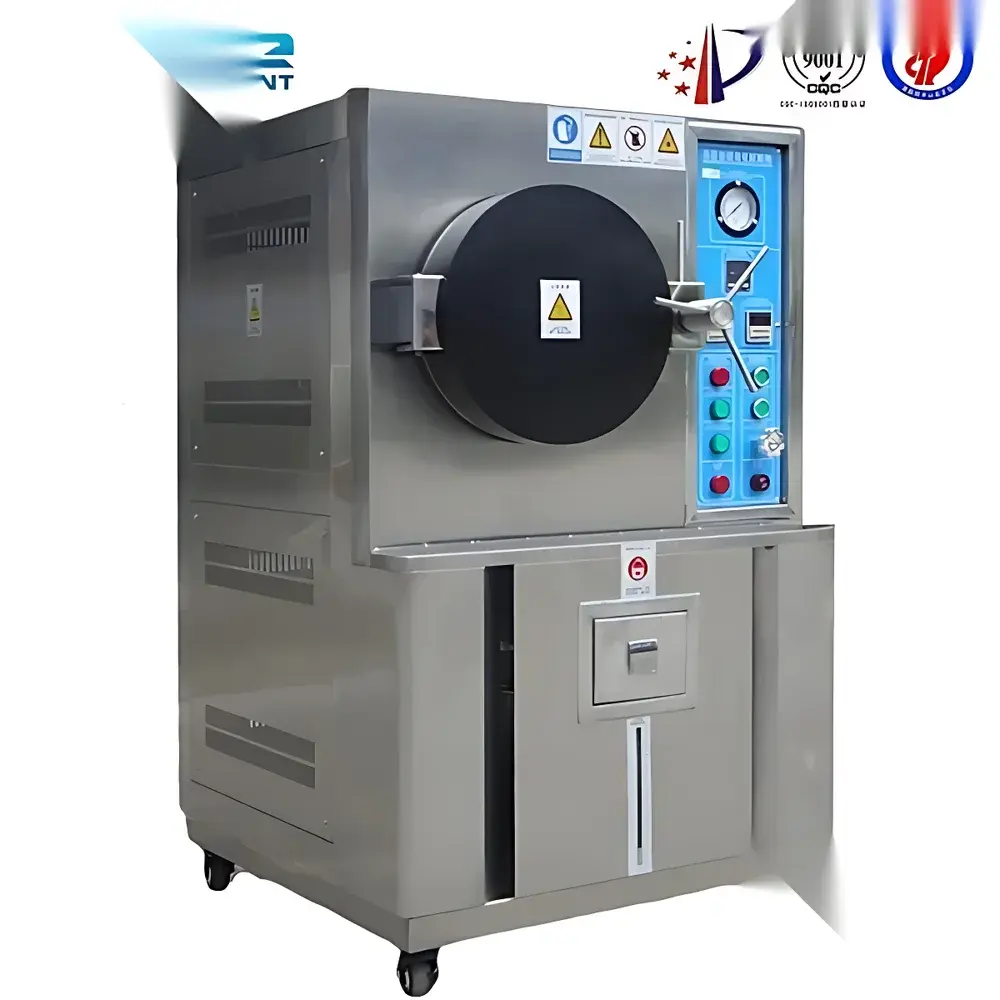
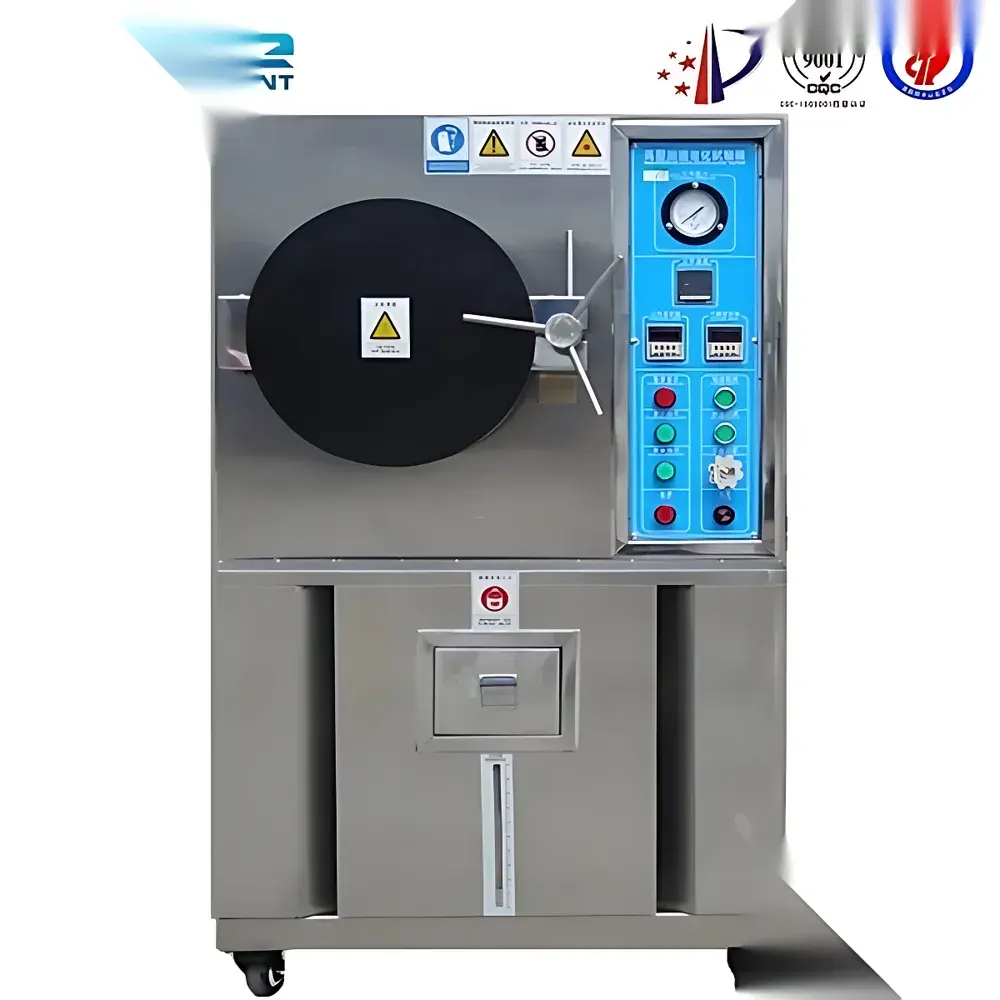
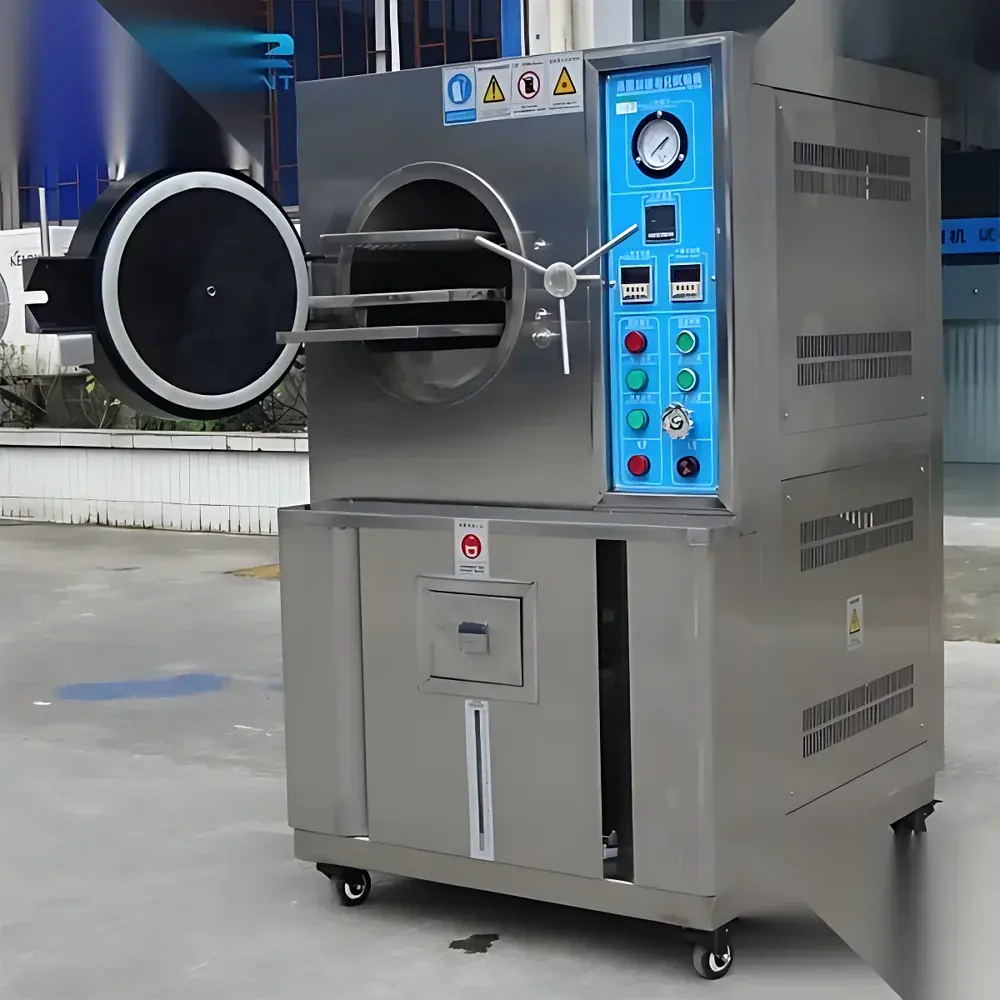
Accelerated Stress Testing (HAST) Chamber – Generic Industrial Grade
| Brand | Other Brands |
|---|---|
| Origin | Imported |
| Manufacturer Type | Authorized Distributor |
| Temperature Range | 100–132 °C |
| Humidity Range | 75–100 % RH (Saturated Steam) |
| Pressure Range | 0–200 kPa (gauge), equivalent to 0–2 kg/cm² (gauge) |
| Temp. Uniformity | ±2.0 °C at 100 °C |
| Temp. Fluctuation | ±0.5 °C (unloaded) |
| Humidity Fluctuation | ±3 % RH |
| Ramp Rate | 0.7–1.0 °C/min (unloaded) |
| Temp. Cycling Range | 20–80 °C |
| Time Setting | 0–9999 h |
| Power Supply | AC 380 V |
| Internal Construction | SUS304 Stainless Steel Mirror-Finish Chamber |
| Insulation | High-Density Microglass Wool |
| Cooling System | Hermetic Twin-Stage Refrigeration with Tecumseh (France) Compressor |
| Dual-Door Sealing | Silicone Gasket + Secondary Compression Seal |
Overview
The Accelerated Stress Testing (HAST) Chamber is an engineered environmental stress screening system designed for highly accelerated reliability evaluation of electronic components, printed circuit boards (PCBs), semiconductor packages, and moisture-sensitive devices (MSL-rated). Unlike conventional temperature-humidity testing, HAST operates under elevated temperature, high relative humidity, and controlled overpressure—typically 100–132 °C, 85–100 % RH, and 100–200 kPa (gauge)—to replicate years of field-level moisture ingress and electrochemical degradation in hours or days. This methodology follows JEDEC JESD22-A110 and JESD22-A118 standards, enabling failure mode identification—including corrosion, intermetallic growth, wire bond lift-off, and delamination—under thermodynamically accelerated conditions governed by the Arrhenius–Eyring model.
Key Features
- Triple-parameter control architecture: independent real-time regulation of temperature, humidity (saturated steam), and chamber pressure via PID-controlled steam generator, pneumatic pressure regulator, and dual-stage refrigeration-heating loop
- SUS304 stainless steel mirror-finish inner chamber with seamless welded corners and electropolished surface finish—resistant to condensate corrosion and compliant with ISO 14644-1 Class 8 cleanroom compatibility requirements
- Hermetic dual-door sealing system incorporating primary silicone gasket and secondary mechanical compression seal, validated to ≤1.0 × 10⁻⁴ mbar·L/s helium leak rate per IEC 60068-2-17
- Integrated two-stage refrigeration using Tecumseh hermetic compressors (France-sourced), optimized for rapid cooldown from 132 °C to 25 °C within <45 minutes (unloaded), minimizing thermal shock during cycling protocols
- High-efficiency microglass wool insulation (density ≥48 kg/m³) with thermal conductivity ≤0.032 W/(m·K) at 100 °C, ensuring energy stability and low ambient heat emission
- Programmable ramp/soak profiles supporting up to 9999 hours total test duration, with user-defined pressure hold phases and automatic safety cutoff at 135 °C or 210 kPa
Sample Compatibility & Compliance
This HAST chamber accommodates standard JEDEC trays (JEDEC STD-20), 300 mm wafer carriers, and custom fixtures up to 600 × 600 × 600 mm (W×D×H). It supports both saturated steam (100 % RH) and unsaturated modes per MIL-STD-883 Method 1030.5 and AEC-Q200 stress qualification protocols. All control firmware and data logging comply with FDA 21 CFR Part 11 requirements for electronic records and signatures, including audit trail generation, user access levels (admin/operator), and immutable timestamped event logs. Calibration traceability is maintained to NIST-traceable reference standards for temperature (PRT), humidity (capacitive hygrometer), and pressure (piezoresistive transducer).
Software & Data Management
Built-in embedded controller features a 7-inch TFT-LCD touchscreen interface with multilingual support (English, German, Japanese, Korean). Test programs are configured via intuitive drag-and-drop profile builder supporting nested cycles, conditional branching, and alarm-triggered email/SNMP notifications. Raw sensor data (temperature, RH, pressure, time) is logged at 1-second intervals and exportable in CSV or Excel-compatible formats. Optional PC-based software provides advanced statistical analysis—Weibull distribution fitting, acceleration factor calculation (AF), and failure rate projection per Telcordia SR-332—and integrates with LIMS platforms via OPC UA or Modbus TCP.
Applications
- Qualification of plastic-encapsulated microcircuits (PEMs) per IPC/JEDEC J-STD-020 and J-STD-033
- Moisture sensitivity level (MSL) grading and floor life validation for QFN, BGA, and WLP packages
- Reliability screening of automotive-grade ECUs prior to AEC-Q100 stress testing
- Failure analysis correlation studies between HAST-induced defects and real-world field returns
- Process validation for conformal coating adhesion and solder mask integrity under combined thermal-moisture stress
FAQ
What pressure range does this HAST chamber support, and how is overpressure generated?
The chamber delivers 0–200 kPa (gauge) pressure, achieved via regulated steam injection into a sealed chamber volume—no compressed air or nitrogen required. Pressure is stabilized using a proportional pneumatic control valve and monitored continuously with a calibrated absolute pressure transducer.
Is the system compatible with JEDEC JESD22-A118 test conditions?
Yes. Predefined test templates include standard conditions such as 130 °C / 85 % RH / 193 kPa (2 kg/cm²) for 96 h, fully aligned with JESD22-A118 Rev. 1.1 requirements for unbiased HAST testing.
How is temperature uniformity verified across the working volume?
Uniformity is validated per IEC 60068-3-5 using nine calibrated PT100 sensors placed on a 3×3 grid at mid-height; results are documented in the factory acceptance test (FAT) report and remain within ±2.0 °C at 100 °C.
Does the chamber support automated data export for quality audits?
Yes. All test data—including setpoints, actual values, alarms, and operator actions—is stored in encrypted binary format with SHA-256 checksums and exportable in tamper-evident CSV files containing digital signatures compliant with ISO/IEC 17025 documentation requirements.
What maintenance intervals are recommended for long-term calibration stability?
Annual verification of temperature/humidity/pressure sensors against NIST-traceable references is advised. Refrigeration oil and desiccant filters require replacement every 24 months under continuous operation; full system recalibration is recommended every 36 months or after major component service.



