
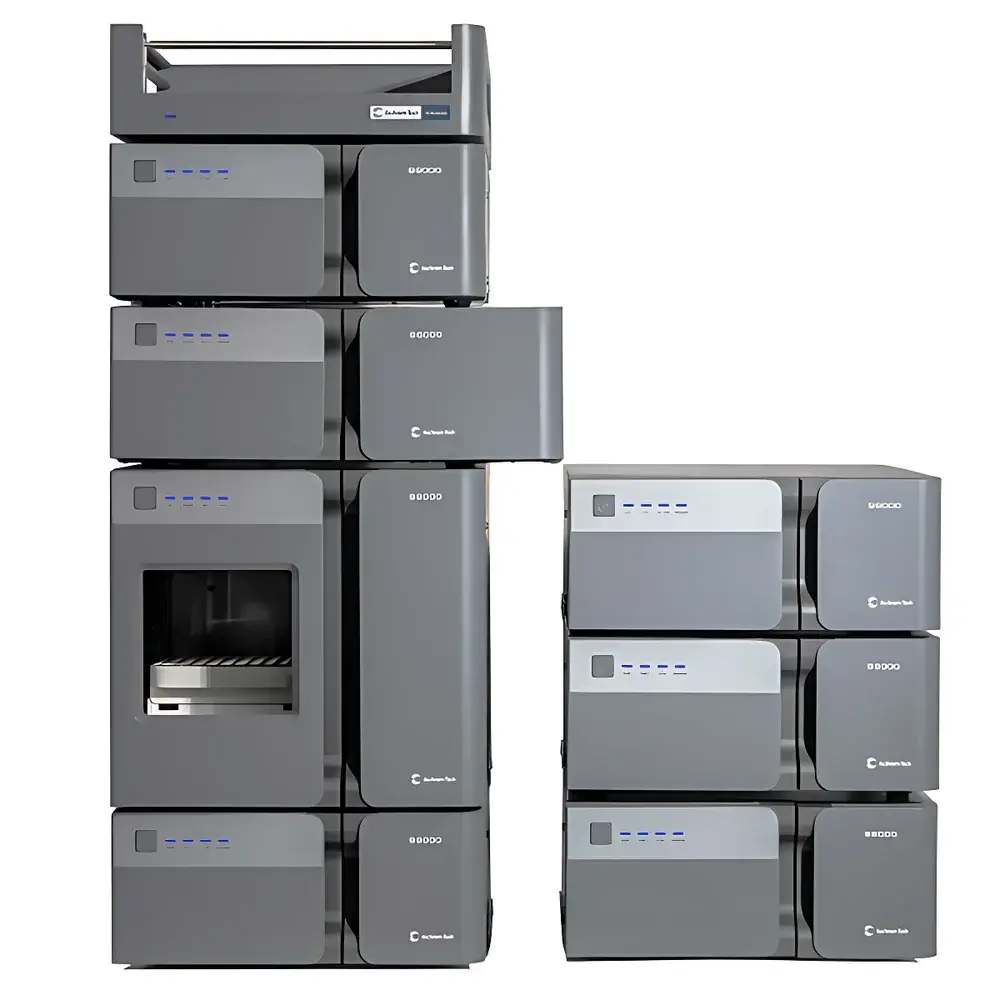
Acchrom-Tech S6000 Online SPE–2D-LC System
| Brand | Acchrom-Tech |
|---|---|
| Origin | Liaoning, China |
| Manufacturer Type | Original Equipment Manufacturer (OEM) |
| Country of Origin | China |
| Model | S6000 Online SPE–2D-LC System |
| Instrument Category | Conventional High-Performance Liquid Chromatograph (HPLC) |
| Application Scope | General-purpose analytical platform for complex matrix samples |
Overview
The Acchrom-Tech S6000 Online SPE–2D-LC System is an integrated, fully automated chromatographic platform engineered for high-throughput, robust quantification and identification of trace analytes in challenging sample matrices. It combines online solid-phase extraction (SPE) with comprehensive two-dimensional liquid chromatography (2D-LC), enabling orthogonal separation mechanisms—typically strong cation exchange (SCX) or reversed-phase (RP) in the first dimension and ultra-high-resolution C18 in the second—to resolve co-eluting compounds that conventional 1D-HPLC cannot distinguish. The system operates on the principle of heart-cutting or comprehensive (LC×LC) modulation, depending on configuration, and is designed to eliminate manual sample preparation steps such as offline SPE cartridge conditioning, elution, evaporation, and reconstitution. By integrating extraction, concentration, fraction transfer, secondary separation, and detection into a single fluidic pathway, the S6000 reduces carryover risk, improves method reproducibility (RSD < 1.5% for retention time, < 3.0% for peak area across 24-h runs), and supports unattended operation for up to 72 hours.
Key Features
- Fully automated online SPE module with programmable column switching valves (6-port/2-position and 10-port/2-position configurations), supporting dual-column backflush and solvent recycling modes
- Two independently controlled LC channels: Dimension 1 (preparative-scale, 3–5 µm particles, 2–4.6 mm ID columns) and Dimension 2 (analytical-scale, sub-2 µm particles, 2.1 mm ID columns) with synchronized gradient delivery
- Integrated six-way high-pressure injection valve enabling precise trapping and transfer of enriched analytes from SPE cartridge to 2D column without flow interruption
- Modular detector compatibility—including UV-Vis (190–800 nm, 1 nm resolution), fluorescence (Ex/Em 200–900 nm), and optional mass spectrometry interfaces (ESI/APCI sources for LC-MS coupling)
- Robust architecture with pressure tolerance up to 600 bar on Dimension 2 channel and 400 bar on Dimension 1 and SPE modules
- Temperature-controlled compartments for both columns (5–80 °C) and autosampler (4–40 °C) to ensure retention time stability and analyte integrity
Sample Compatibility & Compliance
The S6000 accommodates aqueous, organic, and mixed-solvent samples—including hydrolyzed (saponified), protein-digested, or environmental extracts—with minimal pretreatment. It supports standard SPE sorbents (C18, HLB, SCX, SAX, silica) in cartridge or monolithic formats (2–100 mg bed mass). The system meets fundamental requirements for regulated environments: hardware timing accuracy complies with ASTM E2656-21 (Standard Practice for HPLC System Performance Verification); data acquisition and audit trail functionality align with FDA 21 CFR Part 11 principles when deployed with validated software configurations; and column oven temperature control satisfies ISO 17025:2017 clause 6.4.3 for equipment calibration traceability. While the base instrument does not ship with pre-certified GxP validation packages, it provides all necessary electronic logs (system event history, method change records, user login/logout timestamps) required for internal IQ/OQ/PQ execution.
Software & Data Management
The Acchrom-Tech ChromaSight™ workstation is a Windows-based, bilingual (Chinese/English toggle) software platform developed in-house to support full lifecycle method development, execution, and reporting. It features sequence-driven automation with real-time monitoring of pressure, flow rate, UV absorbance, and valve position; customizable report templates compliant with GLP documentation standards; and raw data export in open formats (ASCII, .csv, .mzXML for MS-coupled setups). Audit trail functionality includes immutable records of parameter modifications, integration events, and user authentication actions. Data security protocols include role-based access control (administrator, analyst, reviewer), encrypted local storage, and optional network deployment with SQL Server backend for centralized data governance. Software validation documentation (URS, FRS, DQ/IQ/OQ test scripts) is available upon request for regulated laboratory implementation.
Applications
- Residue analysis in food safety: multi-class pesticide screening in fruits, vegetables, and animal tissues per EU SANTE/11312/2021 guidelines
- Pharmaceutical impurity profiling: isolation and quantification of genotoxic degradants in APIs using orthogonal 2D separation selectivity
- Environmental monitoring: determination of endocrine-disrupting compounds (e.g., bisphenols, alkylphenols) in wastewater and sludge following EPA Method 1694
- Clinical toxicology: simultaneous quantification of >50 drugs and metabolites in plasma via online phospholipid removal and 2D-RP/RP separation
- Natural product research: fractionation and dereplication of complex botanical extracts without prior fraction collection or lyophilization
FAQ
Does the S6000 support method transfer from offline SPE workflows?
Yes—the system allows direct import of existing SPE protocols via customizable valve timing sequences and gradient tables; method translation typically requires only minor optimization of loading flow rate and elution strength.
Can the 2D-LC mode be operated independently of the online SPE module?
Yes—users may bypass the SPE manifold using software-configurable valve states, converting the system into a standalone 2D-LC platform for method scouting or reference standard analysis.
Is remote monitoring supported?
The ChromaSight™ workstation includes built-in HTTP server functionality for secure web-based status viewing (pressure, temperature, run progress) through enterprise firewalls; full remote control requires local network configuration and IT policy approval.
What maintenance intervals are recommended for the online SPE components?
SPE cartridges require replacement after 200–500 injections depending on matrix complexity; switching valves should undergo seal inspection every 6 months or 1,000 cycles; detailed PM schedules are provided in the Operation & Maintenance Manual (Rev. 3.2).




