
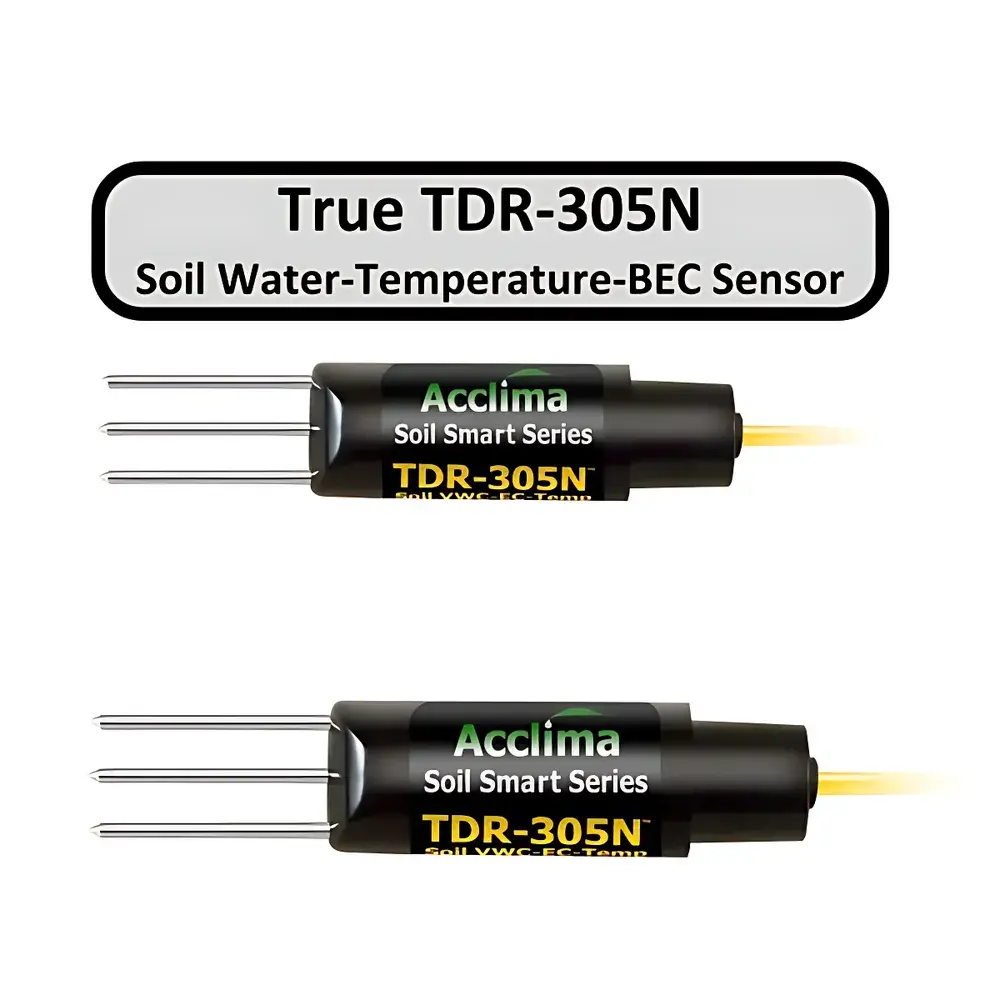
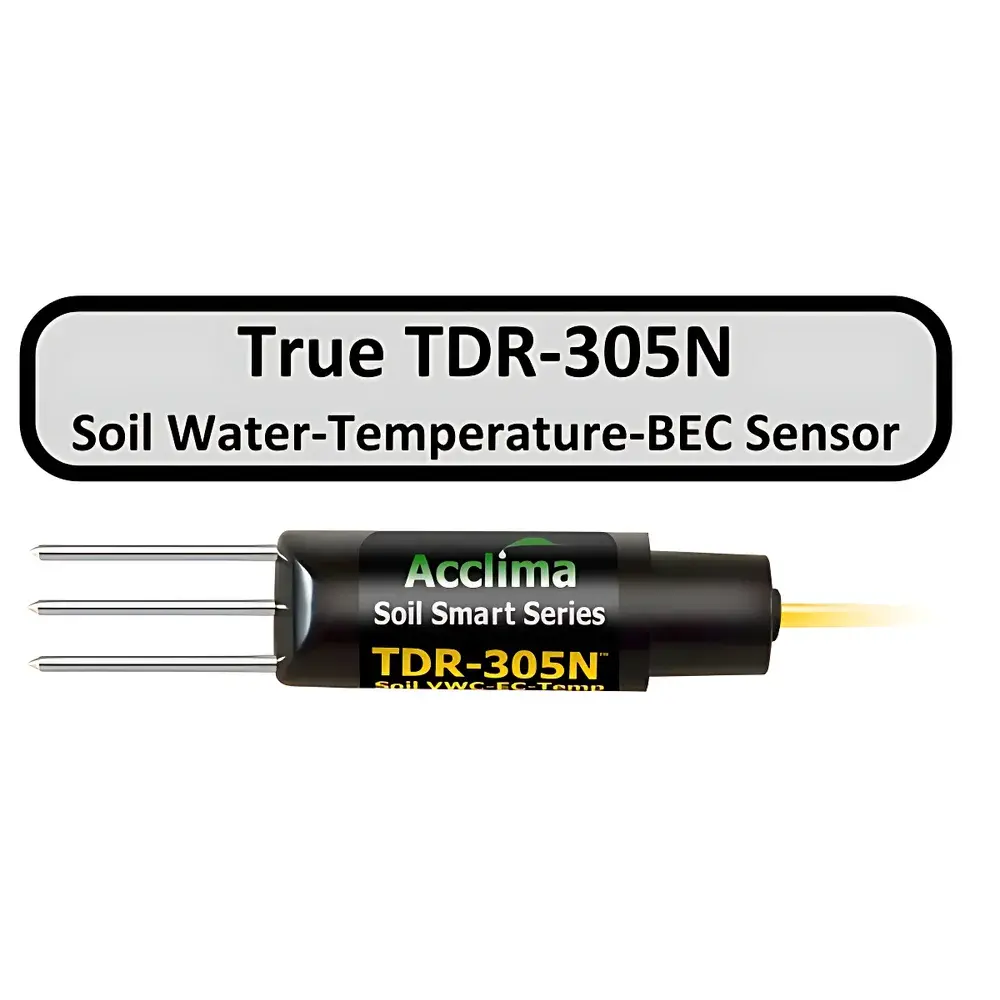
Acclima TDR305N Integrated Soil Moisture, Temperature & Electrical Conductivity Sensor
| Brand | Acclima, Inc. |
|---|---|
| Origin | USA |
| Model | TDR305N |
| Instrument Type | Soil Moisture / Water Potential Analyzer |
| Volumetric Water Content Range | 0–100% VWC |
| Resolution | 0.1% VWC |
| Accuracy | ±2% FS |
| Repeatability (RMS) | 0.07% VWC |
| Dielectric Constant Range | 1–100 |
| Resolution | 0.1 |
| Accuracy | ±2% |
| Bulk EC Range | 0–3000 µS/cm |
| Stability | ±1% FS |
| Soil Temperature Range | −40 to +60 °C |
| Resolution | 0.1 °C |
| Accuracy | ±0.25 °C (5–35 °C), ±0.5 °C (−15–50 °C) |
| Pore Water EC (Hilhorst Model) | 0–55,000 µS/cm |
| Volume EC Resolution | 1 µS/cm |
| Repeatability | 3 µS/cm |
| Accuracy | ±25 µS/cm (0–1000 µS/cm), ±2.5% (1000–2000 µS/cm), ±5% (2000–5000 µS/cm) |
| Rise Time (20–80%) | 300 ps |
| Waveform Digitization Resolution | 5 ps |
| Incident Pulse Amplitude | 2.3 V |
| Power Supply | 6.5–15 V DC |
| Quiescent Current | 10 µA |
| Active Current | 118 mA @ 12 V DC |
| Output Interface | 3-wire SDI-12 v1.4 compliant |
| Probe Dimensions | 49.9 mm × Ø3.5 mm |
| Body Dimensions | 150 × 33 mm |
| Weight (no cable) | 121 g |
| Standard Cable Length | 5 m (optional: 10 m) |
| Housing | Waterproof epoxy-filled enclosure |
Overview
The Acclima TDR305N is a fully integrated, high-fidelity time-domain reflectometry (TDR) sensor engineered for simultaneous, in-situ measurement of volumetric water content (VWC), soil temperature, and bulk electrical conductivity (EC). Released in September 2021 as an evolution of the TDR310N platform, the TDR305N features a compact 5 cm probe length optimized for high-density vertical profiling in pre-augered boreholes—prioritizing spatial resolution and installation repeatability over total sampling volume. Its core architecture embeds ultra-high-speed waveform generation and digitization circuitry with a precision 5-picosecond timebase, enabling true time-domain analysis of electromagnetic pulse propagation through heterogeneous soil matrices. Unlike conventional analog TDR systems that rely on threshold-based travel-time estimation, the TDR305N captures full incident and reflected waveforms at nanosecond-scale fidelity, supporting advanced dielectric dispersion modeling and robust signal deconvolution—even under elevated salinity conditions where traditional TDR sensors exhibit signal attenuation or reflection ambiguity.
Key Features
- Integrated triple-parameter sensing: simultaneous VWC, temperature, and bulk EC via single-probe TDR interrogation
- High-voltage pulse output (2.3 V) with 300 ps 20–80% rise time, ensuring reliable waveform integrity in high-conductivity soils (>3,000 µS/cm)
- Onboard firmware with adaptive waveform analysis algorithms—including Hilhorst model-based pore-water EC estimation—validated against ASTM D511 and ISO 11277 soil characterization protocols
- SDI-12 v1.4-compliant 3-wire digital interface compatible with Campbell Scientific CR-series, Onset HOBO, Decagon EM50, and other industry-standard dataloggers
- Mechanically optimized form factor: 33 mm diameter body designed for vertical insertion using a 34 mm flat-bottom auger; mates precisely with 1″ Schedule 40 PVC conduit used as depth-adjustable handling sleeve
- Hermetically sealed, epoxy-filled housing rated IP68 for continuous submersion and long-term field deployment across −40 to +60 °C ambient ranges
- Ultra-low quiescent power draw (10 µA) enabling multi-year operation on solar-recharged battery systems; active measurement current limited to 118 mA @ 12 V DC
Sample Compatibility & Compliance
The TDR305N is validated for use in mineral soils, organic substrates, and engineered growing media including peat, coir, and hydroponic aggregates. Its 5 cm probe geometry minimizes root disturbance and enables high-resolution stratified monitoring in shallow-rooting crops, turfgrass, and ecological restoration sites. Calibration traceability aligns with NIST-traceable reference standards for dielectric permittivity (ASTM D257) and electrical conductivity (ASTM D1125). Data acquisition workflows support GLP-compliant metadata tagging—including timestamped measurement events, firmware revision logging, and diagnostic flagging of signal-to-noise ratio (SNR) degradation. The SDI-12 protocol implementation includes CRC error checking and supports audit-ready data export formats required under FDA 21 CFR Part 11 for regulated agricultural research applications.
Software & Data Management
No proprietary software is required: raw waveform data and processed parameters are delivered via standardized SDI-12 commands (e.g., “M!” for moisture, “E!” for EC, “T!” for temperature). Third-party platforms—including LoggerNet, ShortCut, and Python-based PySDI12 libraries—natively parse output strings containing calibrated values, diagnostic flags, and internal sensor diagnostics. Firmware updates are performed in-field via SDI-12 command sequence without hardware disassembly. All measurements include embedded uncertainty estimates derived from real-time RMS noise analysis and temperature-compensated dielectric calibration curves. Exported datasets conform to FAO’s WaPOR metadata schema and are interoperable with USDA SCAN, COSMOS, and ICOS soil monitoring networks.
Applications
- High-frequency irrigation scheduling in precision viticulture and orchard systems
- Long-term vadose zone monitoring for landfill leachate plume tracking and remediation validation
- Soil hydraulic property inversion (θ(h) and K(θ) functions) using multi-depth TDR305N arrays coupled with tensiometric validation
- Salinity stress phenotyping in controlled-environment plant trials (CEPs) under ISO 22000-compliant lab protocols
- Calibration transfer studies between laboratory TDR benchtop systems (e.g., IMKO TRIME-PICO) and field-deployed sensor networks
- Validation of satellite-derived soil moisture products (e.g., SMAP, Sentinel-1) at eddy-covariance flux tower footprints
FAQ
Is the TDR305N compatible with legacy SDI-12 dataloggers?
Yes—the sensor adheres strictly to SDI-12 version 1.4 specification and has been verified with dataloggers manufactured prior to 2005, including Campbell Scientific CR10X and older Onset U30 series units.
Does it require factory recalibration after field deployment?
No—each unit ships with NIST-traceable calibration certificates for VWC, temperature, and EC. Field recalibration is not recommended; instead, users perform periodic validation using gravimetric soil sampling per ASTM D4959.
Can it be installed horizontally or only vertically?
Vertical installation is strongly recommended to ensure consistent probe-soil coupling and minimize air gap artifacts. Horizontal mounting is possible but requires custom mechanical fixation and increases susceptibility to thermal gradient-induced drift.
What is the maximum allowable cable length for reliable SDI-12 communication?
At 5 m standard length, signal integrity is guaranteed up to 100 m total loop distance (sensor + logger). For 10 m cables, total loop must remain ≤80 m with shielded twisted-pair wiring and proper grounding per SDI-12 EIA-485 guidelines.
How does its accuracy compare to laboratory TDR systems?
While lab-grade TDR instruments (e.g., Tektronix oscilloscope-based setups) achieve sub-0.01% VWC resolution, the TDR305N delivers field-deployable accuracy of ±2% FS VWC—consistent with ISO 10381-7 requirements for in-situ soil moisture monitoring networks.
Related Products







