
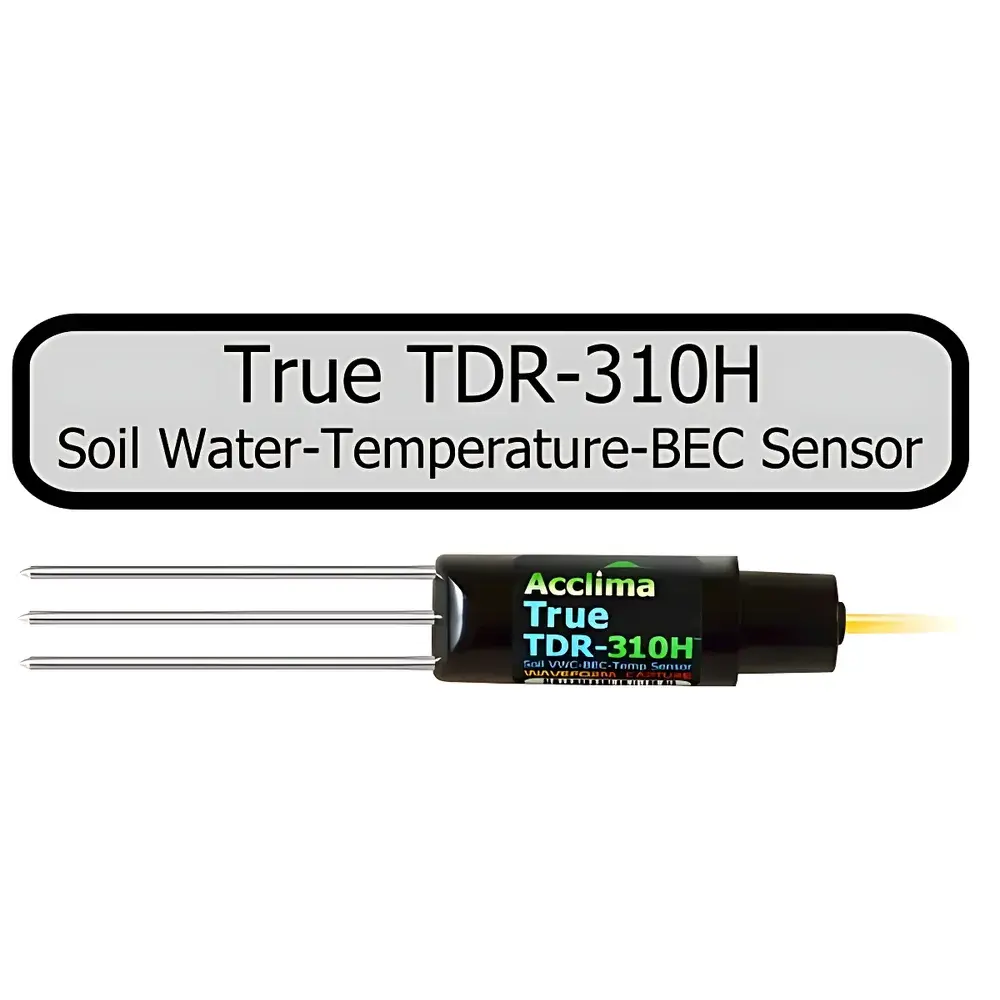
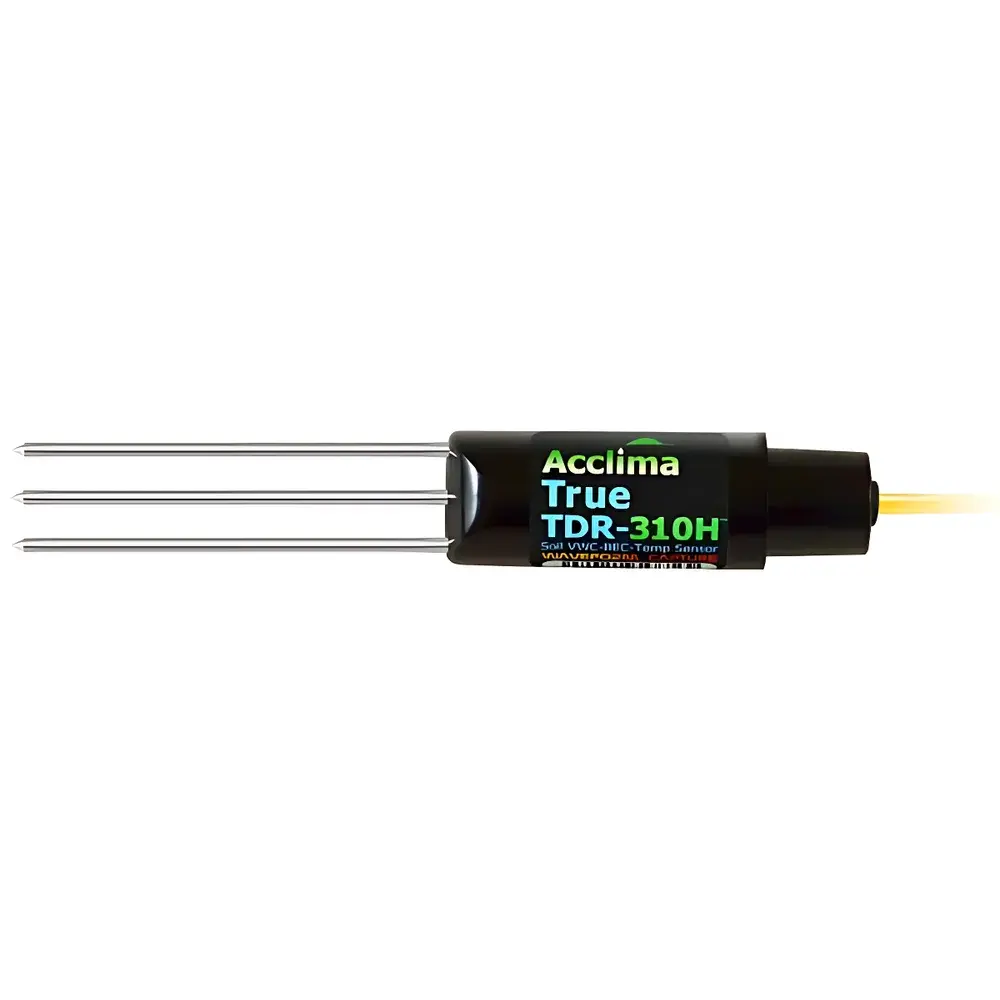
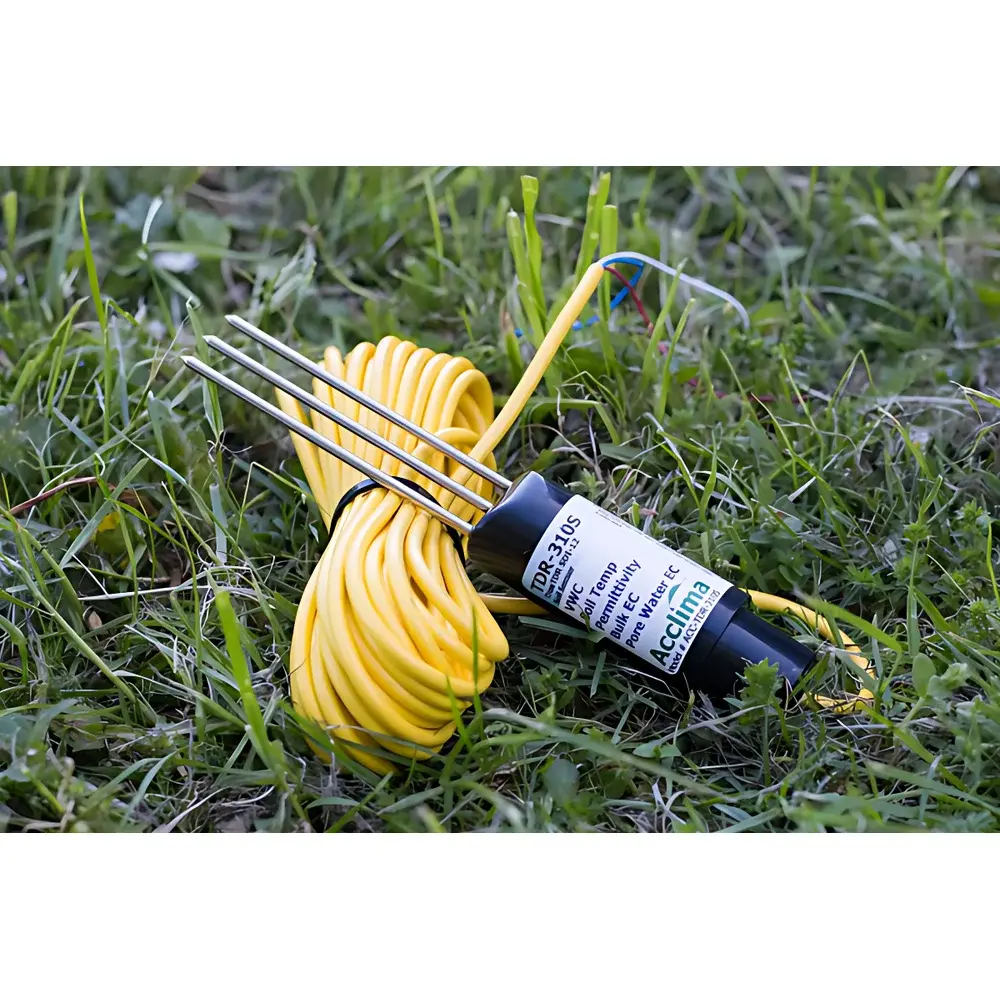
Acclima TDR310H Integrated Soil Water Content, Salinity & Temperature Sensor
| Brand | Acclima, Inc. |
|---|---|
| Origin | USA |
| Model | TDR310H |
| Volumetric Water Content (VWC) | 0–100% (0.1% resolution |
| Soil Temperature | −40 to +60 °C (0.1 °C resolution |
| Dielectric Constant | 1–80 (0.1 resolution |
| Bulk Electrical Conductivity (ECb) | 0–5000 μS/cm |
| Pore Water Electrical Conductivity (ECw) | 0–55,000 μS/cm (1 μS/cm resolution |
| Response Time | 0.25 s |
| Power Supply | 3.5–15 V DC |
| Operating Current | 36 mA @ 12 V DC (typical), <10 μA idle |
| Output Interface | SDI-12 |
| Probe Length | 15 cm |
| Probe Diameter | 0.35 cm |
| Dimensions | 22.56 × 3.34 cm |
| Weight | 440 g (body only, no cable) |
Overview
The Acclima TDR310H is an integrated time-domain reflectometry (TDR) sensor engineered for high-fidelity, simultaneous measurement of soil volumetric water content (VWC), bulk electrical conductivity (ECb), pore water electrical conductivity (ECw), and soil temperature. Unlike conventional capacitance or impedance-based sensors, the TDR310H employs true time-domain analysis—digitizing the full incident and reflected electromagnetic waveform with 5-ps timing resolution. This enables direct, physics-based calculation of dielectric permittivity from signal propagation time, independent of soil salinity or electrode polarization effects. The sensor supersedes the TDR310S and incorporates enhanced firmware algorithms, lower power consumption, and improved stability in high-salinity and low-moisture conditions—critical for long-term field deployments in arid, saline, or precision irrigation environments.
Key Features
- True TDR architecture with ultra-fast waveform generation and digitization—no reliance on voltage/current amplitude or resonance frequency.
- 5-picosecond timebase resolution enabling sub-nanosecond propagation delay measurement for high-precision dielectric constant derivation.
- Simultaneous, co-located measurement of VWC, ECb, ECw, and temperature using a single 15-cm three-rod probe assembly.
- Salinity-resilient VWC computation: replaces the TOPP equation’s nonlinear region (>50% VWC) with a calibrated linear propagation-time function, improving accuracy across wide moisture ranges.
- Temperature-compensated ECw calculation using the Rhoades model framework, accounting for soil porosity (n) and empirical texture-dependent exponent (m).
- Low-power SDI-12 interface compatible with most environmental data loggers (e.g., Campbell Scientific CR series, Onset HOBO, Decagon EM50); quiescent current <10 µA supports solar/battery-powered networks.
- Ruggedized ABS housing and stainless-steel probe rods rated for permanent burial in agricultural, ecological, and geotechnical monitoring applications.
Sample Compatibility & Compliance
The TDR310H is validated for use in mineral soils ranging from coarse sand to heavy clay, including saline, sodic, and organic-rich substrates. Its TDR methodology eliminates electrode contact resistance errors and ensures stable performance in conductive media where traditional EC sensors drift or saturate. While not certified to ISO/IEC 17025 as a standalone calibration standard, the sensor’s traceable dielectric and thermal response aligns with ASTM D5778 (Standard Test Method for Electronic Friction Cone and Piezocone Penetration Testing) and USDA NRCS Soil Moisture Monitoring Guidelines. Data output conforms to SDI-12 v1.3 protocol, supporting interoperability in networks requiring FAO-56, CIMIS, or WMO-compliant hydrometeorological reporting frameworks.
Software & Data Management
The TDR310H operates natively via SDI-12 command set, requiring no proprietary software for basic interrogation. Raw waveform data is not exposed externally; instead, the onboard firmware performs real-time signal processing—including baseline correction, reflection peak detection, and multi-parameter regression—and returns calibrated engineering units (VWC %, °C, ECb µS/cm, ECw µS/cm) in ASCII format. For integration into regulated environments (e.g., USDA ARS field trials, EPA site characterization), the sensor supports audit-ready timestamped logging when paired with data loggers compliant with FDA 21 CFR Part 11 requirements (electronic signatures, data integrity controls). Acclima provides documented uncertainty budgets for each parameter, referenced to NIST-traceable dielectric standards and ITS-90 thermistor calibrations.
Applications
- Precision irrigation scheduling and deficit irrigation research in orchards, vineyards, and row crops.
- Soil salinity mapping and leaching requirement modeling in reclaimed coastal or irrigated farmland.
- Long-term ecohydrological monitoring in flux towers, critical zone observatories (CZOs), and LTER sites.
- Validation of satellite-derived soil moisture products (e.g., SMAP, Sentinel-1) at in situ validation scales.
- Contaminant transport studies where pore-water EC serves as a proxy for solute concentration gradients.
- Geotechnical stability assessment in landfill cover systems and tailings dam monitoring.
FAQ
Does the TDR310H require soil-specific calibration?
No—its dielectric constant calculation is physics-based and does not rely on empirical calibration curves. However, users may apply optional texture-specific VWC correction factors if operating outside the validation range of coarse-to-medium loams.
How does it differ from FDR or capacitance sensors?
Unlike frequency-domain reflectometry (FDR) or capacitance sensors, the TDR310H measures electromagnetic wave velocity directly—not resonant frequency or impedance magnitude—making it immune to soil conductivity-induced phase shift errors and electrode fouling.
Can it be used in frozen soil?
Yes—the probe operates down to −40 °C, and the TDR waveform analysis remains valid in partially frozen media, though interpretation of VWC requires adjustment for ice-phase dielectric contrast (εice ≈ 3.2).
Is SDI-12 the only communication interface?
Yes—TDR310H uses SDI-12 exclusively. It does not support RS-485, Modbus, or analog voltage outputs. Integration with non-SDI-12 systems requires a protocol converter or gateway device.
What is the recommended installation depth and spacing?
Probes should be installed vertically at target root-zone depth (typically 10–60 cm), with ≥30 cm horizontal separation between units to avoid electromagnetic crosstalk. Horizontal installation is not recommended due to rod coupling asymmetry.



