
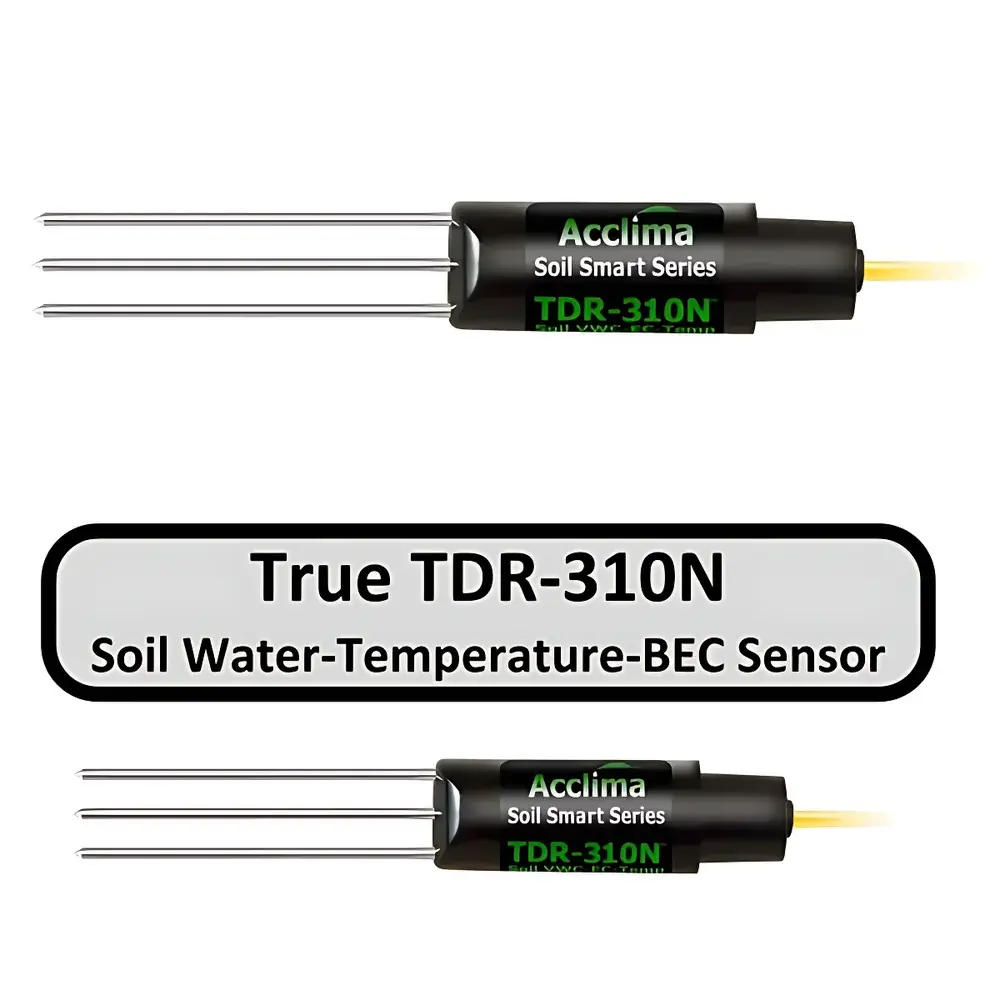
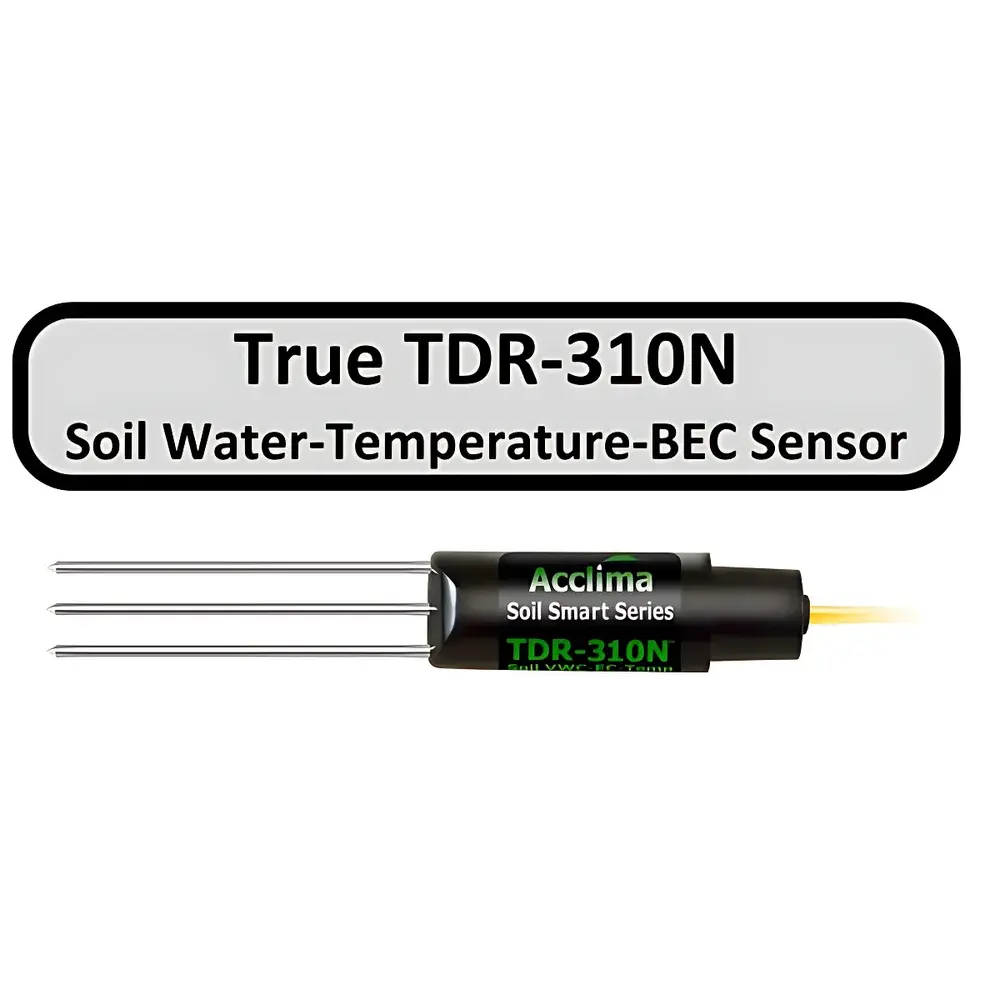
Acclima TDR310N Integrated Soil Moisture, Temperature, and Electrical Conductivity Sensor
| Brand | Acclima, Inc. |
|---|---|
| Origin | USA |
| Model | TDR310N |
| Sensor Type | TDR-based Volumetric Water Content, Soil Temperature, and Bulk Electrical Conductivity Sensor |
| Measurement Principle | Time-Domain Reflectometry (TDR) with 5 ps timebase resolution |
| Output Interface | 3-wire SDI-12 v1.4 compliant |
| Power Supply | 6.5–15 V DC |
| Idle Current | 10 µA |
| Active Current | 118 mA @ 12 V DC |
| Probe Dimensions | 99.2 mm × Ø3.5 mm |
| Body Dimensions | 200 mm × 33 mm |
| Weight (sensor only) | 132 g |
| Standard Cable Length | 5 m (optional 10 m) |
| Enclosure | Waterproof epoxy-filled housing |
Overview
The Acclima TDR310N is a fully integrated, high-fidelity time-domain reflectometry (TDR) sensor engineered for simultaneous, co-located measurement of volumetric water content (VWC), soil temperature, and bulk electrical conductivity (EC). Released in September 2021 as the direct successor to the TDR310L, the TDR310N features an enhanced high-voltage waveform generator that maintains signal integrity and measurement reliability in soils with elevated salinity—up to 3,000 µS/cm bulk EC—where conventional low-power TDR sensors exhibit degraded reflection fidelity. Unlike legacy designs relying on analog timing or interpolated sampling, the TDR310N implements ultra-fast waveform generation and digitization with a precision 5-picosecond (ps) internal timebase, enabling true time-domain analysis of the propagating electromagnetic pulse without interpolation artifacts. This architecture supports robust dielectric constant determination (εr = 1–100, ±2% FS) and eliminates reliance on empirical calibration curves for VWC estimation across diverse soil textures and organic matter contents.
Key Features
- True TDR architecture with 5 ps timebase resolution and 300 ps incident pulse rise time—enabling sub-nanosecond temporal discrimination of reflection events.
- High-voltage pulse generation optimized for stable performance in high-conductivity soils (up to 3,000 µS/cm bulk EC), reducing signal attenuation and improving waveform interpretability.
- Integrated triple-parameter sensing: VWC (0–100% VWC, ±2% FS accuracy), soil temperature (−40°C to +60°C, ±0.25°C from 5–35°C), and bulk EC (0–6,000 µS/cm).
- SDI-12 v1.4-compliant 3-wire digital interface—compatible with all industry-standard dataloggers including Campbell Scientific CR series, Onset HOBO, METER Group EM50, and Decagon (now METER) Em50G.
- Low-power design: 10 µA quiescent current; 118 mA peak draw during measurement cycle—enabling multi-year deployment on solar-recharged systems.
- Mechanically optimized probe geometry: 99.2 mm × Ø3.5 mm stainless-steel rods with 34 mm flat-bottom auger-compatible profile for vertical insertion into pre-bored holes.
- Robust epoxy-filled housing rated for continuous field exposure across −40°C to +60°C ambient conditions.
Sample Compatibility & Compliance
The TDR310N is validated for use in mineral soils, sandy loams, clays, peat-based substrates, and engineered growing media—including greenhouse substrates and turf root zones. Its high-voltage TDR excitation and advanced waveform analysis firmware mitigate errors associated with clay dispersion, surface conduction, and pore-water ion mobility—factors known to impact lower-resolution TDR and capacitance-based sensors. The sensor complies with ASTM D5778 (Standard Test Method for Subsurface Exploration Using the Seismic Cone and Strain-Gauge Piezocone Penetrometer) for signal integrity in conductive media, and its SDI-12 implementation conforms to ANSI/TIA-568-C.2 and ISO/IEC 11801 structured cabling guidelines for sensor network integration. While not intrinsically certified for hazardous locations, its epoxy encapsulation meets IP68 ingress protection standards per IEC 60529.
Software & Data Management
Raw waveform data is processed onboard using Acclima’s proprietary firmware, which applies deconvolution-based travel-time detection and Hilhorst-model correction for pore-water EC estimation (0–55,000 µS/cm). No external calibration is required for standard mineral soils; factory calibration coefficients are stored in non-volatile memory and applied automatically during each measurement cycle. SDI-12 command set supports asynchronous polling, burst-mode acquisition, and diagnostic queries (e.g., “M1!” for VWC, “M2!” for temperature, “M3!” for bulk EC). Data output adheres to SDI-12 v1.4 specification, ensuring compatibility with GLP/GMP-aligned data acquisition workflows. When deployed with dataloggers supporting audit-trail logging (e.g., Campbell CR6 with OS v2.0+), timestamped sensor readings can be mapped to 21 CFR Part 11-compliant electronic records when paired with appropriate system validation protocols.
Applications
- Irrigation scheduling and precision agriculture—enabling real-time, depth-resolved water budgeting across crop root zones.
- Soil hydrology research—including infiltration modeling, solute transport studies, and vadose zone flux quantification.
- Environmental monitoring networks assessing soil moisture–climate feedbacks in long-term ecological research sites (LTER).
- Landfill and containment barrier performance assessment via moisture and leachate conductivity profiling.
- Green infrastructure evaluation—monitoring retention capacity and drainage dynamics in bioswales and rain gardens.
- Ecophysiological studies correlating rhizosphere water status with plant water potential and stomatal conductance.
FAQ
What distinguishes the TDR310N from the TDR310L and TDR310H models?
The TDR310N replaces the TDR310L with higher-voltage pulse generation and improved high-EC stability. It consumes more power than the TDR310H but delivers superior waveform fidelity in saline soils due to its dedicated high-speed digitizer and 5 ps timebase.
Is factory calibration traceable to NIST standards?
Yes—dielectric calibration is performed against NIST-traceable liquid standards (ethanol/water mixtures) and verified using solid-phase reference media with certified permittivity values.
Can the TDR310N be used in frozen soils?
It operates mechanically down to −40°C, but VWC accuracy is not specified below 0°C due to phase-change effects on dielectric response; temperature readings remain valid.
Does the sensor require soil-specific calibration?
No—its physics-based TDR algorithm and built-in Hilhorst model eliminate the need for site-specific calibration in most mineral soils. Organic or highly heterogeneous media may benefit from localized verification using gravimetric sampling.
How is cable length extension handled without signal degradation?
The SDI-12 interface supports up to 200 m total loop length at 12 V DC. For extensions beyond 10 m, twisted-pair shielded cable (Belden 8761 or equivalent) is recommended to maintain noise immunity and timing integrity.







