
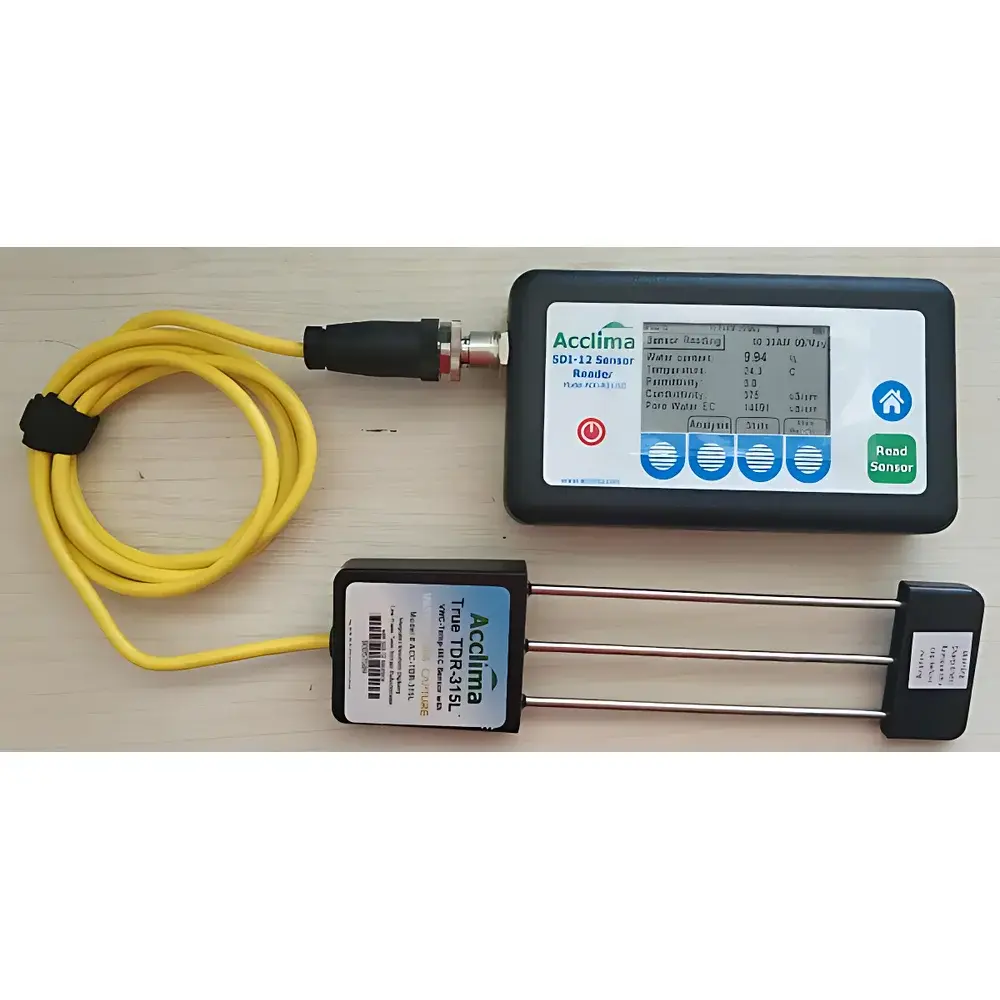
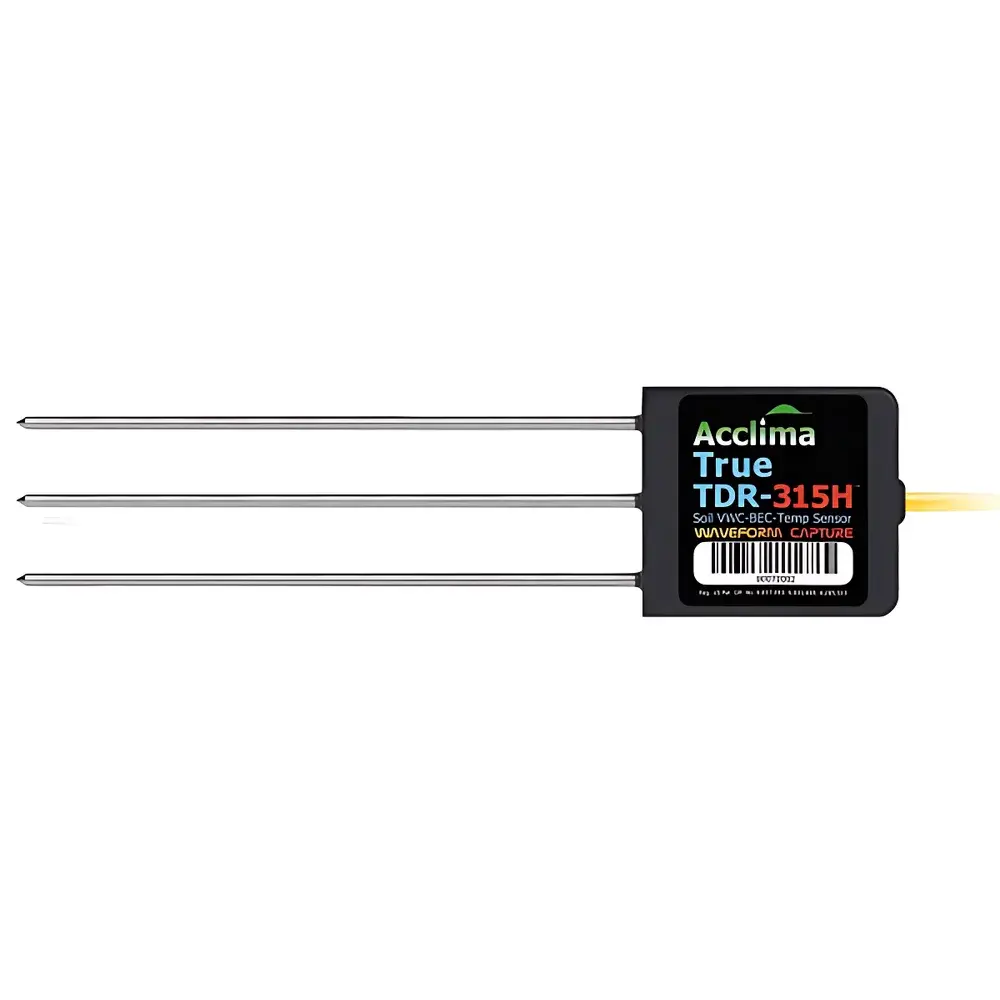
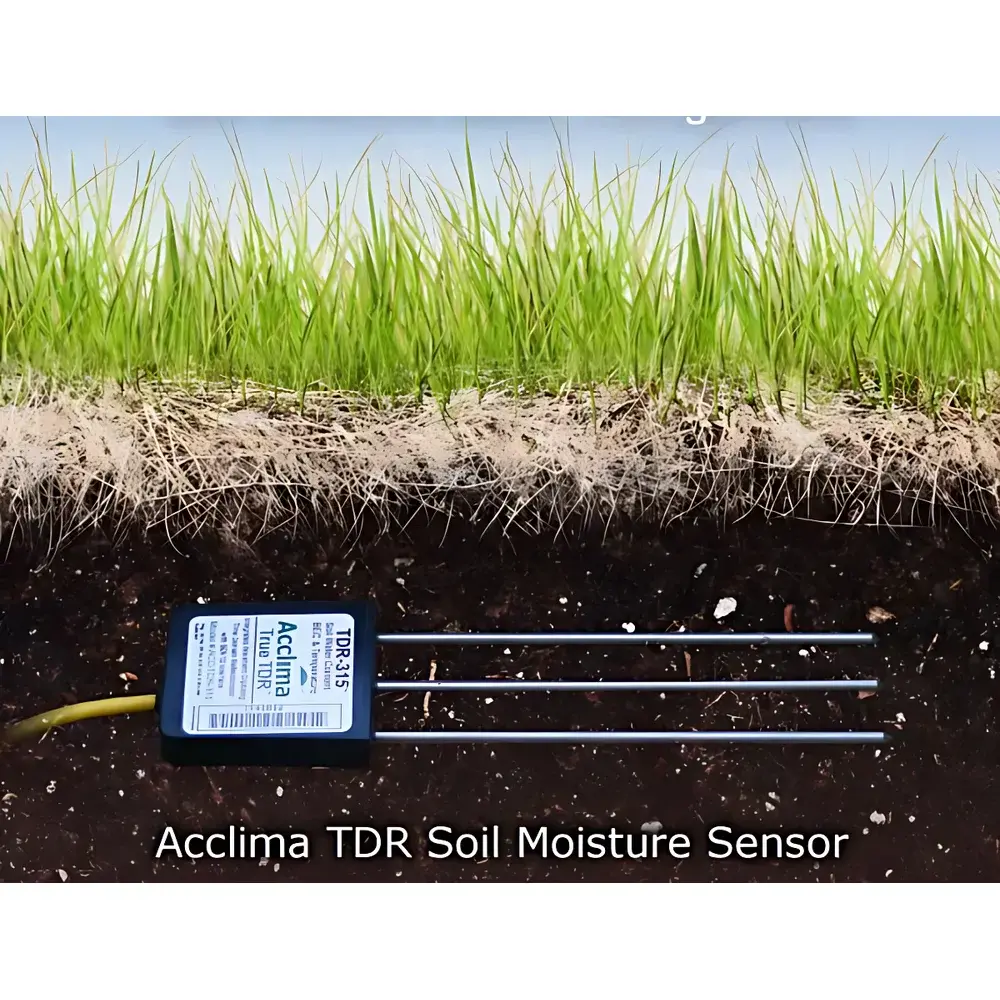
Acclima TDR315H Integrated Soil Water Content, Salinity & Temperature Sensor
| Brand | Acclima, Inc. |
|---|---|
| Origin | USA |
| Manufacturer Type | Authorized Distributor |
| Product Category | Imported Instrument |
| Model | TDR315H |
| Instrument Type | Volumetric Water Content / Soil Water Potential Analyzer |
| VWC Range | 0–100% |
| VWC Resolution | 0.1% |
| VWC Repeatability (RMS) | ±0.07% |
| VWC Accuracy | ±1% (coarse-medium soils), ±2.5% (fine-textured soils) |
| Dielectric Constant Range | 1–80 |
| Dielectric Resolution | 0.1 |
| Dielectric Accuracy | ±1% (coarse-medium), ±2% (fine-textured) |
| Soil Temperature Range | −40 to +60 °C |
| Temp Resolution | 0.1 °C |
| Temp Accuracy | ±0.25 °C |
| Bulk EC Range | 0–5000 µS/cm |
| Pore Water EC Range | 0–55,000 µS/cm |
| EC Resolution | 1 µS/cm |
| EC Repeatability | ±3 µS/cm |
| EC Accuracy | ±25 µS/cm (0–1000 µS/cm), ±2.5% (1000–2000 µS/cm), ±5% (2000–5000 µS/cm) |
| Response Time | 0.25 s |
| Power Supply | 3.5–15 V DC |
| Operating Current | 36 mA @ 12 V DC (active), <10 µA (idle) |
| Output Protocol | SDI-12 |
| Probe Length | 15 cm |
| Probe Diameter | 0.35 cm |
| Housing Dimensions | 21.15 × 5.3 × 1.9 cm |
| Weight | 440 g (body only) |
Overview
The Acclima TDR315H is an integrated, high-fidelity soil sensor engineered for simultaneous, real-time measurement of volumetric water content (VWC), bulk electrical conductivity (ECb), pore water electrical conductivity (ECw), and soil temperature. Unlike conventional capacitance or FDR-based sensors, the TDR315H implements true time-domain reflectometry (TDR) — a physics-based method that analyzes the propagation velocity and reflection characteristics of electromagnetic pulses traveling along parallel waveguide rods embedded in soil. This approach directly quantifies the dielectric permittivity (εr) of the soil matrix without reliance on voltage or current amplitude, rendering its VWC and dielectric outputs inherently insensitive to soil salinity, clay content, or bulk density variations. Introduced in May 2019 as the successor to the TDR315L, the TDR315H incorporates a custom 5-ps resolution timebase, ultra-fast waveform digitization (up to 20 GS/s), and proprietary firmware for on-device time-domain analysis — enabling sub-250-ms measurement cycles with enhanced stability in saline and fine-textured media.
Key Features
- True TDR architecture with picosecond-level timing precision (5 ps resolution), eliminating calibration drift associated with analog amplitude-based methods.
- Simultaneous acquisition of VWC, εr, ECb, ECw, and temperature in a single 0.25-second measurement cycle.
- Dual EC derivation: bulk EC calculated from inter-probe resistance; pore water EC derived via the Rhoades–van Genuchten–Hilhorst model using εr, VWC, and empirical soil-specific exponents (n, m).
- Temperature-compensated thermistor (±0.25 °C accuracy) co-located within the sensor head for spatially aligned thermal correction of dielectric and conductivity outputs.
- Low-power SDI-12 interface compatible with industry-standard dataloggers (Campbell Scientific, Onset HOBO, Decagon Em50, etc.), supporting multi-sensor networks with minimal wiring overhead.
- Ruggedized ABS housing (IP68-rated) and stainless-steel waveguides designed for long-term burial in agricultural, hydrological, and ecological monitoring sites.
Sample Compatibility & Compliance
The TDR315H operates across a broad spectrum of soil textures — from coarse sands to heavy clays — and maintains measurement integrity in high-salinity environments (ECw up to 55,000 µS/cm) where traditional TDR systems exhibit signal attenuation or waveform distortion. Its dielectric measurement methodology complies with ASTM D5778 (Standard Test Method for Electronic Friction Cone and Piezocone Penetration Testing) principles for electromagnetic wave propagation in porous media. While not certified to ISO/IEC 17025, the sensor’s traceable accuracy specifications align with USDA-ARS and NRCS field validation protocols for soil moisture instrumentation. Data integrity meets GLP-compliant logging requirements when paired with SDI-12 loggers supporting timestamped, non-volatile storage and audit trails.
Software & Data Management
The TDR315H requires no proprietary software for operation: it communicates exclusively via open SDI-12 v1.3 protocol, enabling seamless integration into existing environmental data infrastructure. Raw waveforms are processed internally; users receive calibrated physical units (%, °C, µS/cm, εr) directly — eliminating post-acquisition curve-fitting or empirical correction tables. For advanced diagnostics, Acclima provides optional waveform export tools (via USB-to-SDI-12 adapters) allowing researchers to inspect raw pulse reflections, assess probe-soil contact quality, and validate travel-time calculations against theoretical models. All output values are linearly scaled and factory-characterized per probe batch, with calibration certificates available upon request.
Applications
- Irrigation scheduling and precision agriculture decision support systems requiring salt-aware VWC quantification.
- Soil salinity mapping in arid-zone farming, coastal reclamation projects, and managed aquifer recharge studies.
- Long-term ecohydrological monitoring in flux towers, critical zone observatories (CZOs), and LTER sites.
- Calibration and validation of satellite-based soil moisture products (e.g., SMAP, Sentinel-1) at ground-truth reference stations.
- Controlled-environment research including lysimeter studies, rhizotron experiments, and soil biogeochemical modeling.
FAQ
How does the TDR315H differ from capacitance-based soil moisture sensors?
It measures dielectric permittivity via direct time-of-flight analysis of electromagnetic pulses — not via resonant frequency or impedance magnitude — making it immune to conductive interference and enabling accurate VWC estimation across variable salinity and texture conditions.
Does the sensor require soil-specific calibration?
No. Factory calibration covers typical mineral soils; however, for organic-rich (e.g., peat) or highly volcanic soils, users may apply site-specific εr–VWC relationships without modifying hardware or firmware.
Can the TDR315H be used in frozen soil?
Yes — its −40 to +60 °C operating range and dielectric-based principle allow detection of ice-phase water content, though interpretation requires adjustment for the dielectric contrast between ice (εr ≈ 3.2) and liquid water (εr ≈ 80).
What is the maximum cable length supported for SDI-12 communication?
Up to 200 meters with standard twisted-pair shielded cable (22 AWG), provided total bus capacitance remains below 10 nF and power supply ripple is minimized per SDI-12 specification.
Is pore water EC (ECw) calculated in real time?
Yes — ECw is computed onboard using measured ECb, VWC, and preloaded textural parameters (n, m), eliminating the need for external spreadsheet-based conversion.







