
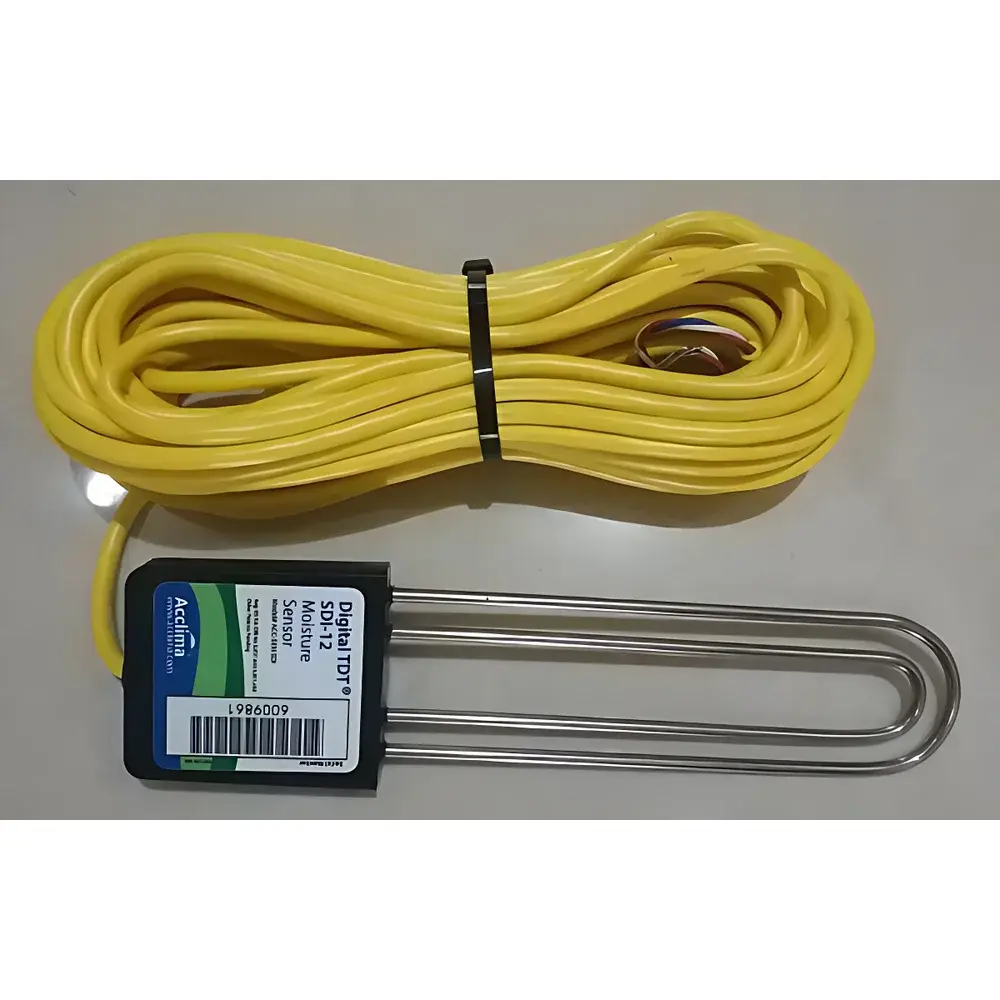
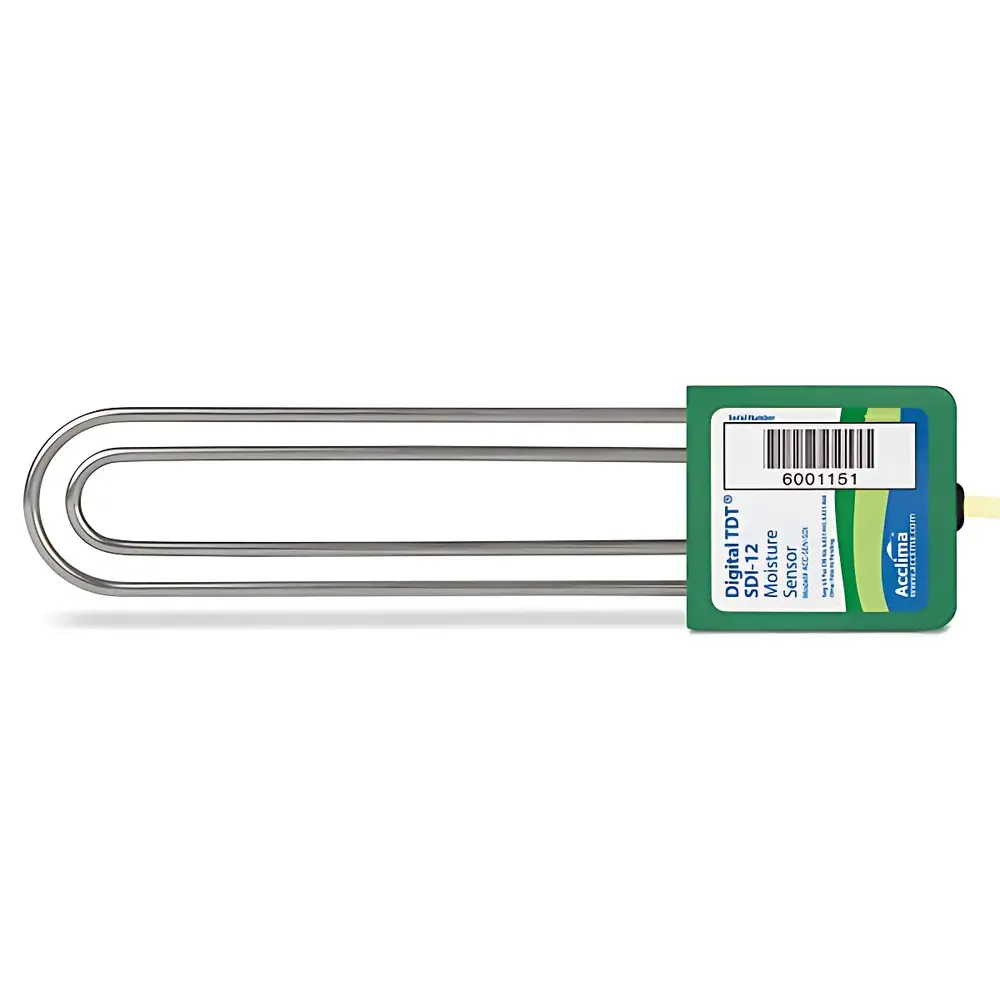
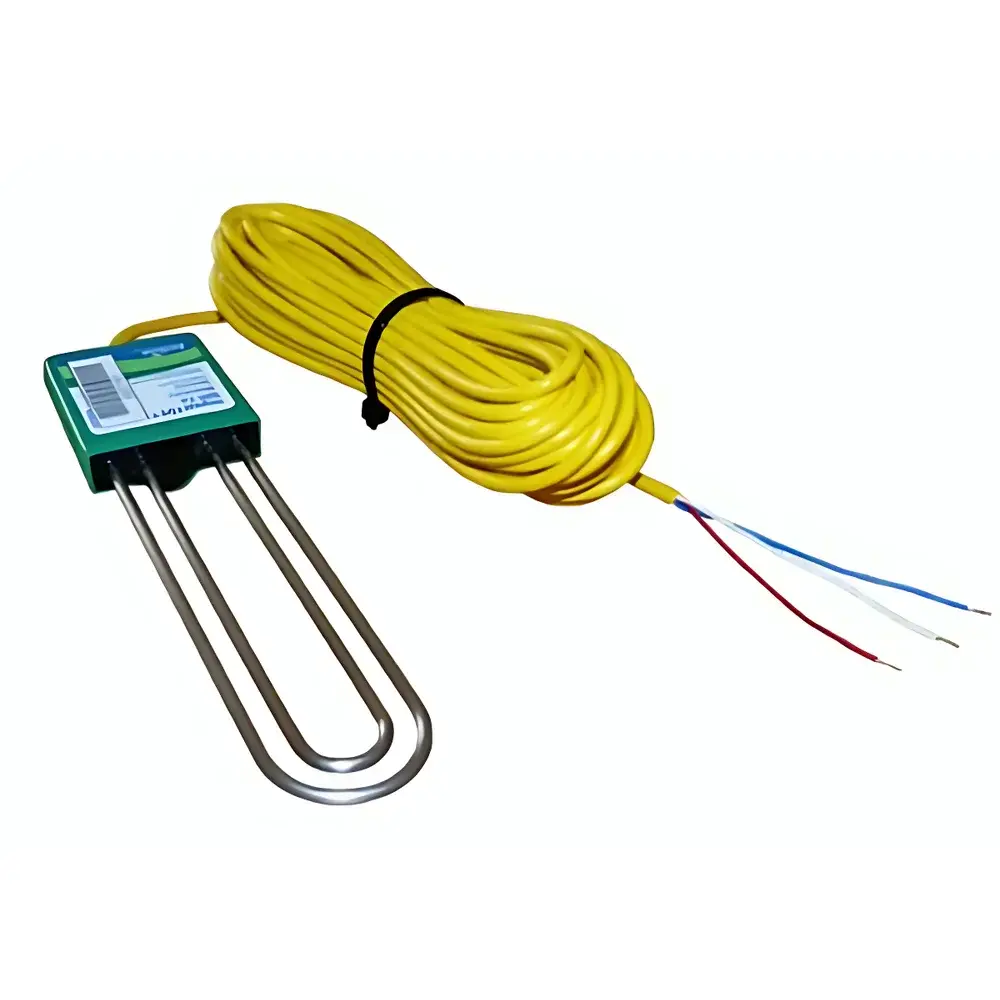
Acclima TDT Soil Moisture Sensor
| Brand | Acclima, Inc. |
|---|---|
| Origin | USA |
| Model | TDT |
| Instrument Type | Volumetric Water Content (VWC) and Bulk Electrical Conductivity (EC) Sensor |
| Measurement Principle | Time Domain Transmission (TDT) |
| VWC Range | 0–100.00% VWC |
| VWC Resolution | 0.06% VWC |
| VWC Accuracy | ±2% VWC (typical mineral soils) |
| Bulk EC Range | 0–5 dS/m |
| Bulk EC Resolution | 0.01 dS/m |
| Bulk EC Accuracy | ±0.2 dS/m |
| Bulk EC Stability | ±1% of full scale (0–5 dS/m) |
| Soil Temperature Range | –20 to +50 °C |
| Soil Temperature Resolution | 0.1 °C |
| Soil Temperature Accuracy | ±0.3 °C (0–40 °C), ±0.5 °C (–20–0 °C and 40–50 °C) |
| Response Time | 450 ms |
| Power Supply | 5–15 VDC (12 VDC nominal) |
| Current Draw | 84 mA (during measurement burst) |
| Output Protocol | SDI-12 v1.3 |
| Operating Temperature (in soil) | 0.5–50 °C (non-frozen conditions) |
| Storage Temperature | –20 to +75 °C |
| Dimensions | 20 × 5.33 × 1.5 cm |
| Weight | 220 g |
| Cable Length | 10 m |
Overview
The Acclima TDT Soil Moisture Sensor is a rigorously engineered field probe designed for high-fidelity, in-situ measurement of volumetric water content (VWC), bulk electrical conductivity (EC), and soil temperature using Time Domain Transmission (TDT) technology. Unlike capacitance-based or frequency-domain reflectometry (FDR) sensors, the TDT method transmits a fast-rise-time electromagnetic pulse along parallel stainless-steel waveguides embedded in the sensor body. By precisely measuring the propagation time of the pulse through the soil matrix, the sensor calculates dielectric permittivity—directly correlated to VWC—with minimal sensitivity to soil texture, salinity, or temperature-induced drift. This physics-based approach delivers superior accuracy and long-term stability across diverse soil types, making it suitable for scientific-grade environmental monitoring, irrigation scheduling, hydrological modeling, and eddy covariance energy balance studies.
Key Features
- True TDT architecture with calibrated 100 MHz pulse generation and sub-nanosecond timing resolution—eliminating calibration dependency on soil-specific dielectric mixing models.
- Simultaneous acquisition of VWC, bulk EC, and soil temperature within a single 450 ms measurement cycle—enabling synchronized multi-parameter time-series analysis.
- Integrated stainless-steel waveguides (304 SS) with precision-machined spacing and impedance-matched termination—ensuring consistent signal integrity across varying soil densities and moisture states.
- SDI-12 v1.3 digital output interface compatible with industry-standard dataloggers (e.g., Campbell Scientific CR series, Onset HOBO, Decagon EM50), supporting multi-sensor networks with automatic addressing and low-power sleep modes.
- Ruggedized epoxy-filled housing rated IP68 for continuous burial; operational in non-frozen soils from 0.5 °C to 50 °C, with extended storage capability from –20 °C to +75 °C.
- Factory-calibrated traceable to NIST-traceable standards; VWC accuracy validated per ASTM D5957 and ISO 11274 protocols across representative loam, sandy, and clayey soil matrices.
Sample Compatibility & Compliance
The TDT sensor is validated for use in mineral soils with bulk EC up to 5 dS/m and organic matter content ≤20% (w/w). It exhibits negligible hysteresis during wetting/drying cycles and maintains linearity across freeze-thaw transitions when installed above the frost line. While not intended for saturated peat or highly saline sediments (>8 dS/m), its EC compensation algorithm minimizes VWC error in moderately conductive soils (≤3 dS/m). The device complies with IEC 61326-1 (EMC for measurement equipment), RoHS Directive 2011/65/EU, and meets functional safety requirements for outdoor environmental instrumentation per UL 61010-1. Data integrity aligns with GLP principles: all measurements include embedded timestamps, sensor ID, and diagnostic flags for signal quality and cable integrity verification.
Software & Data Management
Raw SDI-12 data streams are protocol-compliant and require no proprietary drivers. Acclima provides open-source Python and MATLAB libraries for batch decoding, unit conversion (VWC %, EC dS/m, °C), and QC flag interpretation. When integrated with cloud platforms such as ThingSpeak, FieldClimate, or custom IoT stacks, the sensor supports automated calibration validation via reference gravimetric sampling workflows. All metadata—including installation depth, soil horizon classification, and local weather context—is configurable via SDI-12 command set (e.g., “M!” for measurement, “C!” for configuration). Audit trails generated by compatible dataloggers satisfy FDA 21 CFR Part 11 requirements when paired with electronic signature-enabled logging systems.
Applications
- Precision irrigation management in row crops, orchards, and vineyards—supporting dynamic deficit irrigation strategies based on real-time root-zone VWC thresholds.
- Long-term soil moisture network deployment for watershed-scale hydrological modeling and climate change impact assessment (e.g., USDA ARS LTAR sites).
- Soil-plant-atmosphere continuum (SPAC) studies requiring co-located, time-synchronized VWC and EC data to partition evapotranspiration components.
- Calibration and validation of satellite-based soil moisture products (e.g., SMAP, Sentinel-1) at field scale under heterogeneous land cover.
- Green infrastructure monitoring—including bioswales, rain gardens, and permeable pavements—where rapid response to infiltration events is critical.
FAQ
How does TDT differ from TDR (Time Domain Reflectometry)?
TDT uses transmission-mode pulse propagation between two waveguides, while TDR relies on reflection analysis from a single terminated probe. TDT eliminates waveform distortion caused by impedance mismatches and provides inherently higher signal-to-noise ratio and better repeatability in coarse or rocky soils.
Is soil-specific calibration required?
No. The sensor employs a universal calibration derived from first-principles dielectric mixing models (e.g., Topp equation variants) and is empirically validated across >12 soil textural classes. Site-specific calibration is optional but not necessary for most agricultural and ecological applications.
Can the sensor operate in frozen soil?
Measurements are invalid below 0.5 °C in situ due to phase-change effects on dielectric response. However, the probe remains physically intact and resumes accurate operation upon thaw without recalibration.
What is the maximum recommended cable length beyond the standard 10 m?
For SDI-12 compliance and noise immunity, total loop resistance must remain <100 Ω. With 22 AWG twisted-pair shielded cable, extensions up to 200 m are feasible using active repeaters or low-capacitance cabling; consult Acclima’s Application Note AN-TDT-04 for layout guidelines.
Related Products







