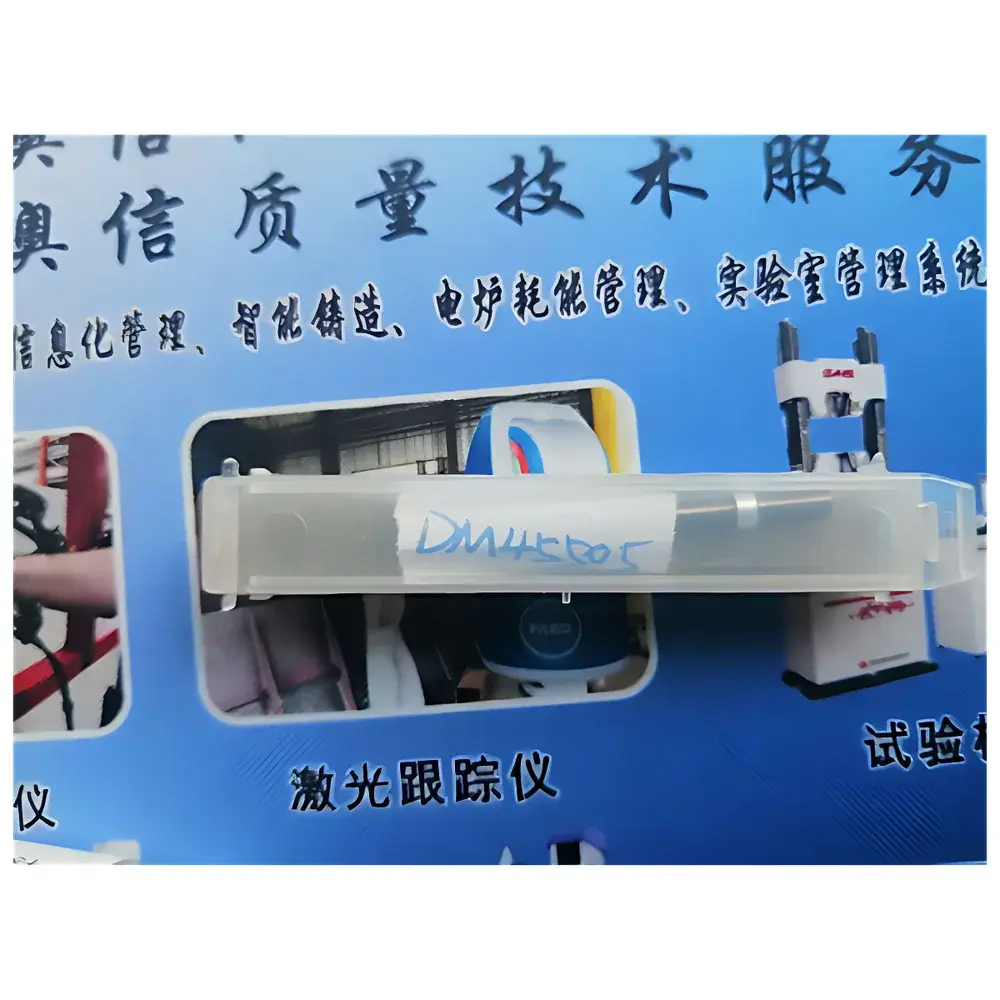
Accretech DM45505 Stylus Tip for Contact Profilometers
| Brand | Accretech |
|---|---|
| Origin | Japan |
| Model | DM45505 |
| Type | Contact Stylus Probe for Surface Profilometry and Roughness Measurement |
| Compliance | Designed for ISO 25178, ISO 4287, ASME B46.1, and JIS B 0601-compliant profilometric systems |
| Mounting Interface | Standard 8-32 UNC threaded shank (compatible with Accretech SJ-410/SJ-510/SJ-610 series, Formtracer series, and other OEM profilometers) |
| Tip Geometry | Spherical diamond tip, nominal radius 2 µm or 5 µm (standard variant), 90° included angle conical backup geometry |
| Shank Diameter | 3.0 mm |
| Total Length | 25 mm |
| Maximum Tracking Force | ≤ 1.5 mN (adjustable via instrument feedback loop) |
| Material | High-purity synthetic diamond tip bonded to hardened stainless steel shank |
Overview
The Accretech DM45505 is a precision-engineered stylus probe designed exclusively for high-accuracy contact profilometry and surface roughness measurement in metrology-grade applications. It operates on the principle of mechanical tracing—where a diamond-tipped stylus physically follows the topography of a sample surface while a displacement transducer (typically inductive or capacitive) records vertical deviations with sub-nanometer resolution. This analog-to-digital conversion enables quantitative evaluation of parameters including Ra, Rz, Rq, Rsk, Rku, and full 2D/3D profile reconstruction per ISO 25178-2 and ISO 4287 standards. The DM45505 is not a standalone instrument but a critical consumable and performance-determining component within Accretech’s Formtracer series (e.g., SV-3100, SV-3000), SJ-series roughness testers (SJ-410, SJ-510), and compatible third-party profilometric platforms requiring 8-32 UNC mounting. Its design prioritizes traceability, thermal stability, and minimal stylus–surface interaction error—ensuring reproducible results across calibration labs, R&D centers, and production QC environments.
Key Features
- Precision-ground synthetic diamond tip with certified spherical radius (2 µm or 5 µm nominal), manufactured under strict cleanroom conditions to minimize micro-fractures and edge wear.
- Optimized cantilever stiffness and resonant frequency response to suppress high-frequency noise during scanning without sacrificing sensitivity to fine surface features.
- Hermetically sealed stainless steel shank with low thermal expansion coefficient (< 10.5 × 10⁻⁶/K), ensuring dimensional stability over extended measurement cycles and ambient temperature fluctuations (18–22 °C).
- Calibration-ready geometry: tip radius, included angle, and centerline alignment are documented per NIST-traceable certificate (available upon request), supporting GLP/GMP audit requirements.
- Interchangeable and field-replaceable design—enables rapid stylus change without recalibrating the entire profilometer system, minimizing instrument downtime.
Sample Compatibility & Compliance
The DM45505 is validated for use on non-abrasive to moderately hard materials, including polished metals (aluminum, stainless steel, titanium alloys), optical glasses, silicon wafers, ceramics, and polymer films. It is unsuitable for heavily oxidized, porous, or highly abrasive surfaces (e.g., cast iron without finishing, sandblasted substrates) where tip wear accelerates beyond acceptable uncertainty thresholds. All measurements conducted with this stylus comply with international surface texture standards: ISO 25178-2 (areal surface texture), ISO 4287 (profile-based roughness), ASME B46.1 (U.S. surface characterization), and JIS B 0601 (Japanese industrial standard). When integrated into an Accretech system configured with certified reference standards (e.g., NIST SRM 1961, PTB roughness samples), measurement uncertainty budgets conform to ISO/IEC 17025 requirements for accredited testing laboratories.
Software & Data Management
The DM45505 functions transparently within Accretech’s proprietary TracerPack™ software suite (v5.3+), which supports automated tip qualification routines, real-time force monitoring, and adaptive scanning speed control based on local slope. Raw displacement data is stored in vendor-neutral ASCII or CSV formats, enabling post-processing in MATLAB, Python (NumPy/SciPy), or Metrology-Specific Software (e.g., MountainsMap®, SPIP™). Audit trail functionality—including operator ID, timestamp, environmental log (temperature/humidity), and stylus usage counter—is enabled when used with systems compliant with FDA 21 CFR Part 11 and EU Annex 11 regulations. Data integrity is preserved through SHA-256 hashing of raw scan files and immutable metadata embedding.
Applications
- Quantitative evaluation of machined surface integrity in aerospace turbine blades and medical implant substrates.
- Verification of polishing efficacy in semiconductor wafer bevels and MEMS device cavities.
- Roughness mapping of additive-manufactured metal parts pre- and post-HIP treatment.
- Wear track analysis in tribological studies using linear reciprocating or rotary test configurations.
- Validation of nanoimprint lithography (NIL) master templates and replication fidelity in optical diffraction gratings.
FAQ
What is the recommended maximum scanning speed for the DM45505 stylus?
For optimal signal-to-noise ratio and tip longevity, scanning speeds should not exceed 0.5 mm/s on surfaces with RMS roughness > 0.1 µm; lower speeds (0.1–0.3 mm/s) are advised for sub-nanometer finish evaluation.
Can the DM45505 be used interchangeably with non-Accretech profilometers?
Yes—if the host system provides mechanical compatibility (8-32 UNC thread, 3.0 mm shank clearance) and allows manual or programmable tracking force adjustment within 0.5–1.5 mN range. However, full parameter compliance (e.g., λc filter application, sampling length) requires software-level integration.
How often should the stylus tip be inspected or replaced?
Visual inspection under 100× metallurgical microscope is recommended after every 50 hours of cumulative scanning time; replacement is mandatory if tip radius deviation exceeds ±10% of nominal value or if chipping is observed.
Does the DM45505 include a calibration certificate?
A basic geometric conformity report is supplied with each unit; NIST-traceable certification with uncertainty budget is available as optional add-on (Order Code: DM45505-CAL-NIST).
Is the stylus suitable for measuring soft polymers or biological tissues?
Only under ultra-low-force mode (≤ 0.3 mN) and at reduced scan speeds; deformation artifacts must be assessed via comparative measurement against non-contact methods (e.g., white-light interferometry) for validation.