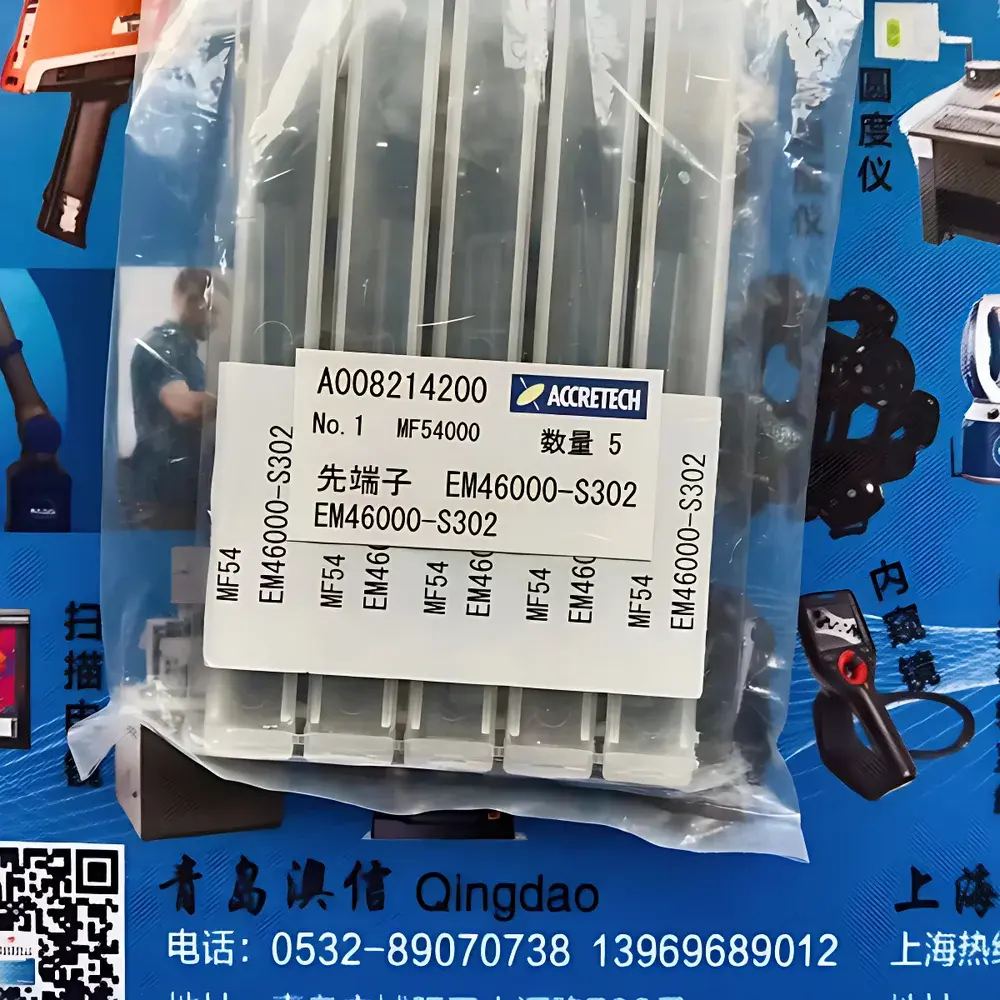
Accretech EM46000-S302 Advanced Surface Topography Measuring System
| Brand | Accretech (Tokyo Seimitsu) |
|---|---|
| Origin | Japan |
| Model | EM46000-S302 |
| Type | High-Precision Contact Profilometer for 2D/3D Surface Metrology |
| Compliance | ISO 25178-2, ISO 4287, ISO 11562, JIS B 0601, ASME B46.1 |
| Measurement Principle | Stylus-based Inductive Displacement Sensing with Dual-Axis Scanning Mechanism |
Overview
The Accretech EM46000-S302 is a high-accuracy, motorized contact profilometer engineered for comprehensive surface topography characterization in precision manufacturing, R&D laboratories, and quality assurance environments. Built upon Tokyo Seimitsu’s decades of expertise in ultra-precision metrology, the EM46000-S302 employs a dual-axis scanning architecture with a high-resolution inductive displacement sensor and diamond-tipped stylus (typically 2 µm radius, 90° included angle) to capture vertical resolution down to sub-nanometer levels and lateral resolution governed by scan step increments as fine as 10 nm. Its measurement principle adheres to the fundamental standards of contact profilometry—mechanical tracing of surface contours under controlled force (typically 0.5–5 mN adjustable), with real-time analog-to-digital conversion of vertical displacement data synchronized to precise X-Y positional feedback. Designed for traceable, repeatable quantification of surface texture parameters—including roughness (Ra, Rz, Rq), waviness, lay, and functional parameters such as Sk, Spk, and Svk—the system meets the metrological rigor required for aerospace component certification, medical device surface validation, semiconductor packaging inspection, and advanced optical substrate qualification.
Key Features
- Motorized bi-directional scanning stage with ±50 mm travel range (X) and ±25 mm (Y), enabling large-area mapping and stitching of multi-field profiles
- High-stability granite base with active vibration isolation interface compatible with standard optical tables
- Programmable stylus force control (0.5–5 mN) with real-time load monitoring to prevent surface damage on soft metals, polymers, or coated substrates
- Dual-mode operation: single-trace 2D profiling and full-area 3D topographic mapping with automatic tilt correction and reference plane fitting
- Integrated temperature-compensated linear encoders (resolution: 10 nm) ensuring metrological traceability per ISO/IEC 17025-accredited calibration protocols
- Modular sensor head design supporting interchangeable stylus configurations (e.g., conical, spherical, chisel) for specialized applications including groove depth, step height, and edge roundness analysis
Sample Compatibility & Compliance
The EM46000-S302 accommodates samples up to 300 mm × 300 mm × 150 mm (W × D × H) with optional custom fixtures for cylindrical, curved, or irregular geometries. It supports non-ferrous and ferrous metals, ceramics, hardened tool steels, injection-molded plastics, thin-film coatings, and polished silicon wafers. All measurement algorithms conform to ISO 25178-2 (areal surface texture), ISO 4287 (profile roughness), and ISO 11562 (filtering and cutoff definitions). Data reporting includes full uncertainty budgets aligned with GUM (Guide to the Expression of Uncertainty in Measurement) principles. The system is routinely deployed in GLP-compliant QA labs and supports audit-ready documentation for FDA 21 CFR Part 11 compliance when integrated with validated software modules.
Software & Data Management
Controlled via Accretech’s proprietary SURFPAK-VX platform (Windows 10/11 64-bit), the EM46000-S302 provides full scripting capability (VBScript, Python API), automated report generation (PDF/CSV/XML), and native export to industry-standard formats including STEP AP210, DXF, and STP for CAD-integrated GD&T verification. SURFPAK-VX implements ISO-defined Gaussian and spline filters, robust segmentation tools for feature extraction (e.g., peak-valley identification, bearing ratio curve analysis), and statistical process control (SPC) dashboards. Audit trail functionality records operator ID, timestamp, parameter settings, and raw data hash values—essential for regulated environments requiring full data integrity per ALCOA+ principles.
Applications
- Quantitative evaluation of turning, grinding, EDM, and laser-textured surfaces in automotive powertrain components
- Verification of surface finish specifications for orthopedic implant bearing surfaces (ASTM F2118, ISO 14289)
- Characterization of micro-structured optical elements (MOEs) and diffractive optical surfaces
- Process validation of additive manufacturing post-processing (e.g., shot peening, vibratory finishing)
- Failure analysis of wear scars, fretting marks, and corrosion-induced topographic degradation
- Calibration support for non-contact methods (e.g., confocal microscopy, white-light interferometry) via NIST-traceable artifact measurement
FAQ
What is the maximum measurable slope angle for reliable tracing without stylus skip?
The EM46000-S302 maintains stable tracking up to ±70° slope angles under default 2 mN force; steeper profiles require dynamic force adjustment or specialized low-radius stylus tips.
Can the system measure step heights below 10 nm?
Yes—vertical resolution is specified at ≤0.1 nm RMS noise floor, enabling sub-5 nm step height measurement with appropriate averaging and environmental stabilization.
Is thermal drift compensation available during long-duration scans?
The system incorporates real-time thermal expansion correction using embedded platinum resistance thermometers (PT100) at critical structural nodes, reducing drift-induced error to <0.5 nm/°C over 8-hour continuous operation.
Does SURFPAK-VX support custom parameter definition per internal QA standards?
Yes—users may define and validate proprietary parameters using embedded formula editor with full version control and change history logging.
What calibration artifacts are recommended for routine verification?
Accretech-certified step-height standards (Si/SiO₂, Cr/Cr₂O₃), roughness calibration specimens (ISO 5436-1 Type A/B), and pitch standards (10–100 µm) are supplied with NIST-traceable certificates of calibration.