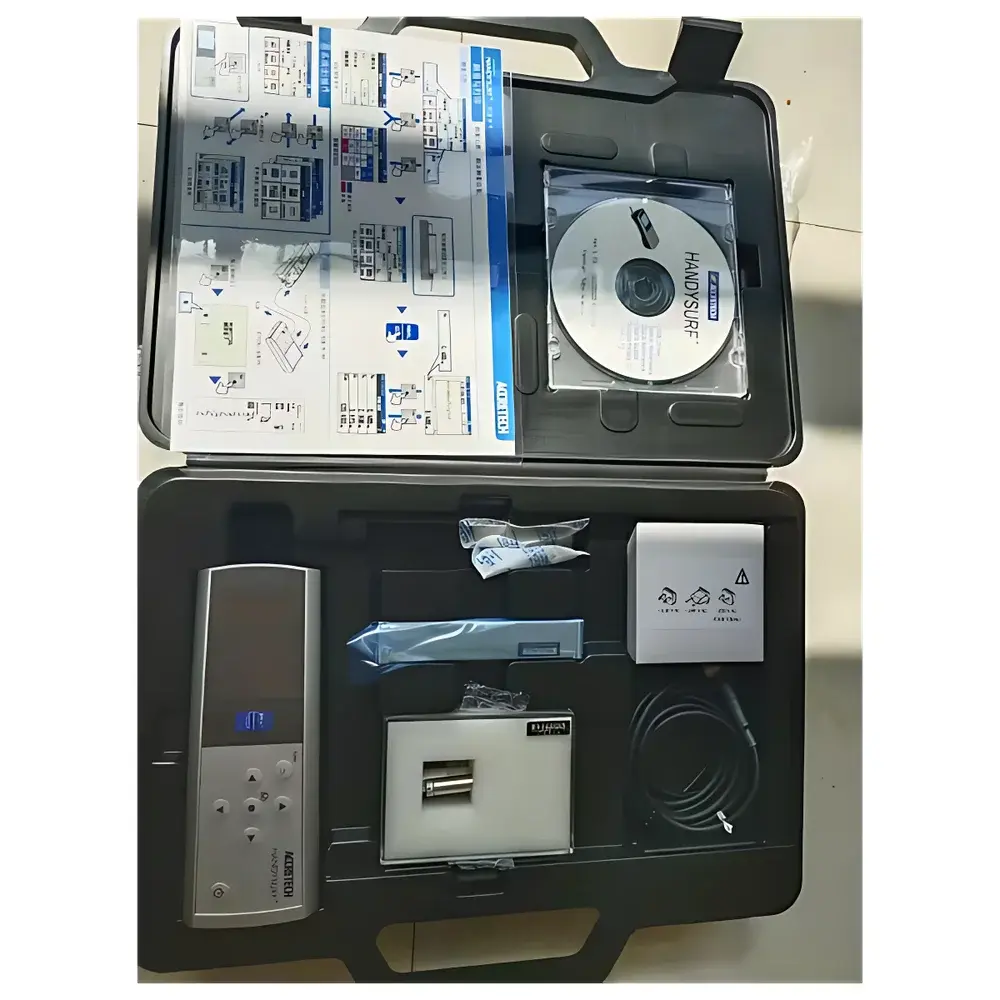
Accretech HANDYSURF+ Portable Contact-Type Surface Roughness Tester
| Brand | Accretech |
|---|---|
| Origin | Japan |
| Model | HANDYSURF+ |
| Measurement Principle | Stylus Profilometry (Contact Mode) |
| Measurement Method | Contact |
| Filter Type | 2RC Gaussian Filter |
| Evaluation Length | 0.2–16 mm |
| Vertical Resolution | 0.0007 µm |
| Measurable Height Range | −210 to +160 µm |
| Display | 2.4″ Color LCD with Full-Character Chinese Support |
| Analysis Modes | Profile Waveform + Parameter Table |
| Standard Analyses | Load Curve, Amplitude Distribution, Peak Count, Motif Analysis |
| Auto Acceptance/Rejection | Configurable Threshold-Based Judgment |
| Compliance | Designed to support ISO 4287, ISO 4288, ISO 13565-1/2/3, ASME B46.1, and JIS B 0601 |
Overview
The Accretech HANDYSURF+ is a next-generation portable surface roughness tester engineered for high-precision, field-deployable metrology in manufacturing QA/QC, R&D laboratories, and on-site maintenance environments. Based on the proven contact stylus profilometry principle, it traces surface topography using a diamond-tipped probe (typically 2 µm radius, 90° included angle) under controlled force (0.75 mN standard), converting mechanical displacement into high-fidelity analog-to-digital signals. Its upgraded architecture—successor to the E-35B platform—integrates enhanced signal conditioning, low-noise amplification, and real-time digital filtering to ensure traceable, repeatable roughness quantification across diverse metallic, ceramic, and polymer surfaces. Unlike non-contact optical systems, the HANDYSURF+ delivers direct physical measurement of actual as-manufactured geometry, making it indispensable for verifying compliance with functional surface specifications such as sealing integrity, coating adhesion, friction behavior, and wear resistance.
Key Features
- Compact, ergonomic handheld design with integrated probe arm and rechargeable Li-ion battery (up to 8 hours continuous operation)
- 2.4-inch full-color TFT-LCD display supporting multi-language UI—including native Chinese character rendering—for global operator accessibility
- High-resolution vertical sensing capability: 0.0007 µm (0.7 nm) resolution with ±1% linearity over full height range (−210 µm to +160 µm)
- Dual-output analysis: simultaneous waveform visualization and tabulated parameter display (Ra, Rz, Rq, Rsk, Rku, Rsm, Rp, Rv, Rt, etc.)
- Comprehensive built-in analysis suite: load curve (bearing ratio), amplitude distribution histogram, peak count statistics, and motif-based analysis per ISO 12085
- Programmable pass/fail logic with up to 10 user-defined criteria per measurement routine, enabling automated go/no-go decisions on production floors
- 2RC Gaussian filter implementation compliant with ISO 11562 for robust separation of roughness, waviness, and form components
Sample Compatibility & Compliance
The HANDYSURF+ accommodates workpieces with maximum height variations from −210 µm to +160 µm relative to the probe reference plane, supporting measurements on turned, ground, milled, EDM-machined, and honed surfaces. Its modular probe holder allows quick exchange of stylus tips optimized for soft metals (e.g., aluminum), hardened steels, or brittle ceramics. The instrument conforms to international standards governing surface texture metrology, including ISO 4287 (parameters), ISO 4288 (assessment procedures), ISO 13565-1/2/3 (motif analysis), ASME B46.1 (U.S. surface finish standard), and JIS B 0601 (Japanese national standard). All measurement data are timestamped and include instrument ID, probe calibration status, and environmental metadata—supporting GLP/GMP documentation requirements and audit readiness.
Software & Data Management
Data export is supported via USB 2.0 interface to PC-based Accretech SURFPAK software (Windows 10/11 compatible), which provides advanced post-processing, statistical process control (SPC) charting, batch report generation (PDF/CSV/XLSX), and comparative overlay of multiple profiles. SURFPAK maintains full traceability through embedded electronic signatures, change logs, and version-controlled analysis templates. For regulated industries, optional configuration supports FDA 21 CFR Part 11 compliance—including user authentication, audit trails, and electronic record integrity controls—when deployed in pharmaceutical device manufacturing or aerospace component verification workflows.
Applications
- Automotive: Cylinder bore finish verification, gear tooth flank roughness, brake disc surface characterization
- Aerospace: Turbine blade root fillet inspection, seal land roughness validation per AMS2700
- Medical Devices: Implant surface texture assessment (e.g., Ti-6Al-4V hip stems per ASTM F2129), surgical tool edge quality control
- Electronics: Heat sink base flatness and roughness correlation with thermal interface material performance
- Tooling & Mold Making: EDM electrode finish evaluation, injection mold cavity replication fidelity
- Academic Research: Correlation studies between surface parameters and tribological behavior under controlled lubrication conditions
FAQ
What stylus tip options are available for the HANDYSURF+?
Standard configuration includes a 2 µm radius, 90° diamond stylus; optional 5 µm radius stylus for softer materials and conical tips for deep groove access are available upon request.
Does the HANDYSURF+ require annual recalibration?
Yes—Accretech recommends traceable calibration against certified roughness standards (e.g., NIST-traceable STEP or NPL artifacts) at least once per year, or after any impact event or stylus replacement.
Can measurement data be integrated into MES or QMS platforms?
Via SURFPAK’s COM/ActiveX interface and configurable CSV export templates, raw profile data and summary parameters can be ingested into enterprise quality management systems such as ETQ Reliance or Siemens Opcenter Quality.
Is the 2RC filter digitally implemented or analog?
The 2RC filter is applied digitally in real time using double-pass convolution algorithms per ISO 11562, ensuring phase-correct filtering without waveform distortion.
What is the typical repeatability (σ) for Ra measurements on machined steel?
Under controlled lab conditions (temperature-stabilized environment, calibrated probe, standardized sampling length), repeatability is typically ≤ ±0.02 µm for Ra values between 0.1–2.0 µm.