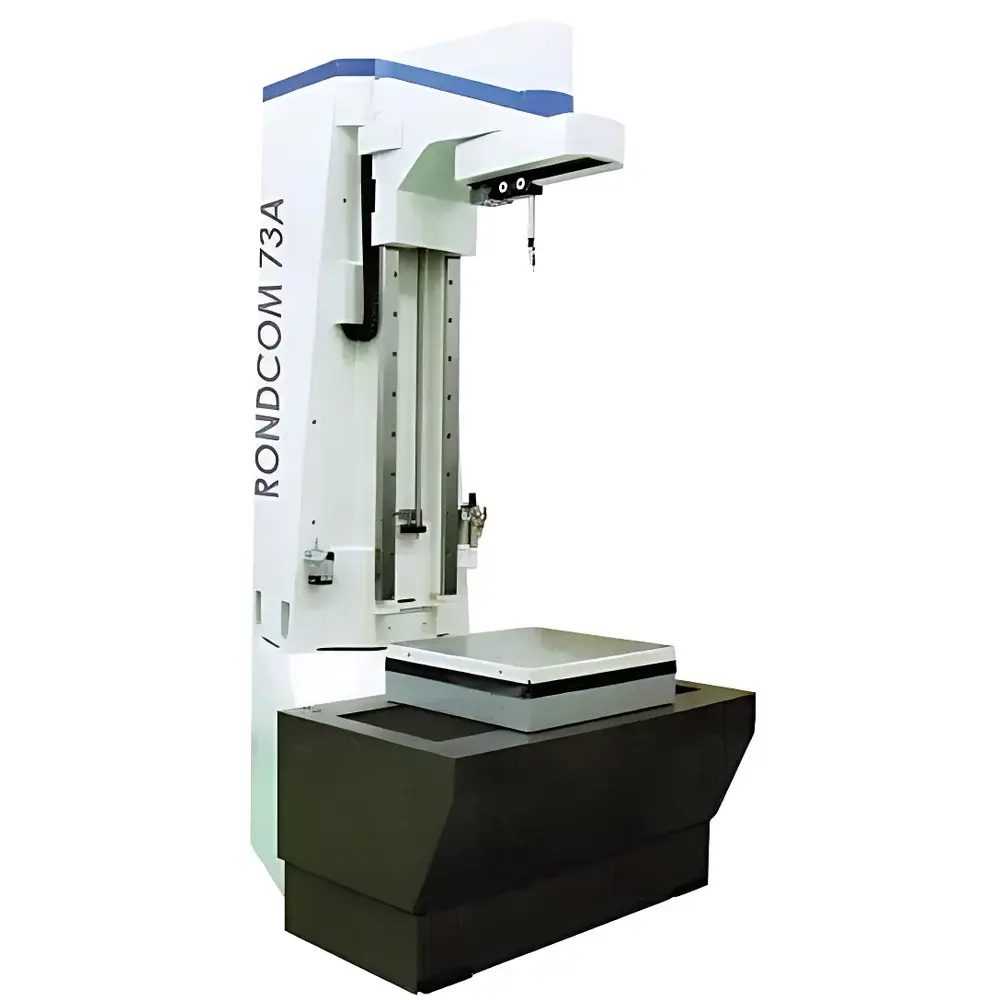
Accretech R73A High-Precision Rotational Roundness and Cylindricity Measuring Instrument
| Brand | Accretech (Tokyo Seimitsu) |
|---|---|
| Origin | Japan |
| Model | R73A |
| Bearing Type | Pneumatic (Air) |
| Measurement Principle | Radial Method with Rotating Sensor Table |
| Z-Axis Travel | 1000 mm |
| Radial (R-Axis) Auto-Zero Function | Yes |
| Tilt & Centering | Fully Automatic Compensation |
| Software Platform | ACCTee |
| Measurement Magnification | 50× to 10,000× (8 selectable steps) |
| Compliance | Designed for ISO 1101, ISO 12181 (Roundness), ISO 12180 (Cylindricity), and ASME Y14.5 geometric tolerance evaluation |
Overview
The Accretech R73A is a high-accuracy, sensor-rotating roundness and cylindricity measuring instrument engineered for metrology laboratories and precision manufacturing environments requiring traceable, repeatable geometric form analysis. It operates on the radial method—where a high-stability inductive probe measures deviations from an ideal circular or cylindrical reference as the workpiece rotates on an ultra-precise air-bearing spindle. Unlike table-rotating systems, the R73A employs a fixed workpiece and rotating sensor assembly, eliminating mass-related dynamic errors and enabling stable measurement of large, heavy, or asymmetric components. Its vertical Z-axis—driven by a high-rigidity linear guide with 1000 mm travel—supports full-height cylindricity evaluation across tall shafts, bearing housings, and turbine casings. The integrated air-bearing rotation system delivers sub-micron angular stability and zero mechanical wear, ensuring long-term calibration integrity without lubrication or warm-up periods.
Key Features
- Air-bearing spindle with active pressure monitoring circuitry: Automatically detects and compensates for supply pressure fluctuations to prevent bearing contact and ensure operational safety.
- Fully automated centering and tilt alignment: Uses iterative probe feedback and real-time vector calculation to determine and correct workpiece eccentricity and angular misalignment—no manual shimming or iterative trial runs required.
- Auto-zero functionality on both Z-axis (vertical column) and R-axis (radial arm): Precisely locates stylus tip position at mechanical origin prior to measurement, safeguarding the probe and ensuring consistent datum referencing.
- Eight-step magnification range (50× to 10,000×): Enables optimized signal-to-noise ratio across diverse part geometries—from coarse forgings to fine-ground bearing races—without hardware reconfiguration.
- Dedicated cross-slide sensor carriage: Improves lateral stability and reduces parasitic motion during small-diameter measurements (e.g., pins, nozzles, or miniature bushings), enhancing repeatability below Ø5 mm.
- Dual-axis digital readout integration: Provides real-time positional feedback during auto-alignment and tilt correction; eliminates manual coordinate entry and minimizes operator-induced error.
- Rigid granite base and thermally stabilized column architecture: Mitigates environmental drift and supports measurement uncertainty budgets compliant with ISO/IEC 17025-accredited calibration practices.
Sample Compatibility & Compliance
The R73A accommodates workpieces up to 1000 mm in height and 600 mm in diameter (with optional extension fixtures). Its fixed-part configuration allows direct mounting of irregular, non-symmetrical, or flanged components—eliminating reliance on centering chucks or collets that introduce clamping distortion. All geometric evaluations conform to international standards including ISO 12181-1 (roundness), ISO 12180-1 (cylindricity), ISO 1101 (geometrical tolerancing), and ASME Y14.5–2018. Data reporting includes GD&T-compliant deviation maps, harmonic spectrum analysis (up to 50th order), and statistical process control (SPC) export formats compatible with Minitab and JMP. System validation documentation supports GLP/GMP audit readiness and satisfies traceability requirements under ISO/IEC 17025 Clause 6.5.
Software & Data Management
ACCTee—the proprietary measurement software platform—provides a modular, scriptable interface for both routine inspection and advanced research workflows. It features real-time waveform visualization, multi-section profile stitching (for tapered or stepped cylinders), and automated report generation with customizable templates (PDF, CSV, XML). Audit trail functionality records all user actions, parameter changes, and calibration events in accordance with FDA 21 CFR Part 11 requirements. Raw data files are stored in vendor-neutral HDF5 format, enabling third-party post-processing in MATLAB, Python (NumPy/H5Py), or metrology-specific tools such as PolyWorks or Q-DAS. Software updates are delivered via secure HTTPS with SHA-256 signature verification.
Applications
The R73A serves critical quality assurance functions across aerospace (turbine blade root profiles, landing gear journals), automotive (crankshaft main journals, CV joint housings), energy (generator rotor bores, pump impeller shrouds), and medical device manufacturing (orthopedic implant stems, dental abutment interfaces). It is routinely deployed for incoming material inspection, in-process verification after grinding or honing, and final release testing prior to assembly. Its ability to decouple form error from fixture-induced distortion makes it indispensable for validating ultra-precision components where traditional CMM-based roundness assessment lacks sensitivity or accessibility.
FAQ
What standards does the R73A support for roundness and cylindricity evaluation?
ISO 12181-1, ISO 12180-1, ISO 1101, and ASME Y14.5–2018.
Can the R73A measure parts with interrupted surfaces or keyways?
Yes—its sensor-rotating architecture and ACCTee’s gap-handling algorithms allow robust evaluation across discontinuous profiles without interpolation artifacts.
Is air supply conditioning required for the pneumatic bearing?
Yes—a clean, dry, oil-free air source with pressure regulation (5–7 bar) and filtration to 0.01 µm is mandatory; optional integrated air treatment modules are available.
Does the system support automated pass/fail decision logic based on GD&T callouts?
Yes—ACCTee permits rule-based tolerance assignment per feature, with configurable alarms and SPC charting tied directly to drawing specifications.
How is measurement uncertainty quantified and documented?
Uncertainty budgets follow ISO/IEC Guide 98-3 (GUM) and include contributions from probe hysteresis, air-bearing runout, thermal expansion, and environmental vibration—validated annually per ISO 17025 procedures.