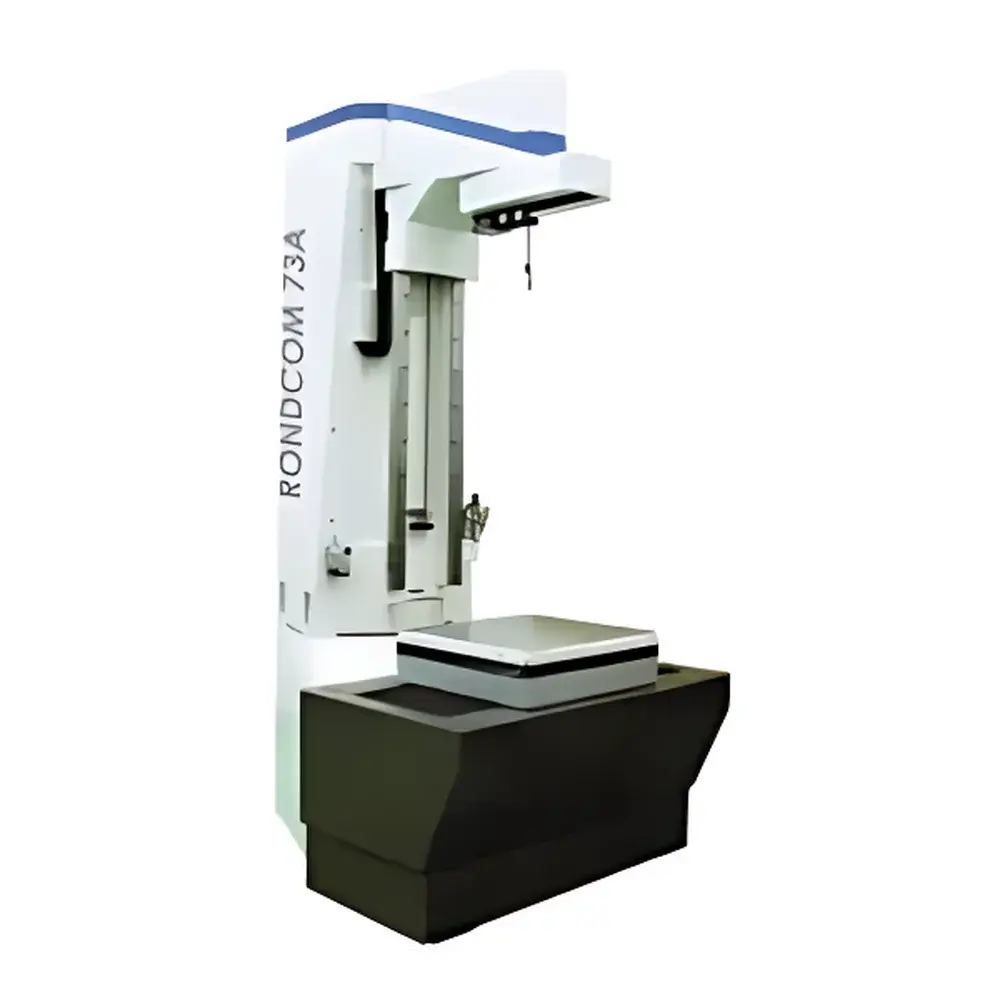
ACCRETECH R73A High-Precision Rotational Roundness and Cylindricity Measuring Instrument
| Brand | ACCRETECH (Tokyo Seimitsu) |
|---|---|
| Origin | Japan |
| Model | R73A |
| Bearing Type | Aerostatic Air Bearing |
| Measurement Principle | Radius Method with Rotating Sensor Spindle |
| Z-Axis Travel | 1000 mm |
| Radial (R-Axis) Auto-Zero Function | Yes |
| Tilt & Centering Compensation | Fully Automated via Software |
| Measurement Magnification | 50× to 10,000× (8-step selectable) |
| Sensor Traverse Mechanism | Integrated Horizontal Probe Translation Unit |
| Z/R-Axis Position Encoders | Built-in Absolute Encoders |
| Air Pressure Monitoring | Real-time Diagnostic Circuit |
| Software Platform | ACCTee Measurement Suite (v6.x or later) |
| Compliance Framework | Designed for ISO 1101, ISO 12181 (Roundness), ISO 12180 (Cylindricity), and ASME Y14.5 geometric tolerance evaluation |
Overview
The ACCRETECH R73A is a high-precision rotational roundness and cylindricity measuring instrument engineered for metrology laboratories and advanced quality control environments requiring traceable, sub-micron geometric assessment of rotationally symmetric components. It operates on the radius method: a precision aerostatic air bearing spindle rotates the workpiece while a high-resolution inductive probe measures radial deviations relative to a theoretical perfect circle or cylinder. The instrument’s core architecture integrates a rigid granite base, a thermally stable Z-axis column with 1000 mm vertical travel, and a dynamically balanced rotating table—enabling full-profile evaluation of large-diameter shafts, bearing races, turbine discs, and hydraulic components up to Ø600 mm (with optional extensions). Its design adheres to fundamental principles of geometric metrology defined in ISO 12181-1 (roundness) and ISO 12180-1 (cylindricity), ensuring measurement uncertainty budgets align with international calibration hierarchies.
Key Features
- Aerostatic air bearing spindle delivering <0.02 µm radial error motion and zero mechanical wear—eliminating lubrication requirements and warm-up delays.
- Fully automated centering and tilt alignment: motorized X-Y stage and angular adjustment mechanism correct workpiece eccentricity and axial misalignment before measurement, reducing operator dependency.
- Integrated absolute encoders on both Z-axis (vertical column) and R-axis (radial arm) enable real-time positional feedback during auto-tilt compensation and eliminate manual coordinate entry.
- Auto-zero functionality on Z and R axes ensures repeatable probe positioning and protects the stylus from overtravel during setup or program execution.
- Eight-step magnification range (50× to 10,000×) allows optimal signal-to-noise ratio selection based on part tolerance class—critical for evaluating tight-tolerance aerospace or medical implant geometries.
- Dedicated sensor traverse unit enables precise lateral positioning of the probe for small-diameter features (e.g., bearing inner rings), improving resolution and reducing cosine error.
- Onboard air pressure diagnostic circuit continuously monitors supply pressure and flow; triggers immediate shutdown if deviation exceeds ±5% of nominal setpoint—preventing bearing collapse or surface scoring.
Sample Compatibility & Compliance
The R73A accommodates parts weighing up to 50 kg and diameters up to 600 mm (standard configuration), with extended tables available for larger assemblies. Workpieces are secured using vacuum chucks, three-jaw chucks, or custom fixtures compatible with ISO 7388-1 tooling interfaces. All measurements conform to ISO 1101 geometric product specification (GPS) standards, supporting GD&T evaluation per ASME Y14.5–2018. Data output formats comply with ISO 10360-5 (CMM acceptance testing) traceability protocols. The system supports audit-ready reporting required under ISO/IEC 17025:2017 accredited laboratories and satisfies documentation prerequisites for FDA 21 CFR Part 11 when deployed with ACCTee’s optional electronic signature and audit trail module.
Software & Data Management
ACCTee measurement software (v6.4+) provides a unified interface for setup, acquisition, analysis, and reporting. It includes ISO-compliant filter algorithms (Gaussian, 2CR, phase-corrected), harmonic decomposition (up to 50th order), and multi-section cylindrical evaluation with zone-based tolerance mapping. Raw data is stored in vendor-neutral ASCII or XML formats, enabling integration with enterprise MES/QMS platforms (e.g., Siemens Opcenter, ETQ Reliance). Calibration certificates, measurement logs, and revision histories are time-stamped and digitally signed. Optional modules support GLP/GMP-compliant workflows, including user access levels, electronic signatures, and immutable audit trails compliant with FDA 21 CFR Part 11 Annex 11 requirements.
Applications
The R73A serves critical dimensional verification tasks across regulated and high-precision industries: evaluation of roundness and cylindricity of jet engine compressor blades per SAE AIR4502; assessment of hydraulic pump rotors against ISO 4386-2 wear criteria; validation of orthopedic implant stem geometry per ASTM F2503; and certification of precision bearing raceways per ISO 492. It is routinely deployed in Tier-1 automotive powertrain labs for crankshaft journal inspection, in semiconductor equipment component suppliers for vacuum chamber concentricity checks, and in national metrology institutes for inter-laboratory comparison studies supporting BIPM CCAUV.K2 key comparisons.
FAQ
What is the maximum permissible part weight and diameter for standard R73A configuration?
Standard configuration supports parts up to 50 kg and Ø600 mm. Extended table options accommodate Ø1000 mm parts with auxiliary support fixtures.
Does the R73A support automated pass/fail judgment against GD&T callouts?
Yes—ACCTee software evaluates tolerances per ASME Y14.5 and ISO 1101, generating binary compliance status with configurable deviation thresholds and statistical process control (SPC) charting.
Is thermal drift compensation integrated into the measurement routine?
The granite base and enclosed column structure minimize thermal gradients; optional environmental monitoring module (temperature/humidity sensors) feeds real-time corrections into the ACCTee thermal drift compensation algorithm.
Can the R73A be integrated into a factory automation line?
Yes—via Ethernet/IP or OPC UA interface, the system supports external PLC-triggered measurement cycles, barcode-driven part identification, and automated report export to shared network drives or cloud-based QMS.
What calibration standards are recommended for periodic verification?
NIST-traceable roundness artifacts (e.g., NIST SRM 2141), certified master cylinders (ISO 12180-3), and laser interferometer-verified linear displacement standards are recommended for annual verification per ISO 10360-5.