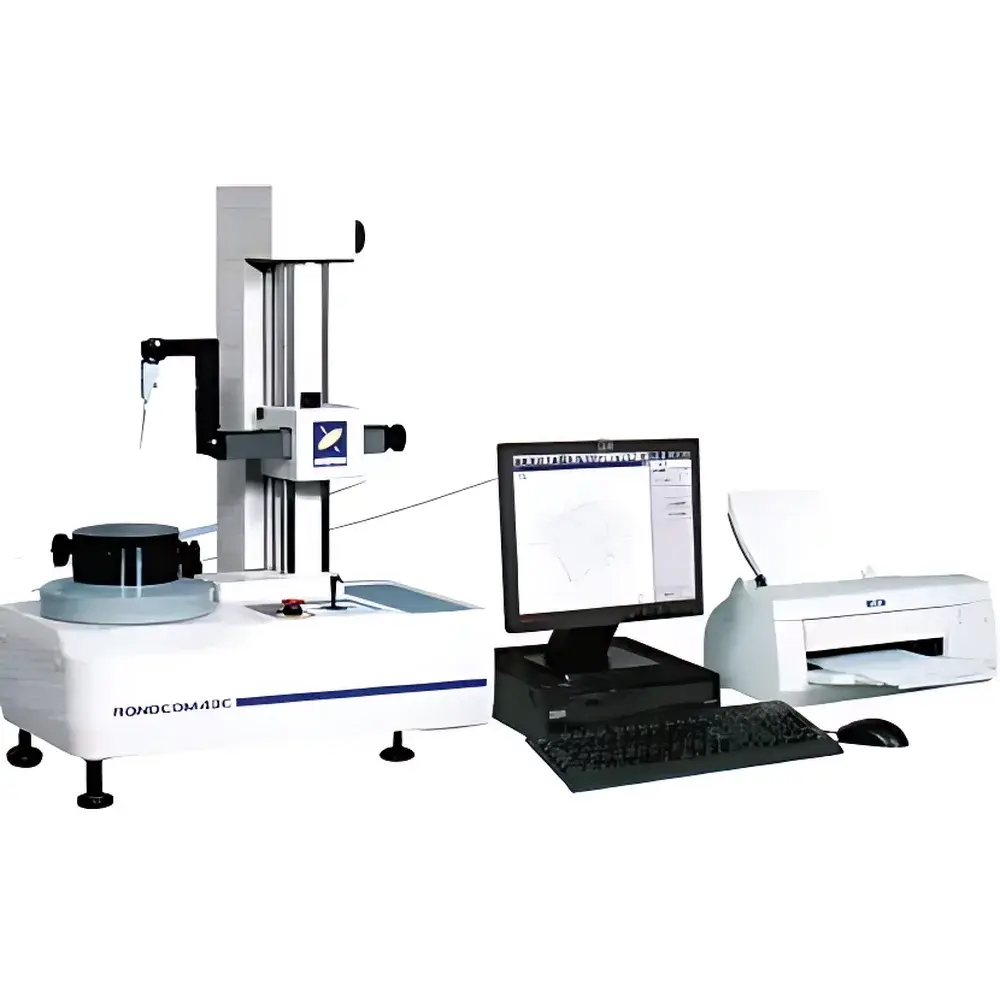
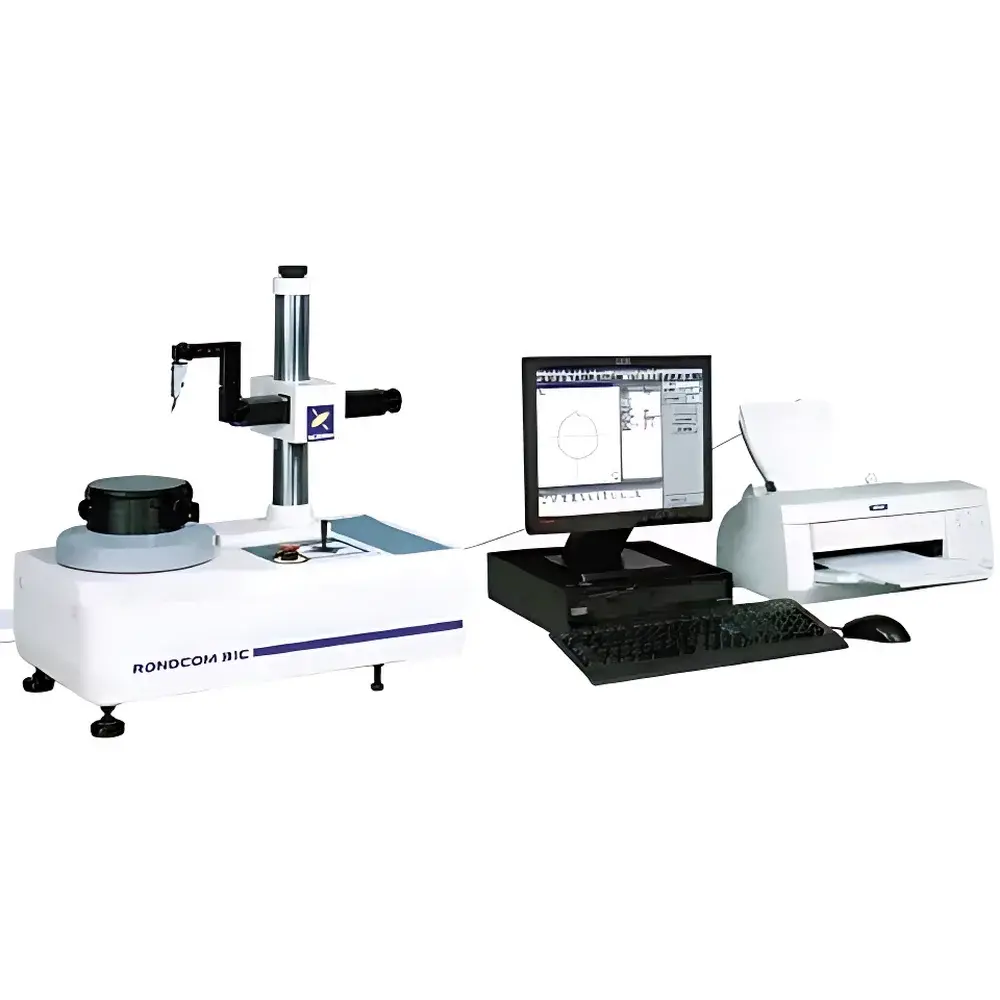
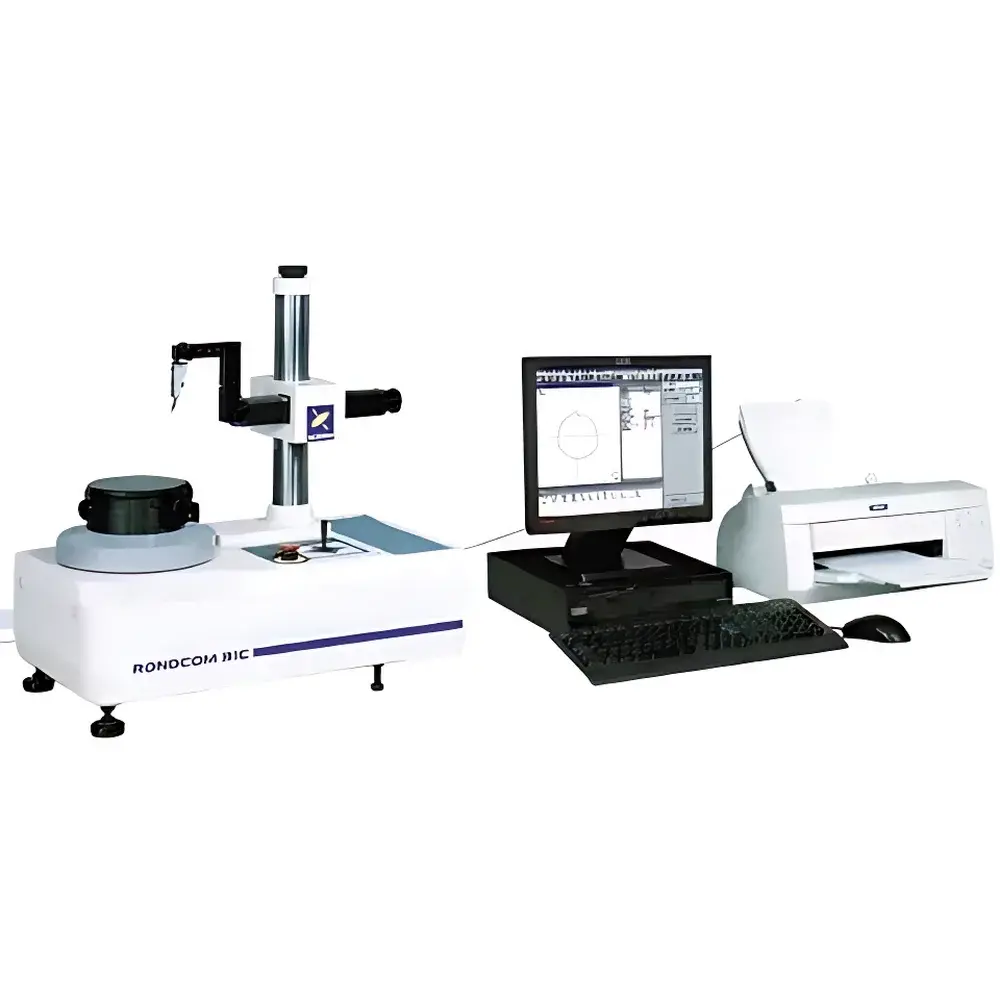
Accretech RONCOM 31C Roundness and Cylindricity Measuring Instrument
| Brand | Accretech (Tokyo Seimitsu) |
|---|---|
| Origin | Japan |
| Model | RONCOM 31C |
| Rotary Axis (θ) | 6 rpm |
| Z-Axis Travel | 200 mm |
| R-Axis Radial Travel | 125 mm |
| Maximum Workpiece Diameter | Ø250 mm |
| Maximum Height (External) | 520 mm |
| Maximum Height (Internal) | 300 mm |
| Spindle Accuracy (ISO 4291 / JIS B7451) | (0.04 + 6H/10000) µm |
| Straightness (Z-axis) | 0.50 mm / 100 mm |
| Sensor Linear Range | ±400 µm |
| Stylus Tip | Ø1.6 mm sintered carbide sphere |
| Measuring Force | 70 mN |
| Filter Options | Digital 2RC & Gaussian filters |
| Rotational cutoffs | 15–500 undulations/rev |
| Axial cutoffs | 0.025–8 mm |
| Data Analysis | MZC, LSC, MIC, MCC, N.C. evaluation methods |
| Software Platform | ACCTee integrated measurement suite |
| Power Supply | AC 100 V, 50/60 Hz |
| Air Supply | 0.35–0.7 MPa, 30 L/min (NTP) |
| Dimensions (W×D×H) | 1800 × 1000 × 1700 mm |
| Mass | 120 kg |
Overview
The Accretech RONCOM 31C is a high-precision roundness and cylindricity measuring instrument engineered for metrology laboratories, precision machining facilities, and quality assurance departments requiring traceable geometric form analysis in accordance with ISO 1101, ISO 5436-1, and JIS B 7451 standards. It employs a high-stiffness, hydrostatic air-bearing rotary spindle as its primary reference axis—ensuring minimal mechanical hysteresis and thermal drift over extended measurement cycles. The instrument operates on the principle of polar coordinate acquisition: a precision linear displacement sensor (LVDT-based) traces radial deviations from the ideal circular or cylindrical profile as the workpiece rotates at a controlled angular velocity (6 rpm). Simultaneously, vertical (Z-axis) translation enables full-height scanning for comprehensive cylindricity, straightness, parallelism, and coaxiality evaluation. Its rigid granite base and thermally stable column architecture minimize environmental influence, supporting reproducible sub-micron form error quantification across production lots and R&D prototypes.
Key Features
- Hydrostatic air-bearing spindle delivering ISO 4291-compliant rotational accuracy of (0.04 + 6H/10000) µm, where H is the measurement height in mm
- Dual-axis servo-controlled motion system: Z-axis travel up to 200 mm, R-axis radial stroke of 125 mm, both equipped with automatic end-stop detection (±5 mm tolerance)
- Integrated ACCTee software platform—providing real-time waveform display, automated centering and leveling routines, and configurable measurement sequences
- Comprehensive form analysis engine supporting five standardized centering algorithms: Minimum Zone Center (MZC), Least Squares Center (LSC), Maximum Inscribed Circle (MIC), Minimum Circumscribed Circle (MCC), and No Correction (N.C.)
- Digital filtering compliant with ISO 12085: selectable 2RC and Gaussian filters with rotational cutoffs ranging from 15 to 500 undulations per revolution and axial cutoffs from 0.025 mm to 8 mm
- Stylus system featuring a Ø1.6 mm sintered tungsten carbide sphere with nominal measuring force of 70 mN—optimized for surface integrity preservation on hardened steels, ceramics, and aerospace alloys
Sample Compatibility & Compliance
The RONCOM 31C accommodates workpieces up to Ø250 mm in diameter and 520 mm in external height (or 300 mm internal height), with a maximum loading mass of 25 kg. The Ø148 mm precision ground granite table includes ±2 mm centering adjustment and ±10 arc-minute tilt compensation—enabling rapid alignment of asymmetric or off-center components. All measurement routines adhere to international geometric tolerancing frameworks defined in ISO GPS (Geometrical Product Specifications), including explicit support for GD&T symbols such as cylindricity (⏣), concentricity (◎), and perpendicularity (⟂). The system’s traceability chain conforms to ISO/IEC 17025 requirements when operated within calibrated environmental conditions (20 ± 1 °C, <50% RH, vibration-isolated foundation). Optional calibration artifacts—including certified roundness masters and step gauges—are available to validate performance per ISO 10360-4.
Software & Data Management
ACCTee serves as the unified interface for setup, execution, and post-processing. It supports GLP-compliant audit trails: every measurement file embeds operator ID, timestamp, environmental logs (if connected to optional sensors), calibration status, and full parameter history. Export formats include ASCII (.txt), CSV, and industry-standard DMIS (Dimensional Measuring Interface Standard) for integration with enterprise SPC systems. Fourier amplitude spectra and power spectral density (PSD) plots are generated automatically to identify periodic errors originating from machine tool harmonics or bearing imperfections. Measurement reports can be annotated with custom notes, overlaid with design nominal profiles, and printed via color or monochrome laser output at scalable magnifications (50× to 100,000×). The software architecture is compatible with Windows-based laboratory networks and supports role-based access control for multi-user environments under FDA 21 CFR Part 11 compliance configurations.
Applications
This instrument is routinely deployed for first-article inspection of turbine blades, bearing races, hydraulic pump rotors, and optical lens mounts—where deviation from ideal roundness directly impacts sealing efficiency, rotational balance, or optical wavefront fidelity. In automotive powertrain QA, it verifies camshaft lobe symmetry and crankshaft journal cylindricity to ensure dynamic load distribution and oil film stability. Aerospace suppliers use it to certify landing gear actuators and actuator housing bores per AS9102 requirements. Academic metrology labs employ the RONCOM 31C for validating novel stylus compensation models and benchmarking non-contact alternatives against tactile reference data. Its ability to decouple harmonic components (via FFT-based decomposition) makes it indispensable for root-cause analysis of machining chatter, chuck-induced distortion, or thermal deformation in turning operations.
FAQ
What standards does the RONCOM 31C comply with for roundness measurement accuracy?
It meets ISO 4291 and JIS B7451 for spindle error characterization, and all form evaluations conform to ISO 1101 and ISO 5436-1 for uncertainty reporting and filter implementation.
Can the system measure internal diameters (ID) and complex stepped geometries?
Yes—internal measurements up to Ø300 mm height are supported using extendable probe arms; stepped features are analyzed via segmented Z-axis scans with user-defined start/stop positions and independent filtering per section.
Is remote operation or network integration possible?
ACCTee supports TCP/IP communication for remote monitoring and scheduled unattended measurement runs; DMIS export enables bidirectional data exchange with MES and QMS platforms.
What maintenance is required to sustain metrological performance?
Daily air supply filtration checks, monthly spindle air gap verification, and annual recalibration by an ISO/IEC 17025-accredited service provider are recommended per Accretech’s Maintenance Protocol Rev. 4.2.
Does the system support custom report templates for corporate QA documentation?
Yes—XML-based report templates can be authored externally and loaded into ACCTee, preserving company logos, header/footer layouts, and signature fields compliant with internal QA SOPs.