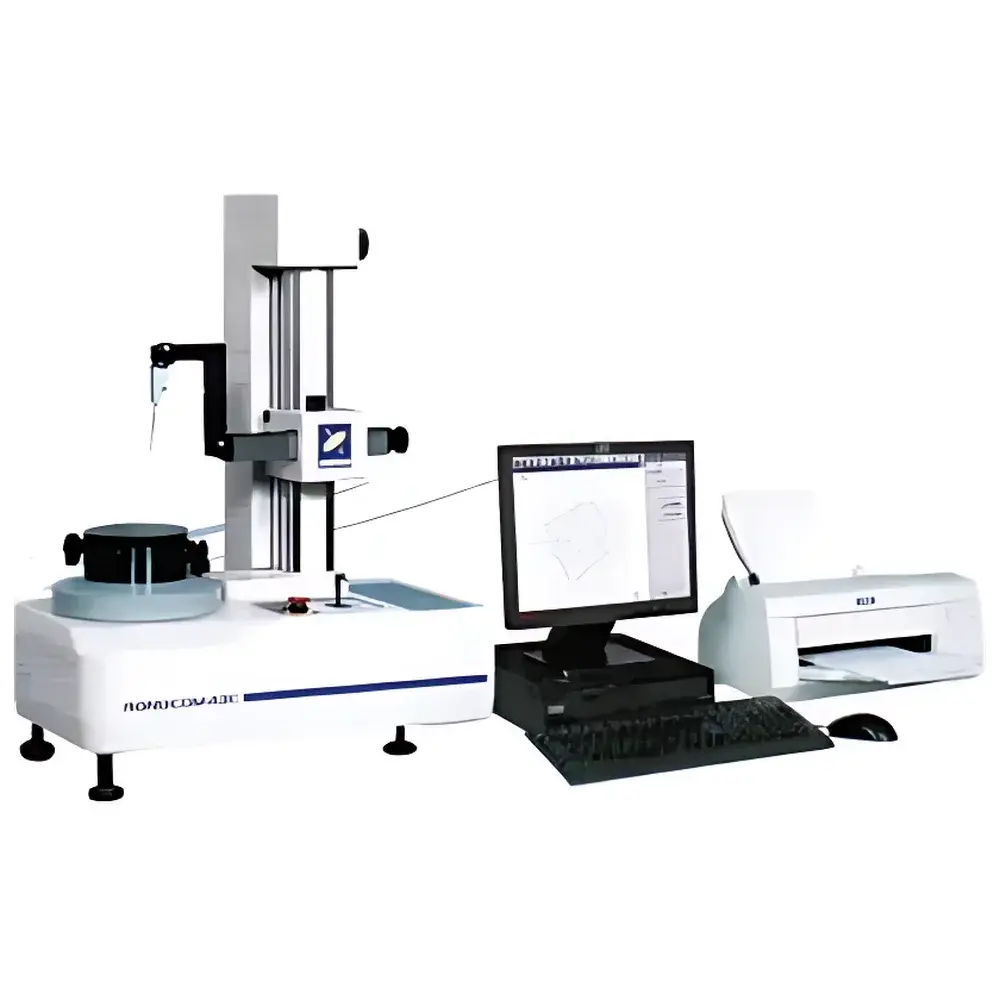
Accretech RONCOM 41C Roundness and Cylindricity Measuring Instrument
| Brand | Accretech (Tokyo Seimitsu) |
|---|---|
| Origin | Japan |
| Model | RONCOM 41C |
| Rotary Axis Precision | (0.04 + 6H/10000) µm per ISO 4291/JIS B7451 |
| Z-Axis Travel | 200 mm |
| Maximum Workpiece Diameter | Φ250 mm |
| Maximum Height Measurement | Ø420 mm (OD) / Ø200 mm (ID) |
| Spindle Speed | 6 rpm |
| Z-Axis Measurement Speed | 0.6–5 mm/s |
| Radial (R-Axis) Travel | 125 mm |
| Pneumatic Supply | 0.35–0.7 MPa |
Overview
The Accretech RONCOM 41C is a high-precision, air-bearing roundness and cylindricity measuring instrument engineered for metrology laboratories and precision manufacturing environments requiring traceable geometric form analysis. It operates on the principle of rotational axis metrology: the workpiece rotates concentrically about a high-stiffness, hydrostatic air-bearing spindle while a tactile probe—equipped with a Φ1.6 mm sintered carbide stylus—scans radially and axially to capture profile deviations in polar and Cartesian coordinates. Designed in strict compliance with ISO 4291 and JIS B7451 standards, the system delivers certified roundness measurement uncertainty governed by the expression (0.04 + 6H/10000) µm, where H denotes the vertical measurement height in millimeters. Its robust granite base, thermally stabilized column structure, and dual-axis (R–Z) servo-controlled positioning ensure mechanical stability across extended measurement cycles—critical for repeatable evaluation of cylindrical components such as bearing races, hydraulic spools, turbine blades, and precision shafts.
Key Features
- Hydrostatic air-bearing spindle delivering ultra-low radial runout and minimal thermal drift—enabling sub-micron repeatability over multi-hour measurement sessions.
- Dual-axis (R–Z) motorized motion control with programmable feed rates: Z-axis measurement speed adjustable from 0.6 to 5 mm/s; R-axis traverse at 5 mm/s; rapid positioning up to 15 mm/s.
- Integrated ACCTee metrology software platform—providing real-time waveform visualization, automated centering and tilt alignment routines, and configurable measurement sequences.
- Comprehensive form evaluation suite supporting five standardized centering algorithms: Minimum Zone Center (MZC), Least Squares Center (LSC), Maximum Inscribed Circle (MIC), Minimum Circumscribed Circle (MCC), and No Correction (N.C.).
- Digital filtering architecture with selectable 2RC and Gaussian filters; harmonic cutoff options spanning 15–500 undulations per revolution (UPR) for rotational data, and spatial wavelength bands from 0.025 mm to 8 mm for axial profiles.
- Full-axis data acquisition synchronized to encoder-resolved angular position (θ-axis), enabling simultaneous evaluation of roundness, cylindricity, coaxiality, parallelism, flatness, perpendicularity, and thickness variation.
Sample Compatibility & Compliance
The RONCOM 41C accommodates workpieces up to Ø250 mm in diameter and 420 mm in external height (or 200 mm internal height), with a maximum load capacity of 25 kg on its Φ148 mm precision rotary table. Centering adjustment range is ±2 mm laterally and ±10 arcminutes angularly—facilitating rapid setup of asymmetric or off-center parts. All measurements adhere to internationally recognized geometric tolerancing frameworks defined in ISO 1101 and ASME Y14.5. The system supports audit-ready documentation required under GLP and GMP-regulated quality systems, including full traceability of calibration records, environmental monitoring logs (temperature, humidity, air pressure), and operator-annotated measurement reports compliant with ISO 17025 clause 7.8. While not inherently 21 CFR Part 11–validated, its software architecture permits integration with third-party electronic signature and audit-trail modules when deployed in regulated pharmaceutical or aerospace QA/QC workflows.
Software & Data Management
ACCTee serves as the unified interface for instrument control, data acquisition, analysis, and reporting. It enables parametric programming of measurement plans—including automatic start/stop triggers, stepwise Z-axis indexing, and conditional logic for feature-based scanning. Raw profile data is stored in vendor-neutral ASCII formats (CSV, TXT) alongside proprietary .rmd files containing metadata such as stylus geometry, filter settings, and evaluation method selection. Fourier spectrum analysis provides quantitative breakdown of harmonic content—essential for diagnosing machine tool errors, chucking distortion, or bearing raceway waviness. Power spectral density (PSD) plots support root-cause analysis of periodic errors. Reports are exportable to PDF or printed via integrated support for color or monochrome laser printers, with scalable magnification (50× to 100,000×) and overlay annotations for GD&T callouts. Data archiving complies with long-term retention requirements through timestamped, immutable file generation and optional network drive synchronization.
Applications
The RONCOM 41C is routinely deployed in Tier-1 automotive powertrain facilities for verifying camshaft lobe symmetry and crankshaft journal roundness; in bearing manufacturing for certifying raceway form deviation against ABEC-7/ABEC-9 specifications; in medical device production for validating orthopedic implant stem geometry; and in aerospace MRO operations for assessing turbine disk bore cylindricity post-repair. Its ability to resolve surface texture superimposed on macro-form—via configurable low-pass filtering—makes it suitable for hybrid inspection tasks bridging roughness and form metrology. Users also leverage its tilt-compensation function to evaluate non-perpendicular mounting surfaces on gear housings and hydraulic manifolds, where angular misalignment directly impacts functional sealing performance.
FAQ
What standards does the RONCOM 41C comply with for roundness measurement accuracy?
It conforms to ISO 4291 and JIS B7451, with specified rotary axis inaccuracy expressed as (0.04 + 6H/10000) µm.
Can the system measure both internal and external cylindrical features?
Yes—maximum internal diameter capacity is Ø200 mm; external diameter limit is Ø250 mm, with dedicated probe holders and extension kits available for deep-hole applications.
Is ACCTee software compatible with modern Windows OS versions?
ACCTee v4.x supports Windows 10 (64-bit) and Windows 11, with driver certification validated under WHQL guidelines.
Does the instrument support automated pass/fail decision-making based on GD&T tolerances?
Yes—tolerance limits can be preloaded per feature, and the software generates binary conformance flags alongside numerical deviations in final reports.
What maintenance is required for the air-bearing spindle?
Daily filtration checks of the compressed air supply (0.35–0.7 MPa, oil-free, dew point ≤ −20 °C) and quarterly verification of bearing gap pressure using the onboard digital manometer are recommended.