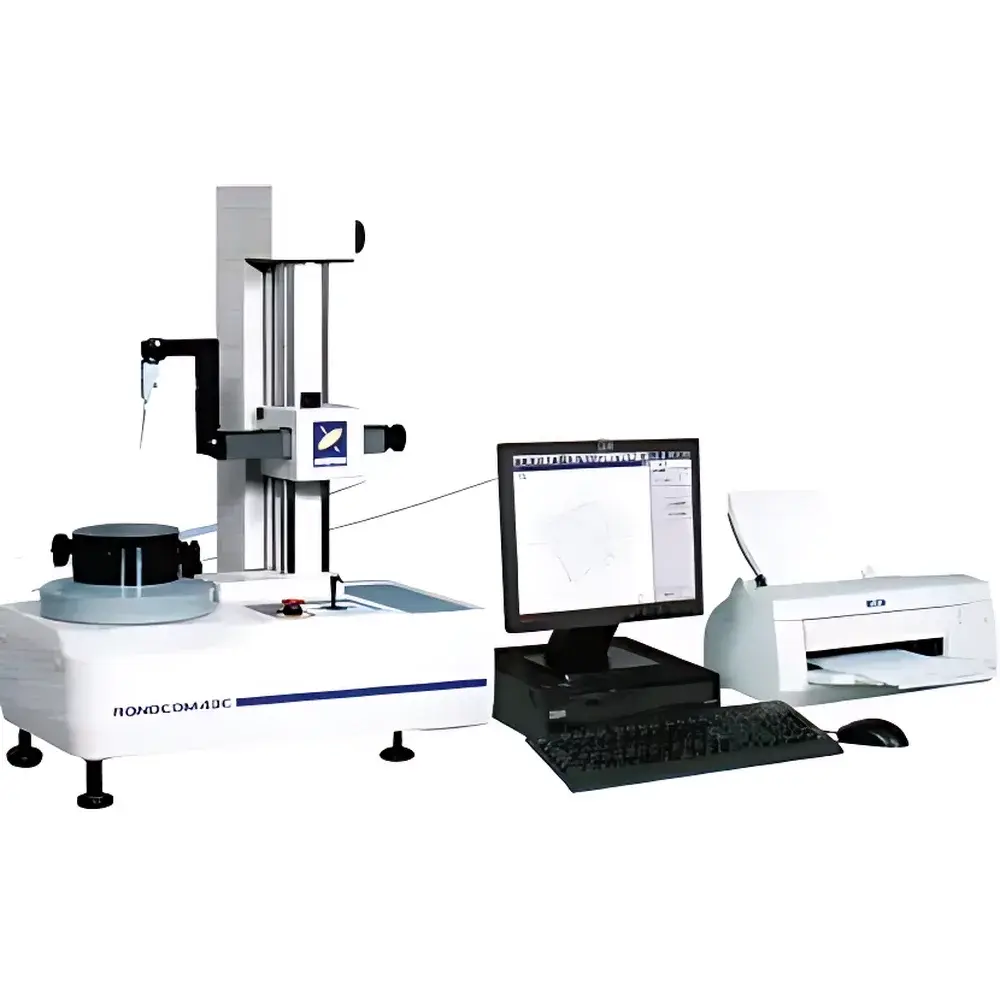
Accretech RONCOM 43C Roundness and Cylindricity Measuring Instrument
| Brand | Accretech (Tokyo Seimitsu) |
|---|---|
| Origin | Japan |
| Model | RONCOM 43C |
| Maximum Measuring Diameter | Ø250 mm |
| Z-Axis Vertical Travel | 300 mm |
| R-Axis Radial Travel | 125 mm |
| Maximum Workpiece Height (OD/ID) | 520 mm / 300 mm |
| Spindle Accuracy (ISO 4291/JIS B7451) | (0.02 + 6H/10000) µm |
| Minimum Zone Circularity Deviation | (0.01 + 3H/10000) µm |
| Z-Axis Straightness | 0.25 µm/100 mm |
| Sensor Linear Range | ±400 µm |
| Stylus Tip | Ø1.6 mm Sintered Carbide Sphere |
| Measurement Force | 70 mN |
| Rotation Speed (θ-axis) | 6 rpm |
| Z-Axis Feed Speed (Measuring) | 0.6–6 mm/s |
| Air Supply | 0.35–0.7 MPa, 30 L/min (NTP) |
| Power | AC 100 V, 50/60 Hz, 600 VA |
| Dimensions (W×D×H) | 1800 × 1000 × 1700 mm |
| Mass | 130 kg |
Overview
The Accretech RONCOM 43C is a high-precision roundness and cylindricity measuring instrument engineered for metrology laboratories, precision manufacturing QA/QC departments, and R&D facilities requiring traceable geometric form analysis in accordance with ISO 4291, JIS B7451, and ASME Y14.5 standards. It employs a high-stiffness, hydrostatic air-bearing spindle assembly to ensure exceptional rotational stability and minimal axis motion error—critical for sub-micron circularity evaluation. The system integrates a vertically aligned, high-accuracy Z-axis column (300 mm travel) and a radial R-axis carriage (125 mm travel), enabling comprehensive 2D and 3D form analysis of rotationally symmetric components—including shafts, bearing races, hydraulic pistons, optical lens mounts, and aerospace turbine discs. Its rigid granite base and thermally stable mechanical architecture minimize environmental drift, supporting repeatable measurements under controlled laboratory conditions.
Key Features
- Hydrostatic air-bearing spindle with certified rotational accuracy per ISO 4291: (0.02 + 6H/10000) µm, where H is the measurement height in mm
- Dual-axis precision motion system: Z-axis vertical straightness ≤ 0.25 µm/100 mm; R-axis radial repeatability optimized for ±2 µm centering adjustment
- Integrated ACCTee measurement software platform—providing real-time waveform display, automated centering & tilt alignment, and configurable measurement sequences
- Comprehensive form analysis suite: roundness, cylindricity, concentricity, coaxiality, parallelism, perpendicularity, flatness, runout, and taper evaluation
- Advanced digital filtering: selectable Gaussian or 2RC filters with cutoff frequencies ranging from 15 to 500 undulations per revolution (UPR) for rotational data, and 0.025 to 8 mm for axial profiles
- Stylus system featuring a Ø1.6 mm sintered tungsten carbide sphere with nominal contact force of 70 mN—optimized for surface fidelity without plastic deformation on hardened steels and ceramics
- Automated stop functionality at ±5 mm limits on both Z- and R-axes, ensuring probe protection during manual setup and program execution
Sample Compatibility & Compliance
The RONCOM 43C accommodates workpieces up to Ø250 mm diameter and 520 mm total height (external) or 300 mm internal height, with maximum loading capacity of 25 kg on its Ø148 mm precision rotary table. Its ±10° tilt adjustment and ±2 mm X/Y centering range support rapid alignment of asymmetric or off-center features. All measurement algorithms—including MZC (Minimum Zone Center), LSC (Least Squares Center), MIC (Maximum Inscribed Circle), and MCC (Minimum Circumscribed Circle)—are implemented per ISO 1101 and ANSI/ASME B89.3.1. The instrument complies with electromagnetic compatibility (EMC) requirements per IEC 61326-1 and safety standards per IEC 61010-1. When operated within validated SOPs and calibrated using NIST-traceable artifacts, it supports GLP/GMP environments and audit readiness for FDA 21 CFR Part 11–aligned data integrity protocols.
Software & Data Management
ACCTee software serves as the unified interface for instrument control, data acquisition, analysis, and reporting. It provides full audit trail logging—including user login, parameter changes, calibration events, and report generation timestamps—enabling compliance with regulatory documentation requirements. Measurement data are stored in vendor-neutral ASCII and CSV formats, facilitating integration with enterprise MES or LIMS platforms. The software supports overlay comparison against CAD nominal geometry, deviation mapping with color-coded contour plots, and automated pass/fail evaluation against user-defined tolerances. Reports include expanded uncertainty estimates (based on GUM principles), statistical summaries (Cp/Cpk), and annotated graphical outputs compatible with ISO/IEC 17025 accredited calibration certificates.
Applications
The RONCOM 43C is routinely deployed in applications demanding rigorous geometric conformity verification: precision bearing raceway roundness certification per ISO 492; cylinder liner ovality assessment in automotive powertrain development; validation of optical component mounting surfaces for low-wavefront-error assemblies; qualification of medical implant stems per ASTM F2082; and incoming inspection of aerospace bushings and turbine blade root forms. Its ability to resolve cylindrical harmonics via Fourier decomposition—combined with power spectral density (PSD) output—makes it indispensable for root-cause analysis of machining-induced form errors such as lobing, chatter marks, or chuck-induced distortion.
FAQ
What standards does the RONCOM 43C comply with for roundness measurement accuracy?
It conforms to ISO 4291 and JIS B7451 for spindle error specification, and all form evaluations follow ISO 1101, ISO 12181 (roundness), and ISO 12180 (cylindricity).
Can the system perform automated multi-layer cylindrical scans?
Yes—via programmable Z-axis stepping and synchronized θ-sampling, enabling full 3D cylindrical surface reconstruction and cross-sectional stack analysis.
Is the ACCTee software validated for regulated industries?
While ACCTee itself is not pre-validated, its audit trail, electronic signature, and data export capabilities support customer-led 21 CFR Part 11 validation under documented IQ/OQ/PQ protocols.
What maintenance is required for the hydrostatic air bearing?
Regular filtration of compressed air (≤0.1 µm particulate, dew point < 5 °C), quarterly pressure regulation checks, and annual spindle runout verification using certified master disks are recommended.
Does the system support custom filter configurations beyond standard UPR settings?
Yes—ACCTee allows user-defined digital filter transfer functions and custom harmonic suppression bands for specialized research applications.