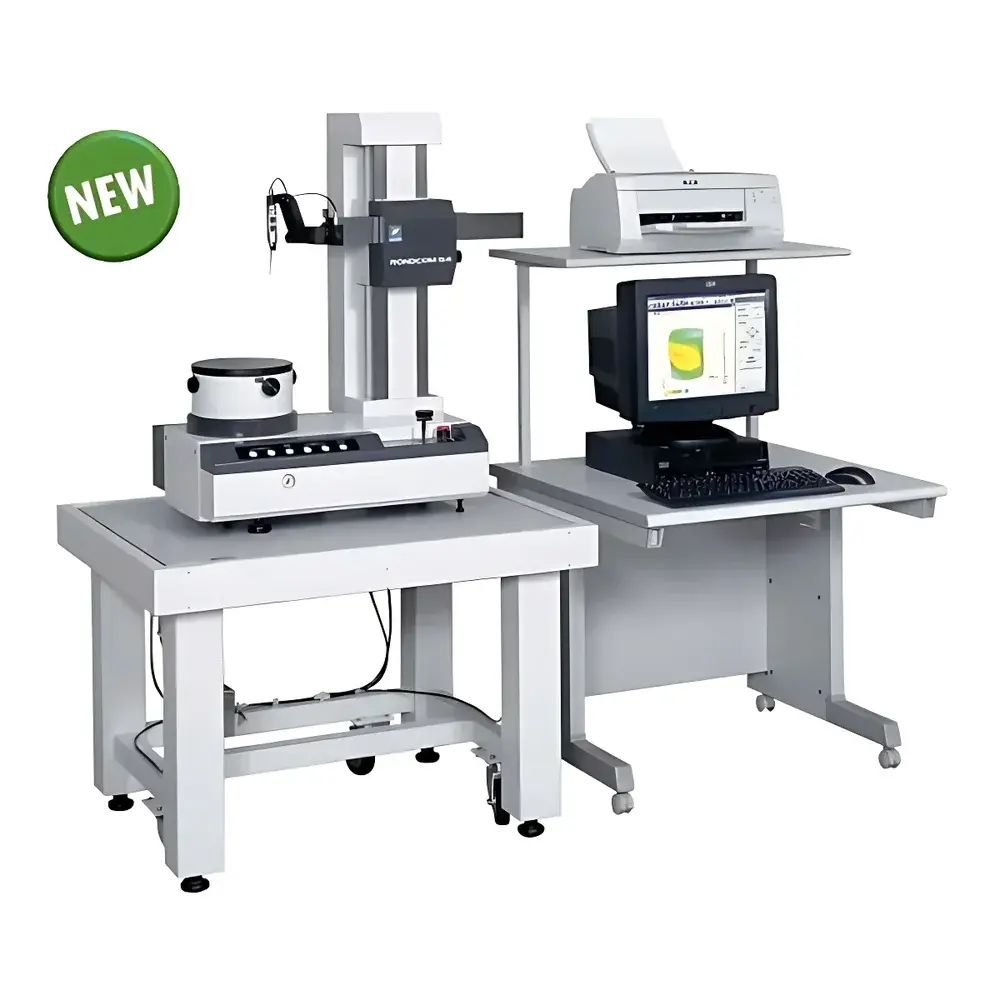
Accretech RONCOM 54 Precision Roundness and Cylindricity Measuring Instrument
| Brand | Accretech (Tokyo Seimitsu) |
|---|---|
| Origin | Japan |
| Model | RONCOM 54 |
| Measurement Range | Max. Diameter Φ300 mm |
| Radial Travel (R-axis) | 170 mm |
| Vertical Travel (Z-axis) | 300 mm (500 mm with high column) |
| Max. Workpiece Diameter | Φ580 mm |
| Max. Height (OD) | 300 mm (500 mm with high column) |
| Spindle Accuracy (Rotational) | (0.02 + 4H/10000) µm per JIS B 7451-1997 (H = height from table to measurement point) |
| Axial Accuracy | (0.02 + 4H/10000) µm per JIS B 7451-1997 (H = distance from rotation center to probe point) |
| Z-axis Straightness | 0.12 µm/100 mm |
| R-axis Straightness | 0.8 µm/150 mm |
| Z-axis Parallelism | 0.8 µm/290 mm (1.18 µm/490 mm with high column) |
| R-axis Parallelism | 1.0 µm/150 mm |
| Radial Indication Accuracy | (2 + L/170) µm (L = measured length) |
| Rotation Speed (θ-axis) | 2–10 rpm (measurement) |
| Z-axis Traverse Speed | 0.5–6 mm/s (max 50 mm/s) |
| R-axis Traverse Speed | 0.5–6 mm/s (max 25 mm/s) |
| Auto-stop Positioning Accuracy | ±5 µm |
| Rotating Table Diameter | Φ220 mm |
| Centering/Tilt Adjustment Range | ±2 mm / ±1° |
| Max. Load Capacity | 30 kg |
| Stylus Force | 30–100 mN (adjustable) |
| Stylus Tip | Φ1.6 mm steel ball, 53 mm length |
| Data Points per Revolution | 14,400 |
| Digital Filter Types | Gaussian, 2RC, Multi-groove |
| Low-pass cutoffs | 15–1500 cycles/rev (rotational), 0.025–8 mm (axial) |
| Band-pass | 15–150, 15–500, 15–1500 cycles/rev (user-definable) |
| Measurement Range | ±1000 µm / ±200 µm |
| Evaluation Methods | MZC (Minimum Zone Circle), LSC (Least Squares Circle), MIC (Maximum Inscribed Circle), MCC (Minimum Circumscribed Circle), N.C. (No Correction), Multi (composite specification) |
| Measurable Parameters | Roundness, Flatness (single/multi-plane), Parallelism, Concentricity, Coaxiality, Cylindricity, Radial Runout, Perpendicularity, Thickness Variation, Total Runout, Radius Measurement, Partial Arc Analysis, Z-axis & R-axis Straightness, Axial Linearity, Cylindrical Surface Deviation |
| Analysis Functions | Auto-centering & auto-tilt correction, Groove profiling (vertical/angular/cursor-based), Combined roundness evaluation modes, Design nominal comparison, 3D cylindrical surface visualization (wireframe, shaded, contour), Real-time profile display, Profile-derived curves (bearing ratio curve, amplitude distribution, power spectral density), Wide-range assessment capability |
| Standard Features | Offset-type chuck holder included |
| Display | 17″ LCD showing measurement conditions, parameters, print settings, 2D/3D profiles, annotations, error logs |
| Output | Color or laser printer (SD card option for data export) |
| Power Supply | AC 220 V, 50–60 Hz ±10%, ~470 VA (excl. printer) |
| Pneumatic Supply | 0.35–0.7 MPa supply pressure |
| Dimensions (W×D×H)/Weight | DX type: 1500×925×1600 mm (1800 mm with column), 500 kg (510 kg) |
| SD type | 2050×900×1700 mm (1900 mm), 194 kg (204 kg) |
Overview
The Accretech RONCOM 54 is a high-precision, dual-axis roundness and cylindricity measuring instrument engineered for metrological-grade geometric analysis of rotationally symmetric components. Based on the proven kinematic architecture of Tokyo Seimitsu’s RONCOM platform, the R54 implements a high-stiffness air-bearing spindle combined with precision linear motion stages on both radial (R) and vertical (Z) axes. Its measurement principle relies on ultra-stable rotational sampling—where the workpiece rotates at controlled angular velocity while a high-resolution inductive probe traces its surface geometry—and orthogonal axial translation for full 3D surface reconstruction. Designed in strict compliance with JIS B 7451-1997 for roundness instrumentation, the system delivers traceable accuracy across a broad range of form tolerances, including roundness, cylindricity, coaxiality, parallelism, and perpendicularity. The R54 supports both manual and fully automated CNC-driven measurement routines, enabling repeatable, operator-independent inspection suitable for ISO/IEC 17025-accredited laboratories and production-integrated quality control environments.
Key Features
- High-fidelity air-bearing spindle with rotational accuracy of (0.02 + 4H/10,000) µm per JIS B 7451-1997—verified at multiple heights up to 500 mm.
- Dual linear axes (R and Z) featuring granite base construction, precision ground guideways, and closed-loop servo control for sub-micron positioning repeatability.
- 14,400 data points per revolution ensure high-resolution profile capture, critical for detecting fine-form deviations such as harmonic distortion or localized waviness.
- Multi-filter digital signal processing—including Gaussian, 2RC, and multi-groove filters—with user-selectable low-pass and band-pass cutoffs aligned to international standards (e.g., ISO 1101, ASME Y14.5).
- Comprehensive evaluation suite supporting MZC (minimum zone), LSC (least squares), MIC/MCC, and composite criteria—enabling direct comparison against GD&T specifications.
- Real-time 3D cylindrical surface rendering with wireframe, shaded, and contour overlays—facilitating intuitive defect localization and cross-sectional analysis.
- Integrated auto-centering and auto-tilt correction algorithms reduce setup dependency and improve measurement reproducibility across diverse part geometries.
- Offset-type chuck holder standard—optimized for thin-walled or asymmetric parts—while supporting optional CNC-enabled variants for unattended operation.
Sample Compatibility & Compliance
The RONCOM 54 accommodates workpieces up to Φ580 mm in diameter and 500 mm in height (with high-column configuration), with a maximum load capacity of 30 kg. Its adjustable centering/tilt stage (±2 mm / ±1°) enables stable mounting of irregular or non-coaxial components, including bearing races, hydraulic spools, turbine blades, and precision shafts. The system complies with JIS B 7451-1997 for roundness instrumentation and supports measurement reporting aligned with ISO 1101 (geometrical tolerancing), ISO 5436-1 (surface texture), and ASME B46.1. All evaluation algorithms are deterministic and fully documented, satisfying audit requirements under ISO/IEC 17025, FDA 21 CFR Part 11 (when paired with compliant software and electronic signature protocols), and GLP/GMP documentation workflows. Traceability is maintained via internal calibration routines and external verification using certified reference artifacts (e.g., NIST-traceable roundness standards).
Software & Data Management
The RONCOM 54 operates with Accretech’s proprietary RONCOM-View software, a Windows-based platform offering full measurement automation, parameter scripting, and report generation. It provides configurable data export formats—including CSV, PDF, and XML—for integration into enterprise MES/QMS systems. Audit trail functionality records all operator actions, parameter changes, and calibration events with timestamps and user IDs—supporting regulatory compliance in medical device, aerospace, and automotive Tier-1 supply chains. SD card logging enables offline data backup and secure transfer without network connectivity. Software modules include design nominal comparison with deviation color mapping, power spectral density (PSD) analysis for identifying machining-related harmonics, and bearing ratio curve (Abbott-Firestone) generation for functional surface characterization. Firmware updates are delivered via encrypted USB media to preserve system integrity.
Applications
The RONCOM 54 serves as a primary metrology tool in advanced manufacturing sectors requiring tight geometric control. Typical applications include: verification of turbine blade root runout and hub concentricity in aerospace propulsion systems; roundness and cylindricity validation of fuel injector nozzles and pump plungers in high-pressure diesel systems; GD&T compliance testing of surgical instrument shafts and orthopedic implant components; dimensional certification of optical lens mounts and semiconductor wafer chucks; and process capability studies (Cpk/Ppk) for grinding, honing, and turning operations. Its ability to perform partial-arc measurements and multi-plane flatness analysis also supports R&D tasks involving non-full-rotation components such as cam lobes or segmented gears.
FAQ
What standards does the RONCOM 54 comply with for roundness measurement?
The instrument conforms to JIS B 7451-1997 for spindle accuracy and supports evaluation methods aligned with ISO 1101, ISO 5436-1, and ASME Y14.5.
Can the R54 perform fully automated measurements without operator intervention?
Yes—when equipped with the optional CNC offset holder and programmed via RONCOM-View, it executes unattended sequences including loading simulation, auto-centering, multi-level scanning, and pass/fail reporting.
Is thermal drift compensated during extended measurement cycles?
While the R54 does not include active thermal compensation, its granite base and low-thermal-expansion materials minimize drift; environmental control (20 ± 1°C, <50% RH) is recommended per ISO 230-2 for metrological validity.
How is measurement uncertainty determined for a given setup?
Uncertainty budgets must be established per ISO/IEC Guide 98-3 (GUM), incorporating contributions from spindle error, probe hysteresis, stylus tip radius effect, filter selection, and environmental factors—Accretech provides application notes and calibration certificates to support this process.
Does the system support third-party software integration?
Raw profile data (X,Y,Z coordinates) and evaluation results are exportable in standardized formats; API access is restricted to OEM-certified partners under NDA for custom MES/QMS integration.