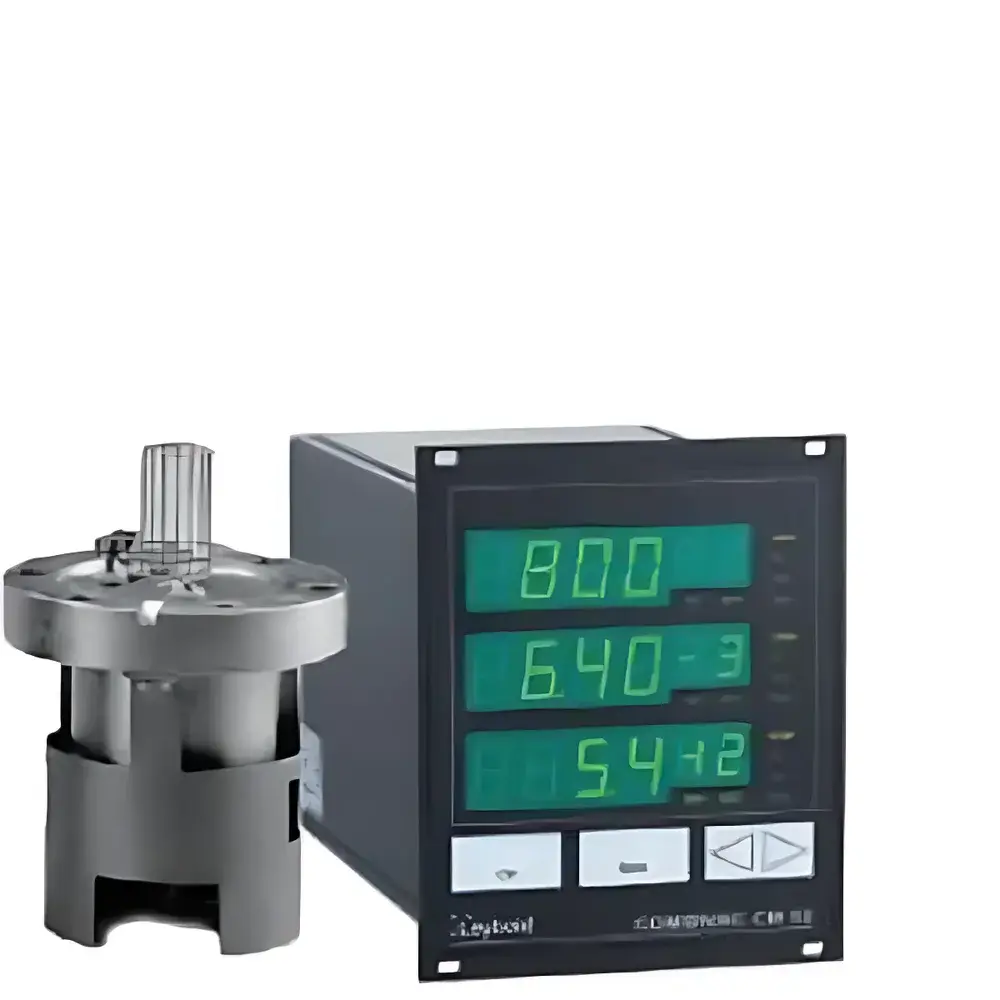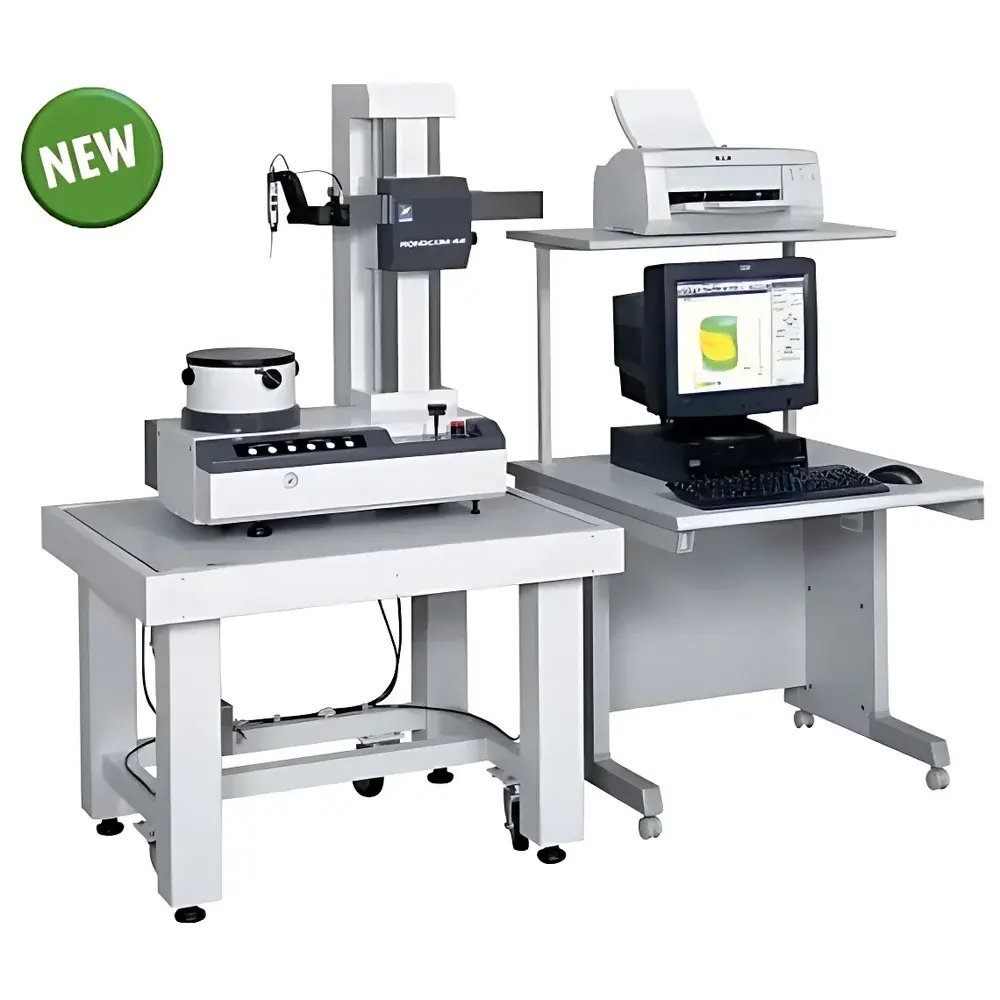
Accretech RONCOM 54 Precision Roundness and Cylindricity Measuring Instrument
| Brand | Accretech (Tokyo Seimitsu) |
|---|---|
| Origin | Japan |
| Model | RONCOM 54 |
| Maximum Measurable Diameter | Ø300 mm |
| Radial Travel (R-axis) | 170 mm |
| Vertical Travel (Z-axis) | 300 mm (500 mm with tall column) |
| Max. Workpiece Diameter | Ø580 mm |
| Max. Measurable Height | 300 mm (500 mm with tall column) |
| Spindle Accuracy (Rotational Axis) | (0.02 + 4H/10000) µm per JIS B 7451-1997 (H = height from table to measurement point) |
| Axial Accuracy | (0.02 + 4H/10000) µm per JIS B 7451-1997 (H = distance from rotation center to probe point) |
| Z-axis Straightness | 0.12 µm/100 mm |
| R-axis Straightness | 0.8 µm/150 mm |
| Z-axis Parallelism | 0.8 µm/290 mm (1.18 µm/490 mm with tall column) |
| R-axis Parallelism | 1.0 µm/150 mm |
| Radial Indication Accuracy | (2 + L/170) µm (L = measurement length in mm) |
| Rotation Speed (θ-axis) | 2–10 rpm during measurement |
| Z-axis Traverse Speed | 0.5–6 mm/s (max 50 mm/s) |
| R-axis Traverse Speed | 0.5–6 mm/s (max 25 mm/s) |
| Auto-Stop Positioning Accuracy | ±5 µm |
| Rotating Table Diameter | Ø220 mm |
| Centering & Tilt Adjustment Range | ±2 mm / ±1° |
| Max. Load Capacity | 30 kg |
| Stylus Force | 30–100 mN (adjustable) |
| Stylus Tip | Ø1.6 mm steel ball, 53 mm length |
| Data Points per Revolution | 14,400 |
| Digital Filter Types | Gaussian, 2RC, Multi-slot |
| Low-pass cutoffs | 15–1000 cycles/rev (rotational), 0.025–8 mm (axial) |
| Band-pass | 15–1500 cycles/rev |
| Measurement Range | ±1000 µm / ±200 µm |
| Evaluation Methods | MZC (Minimum Zone Circle), LSC (Least Squares Circle), MIC (Maximum Inscribed Circle), MCC (Minimum Circumscribed Circle), N.C. (No Correction), Multi (Composite Specification) |
| Measured Parameters | Roundness, Flatness (single/multi-plane), Parallelism, Concentricity, Coaxiality, Cylindricity, Radial Runout, Perpendicularity, Thickness Variation, Total Runout, Radius Measurement, Partial Arc Analysis, Z-axis & R-axis Straightness, Axial Linearity, Cylindrical Surface Deviation |
| Analysis Functions | Auto-centering & auto-tilt correction, Groove Detection (upper/lower limit, angular position, cursor-based), Combined roundness evaluation modes, Design Nominal Value Comparison, 3D Cylindricity Visualization (wireframe, shaded, contour), Real-time profile display, Profile Characterization (bearing ratio curve, amplitude distribution, power spectral density), Wide-range assessment capability, CNC-programmed automated measurement sequence |
| Standard Accessories | Offset-type chuck holder |
| Optional Upgrades | CNC-compatible offset chuck holder |
| Display | 17″ LCD monitor |
| Output | Color printer or laser printer (SD card optional) |
| Power Supply | AC 220 V, 50–60 Hz ±10%, ~470 VA (excl. printer) |
| Pneumatic Supply | 0.35–0.7 MPa supply pressure |
| consumption | 30 NL/min |
| Dimensions (W×D×H)/Weight | DX model: 1500×925×1600 mm (1800 mm with tall column), 500 kg (510 kg) |
| SD model | 2050×900×1700 mm (1900 mm), 194 kg (204 kg) |
Overview
The Accretech RONCOM 54 is a high-precision, dual-axis (R-Z-θ) geometric metrology system engineered for traceable roundness, cylindricity, and associated form error evaluation in regulated manufacturing and calibration laboratories. Operating on the principle of high-resolution stylus-based tactile profilometry synchronized with precision air-bearing spindle rotation and linear motion stages, the instrument captures radial displacement data at up to 14,400 points per revolution across both rotational and axial directions. Its mechanical architecture conforms to JIS B 7451-1997 metrological standards for rotary axis accuracy, with spindle error quantified as (0.02 + 4H/10,000) µm—where H denotes the vertical distance from the reference plane to the measurement point—ensuring consistent uncertainty propagation across varying workpiece heights. Designed for ISO/IEC 17025-compliant dimensional labs and GMP-aligned production environments, the RONCOM 54 supports full uncertainty budgeting per ISO/IEC Guide 98-3 (GUM) and integrates seamlessly into quality management systems requiring documented traceability to national standards (e.g., NIST, NPL, AIST).
Key Features
- Precision air-bearing rotating spindle with sub-micron radial and axial runout performance, validated per JIS B 7451-1997
- Dual linear axes (R and Z) equipped with high-stiffness granite base, preloaded linear guides, and closed-loop servo control for nanometer-level positioning repeatability
- Adjustable stylus force (30–100 mN) with Ø1.6 mm hardened steel spherical tip, enabling stable contact on soft metals, ceramics, and hardened steels without plastic deformation
- Configurable filter architecture supporting Gaussian, 2RC, and multi-slot digital filtering with user-defined cutoff frequencies for rotational (15–1500 cycles/rev) and axial (0.025–8 mm) domains
- Comprehensive evaluation suite compliant with ISO 1101, ISO 12181 (roundness), ISO 12180 (cylindricity), and ASME Y14.5M geometric dimensioning and tolerancing conventions
- CNC-driven automated measurement sequences with programmable dwell, speed ramping, and conditional branching for unattended operation
- Real-time 3D surface reconstruction engine rendering wireframe, shaded, and contour representations of cylindrical surfaces for visual defect localization
Sample Compatibility & Compliance
The RONCOM 54 accommodates workpieces up to Ø580 mm in diameter and 500 mm in height (with tall-column configuration), supporting weights up to 30 kg on its Ø220 mm rotating table. Its ±2 mm centering and ±1° tilt adjustment range enables rapid alignment of asymmetric or off-center components—including bearing races, hydraulic spools, turbine blades, and injection-molded housings—without requiring custom fixturing. All measurement algorithms and reporting outputs are fully compatible with ISO/IEC 17025 clause 7.8 (Reporting of Results) and support audit-ready documentation including measurement uncertainty statements, environmental condition logs (temperature, humidity, vibration), and full traceability to certified reference standards. The system meets electromagnetic compatibility requirements per IEC 61326-1 and safety compliance per IEC 61010-1.
Software & Data Management
The proprietary RONCOM software platform provides full GLP/GMP-aligned data integrity: all measurement sessions generate immutable audit trails recording operator ID, timestamp, environmental parameters, calibration status, and raw profile data (ASCII or binary). Software features include design nominal comparison with tolerance band visualization, statistical process control (SPC) chart export (X̄-R, Cp/Cpk), and native export to common formats (CSV, PDF, STEP AP214, IGES) for integration with PLM and MES systems. For regulated industries, optional 21 CFR Part 11 compliance packages provide electronic signature enforcement, role-based access control, and secure encrypted database storage. All firmware and software updates are digitally signed and version-controlled via Accretech’s authorized service portal.
Applications
The RONCOM 54 serves critical metrology functions across aerospace (turbine shaft roundness certification per SAE AMS2750), automotive (fuel injector nozzle concentricity verification per ISO 4287), medical device manufacturing (orthopedic implant cylindricity per ASTM F2118), and precision bearing production (raceway waviness analysis per ABEC standards). It is routinely deployed for incoming inspection of ground shafts, post-process validation of honed cylinders, failure analysis of out-of-spec rotating components, and calibration of secondary roundness standards used in metrology labs. Its ability to perform partial-arc analysis makes it suitable for evaluating cam lobes, gear teeth flanks, and non-360° machined features where full rotation is mechanically constrained.
FAQ
What standards does the RONCOM 54 comply with for roundness and cylindricity measurement?
It adheres to JIS B 7451-1997 for spindle accuracy verification and supports evaluation methods aligned with ISO 12181-1 (roundness), ISO 12180-1 (cylindricity), and ASME Y14.5-2018 for GD&T interpretation.
Can the system measure non-rotational parts such as flat plates or prismatic components?
Yes—the Z-axis and R-axis profiling capability enables planar flatness, parallelism, and straightness measurements independent of spindle rotation, provided the part fits within the working envelope.
Is remote diagnostics and firmware update supported?
Yes—via secured Ethernet connection and Accretech’s authorized service portal, with mandatory digital signature verification for all firmware revisions.
Does the system support third-party calibration certificate generation?
Yes—software includes configurable certificate templates compliant with ISO/IEC 17025 Annex A, with fields for accredited lab identification, uncertainty budgets, and traceable standard references.
What is the typical recalibration interval recommended for routine use?
Accretech recommends annual recalibration against certified master artifacts (e.g., hemispherical standards, precision cylinders) in accordance with ISO 10012, with interim verification using check standards performed daily or per shift.