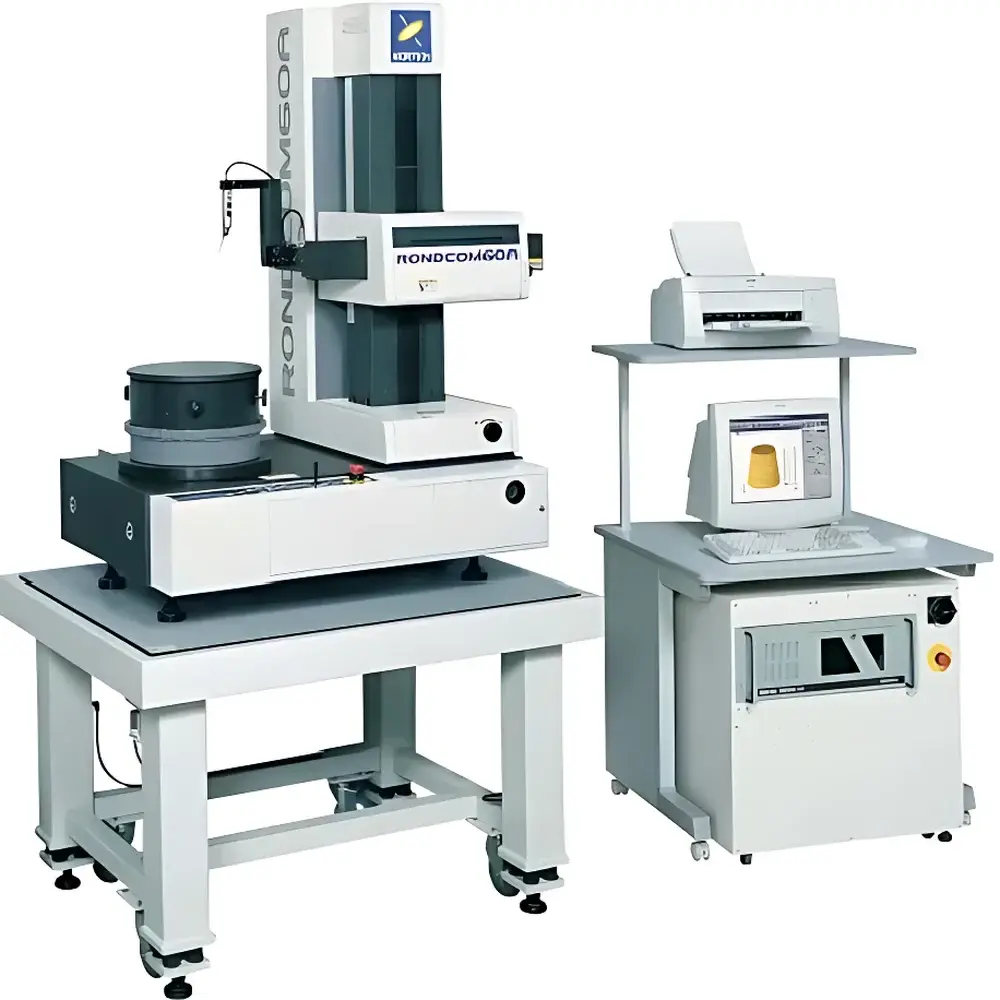
Accretech RONCOM 60A Roundness and Cylindricity Measuring Instrument
| Brand | Accretech (Tokyo Seimitsu) |
|---|---|
| Origin | Japan |
| Model | RONCOM 60A |
| Maximum Measurable Diameter | Ø420 mm |
| Radial (R-axis) Travel | 220 mm |
| Vertical (Z-axis) Travel | 500 mm |
| Maximum Workpiece Height (for roundness/coaxiality) | 700 mm |
| Maximum Workpiece Diameter | Ø680 mm |
| Spindle Accuracy per JIS B7451 | (0.020 + 6H/10000) mm (H = height in mm from turntable surface) |
| Digital Filter Options | 2RC/Gaussian (Rotational: 15–500 cyc/rev |
| Linear | 0.025–8 mm) |
| Probe Force | 70 mN |
| Spherical Tip | Ø1.6 mm Tungsten Carbide |
| Measurement Modes | Rotational (θ), Linear (Z), Combined Cylindricity |
| Software | Real-time Shape Display, Re-analysis of up to 40 Cross-sections, GD&T Compliant Reporting (ISO 1101, ASME Y14.5) |
Overview
The Accretech RONCOM 60A is a high-precision, air-bearing-based roundness and cylindricity measuring instrument engineered for metrology-grade evaluation of rotational symmetric components in production-critical environments. Designed and manufactured by Tokyo Seimitsu Co., Ltd. (now part of the ACCRETECH Group), this system implements a true kinematic separation of motion axes — with a frictionless air-bearing spindle (θ-axis), air-bearing radial arm (R-axis), and precision-ground granite vertical column (Z-axis) — to eliminate mechanical hysteresis, thermal drift, and wear-induced error sources. Its measurement principle relies on high-stability displacement sensing (LVDT or capacitive probe) referenced to a geometrically stable granite frame, enabling traceable, repeatable form analysis per ISO 5436-1 (Geometrical Product Specifications – Surface Texture: Profile Method) and JIS B7451 (Method of Testing Roundness Measuring Instruments). The RONCOM 60A is specifically calibrated and certified to meet CE marking requirements, ensuring compliance with EU Machinery Directive 2006/42/EC and Electromagnetic Compatibility (EMC) Directive 2014/30/EU — making it suitable for integration into regulated manufacturing cells requiring documented safety and environmental robustness.
Key Features
- Air-bearing spindle and R-axis deliver sub-micron rotational stability and zero-contact radial guidance, minimizing Abbe error and enabling long-term repeatability without lubrication or maintenance.
- Monolithic granite base, column, and R-axis structure ensure dimensional stability across temperature fluctuations and suppress vibration coupling — critical for shop-floor deployment near CNC machining centers.
- Integrated diameter measurement capability via high-resolution linear scale on the R-axis, supporting simultaneous roundness and diametral deviation assessment (requires optional calibration standard).
- CNC-controlled multi-section measurement: fully automated centering, leveling, probing, and data acquisition across up to 40 user-defined axial sections — including synchronized θ-Z scanning for full 3D cylindricity reconstruction.
- Post-measurement re-analysis engine allows re-evaluation of stored datasets under altered reference axes (e.g., least-squares vs. minimum-zone), filter settings, or GD&T datums — eliminating need for physical remeasurement.
- Real-time graphical display of polar plots, unwrapped profiles, 3D surface maps, and GD&T-compliant deviation overlays on a 15-inch high-resolution color monitor.
Sample Compatibility & Compliance
The RONCOM 60A accommodates workpieces up to Ø680 mm in diameter and 700 mm in height (for coaxiality evaluation), with a maximum load capacity of 60 kg. Its modular fixturing supports cylindrical, disc-shaped, and stepped components common in automotive powertrain systems (e.g., fuel injector nozzles, piston pins, camshafts), precision bearings (ball, roller, fluid film), and rotating media substrates (magnetic drums, optical encoder rings). All measurement algorithms adhere to ISO 1101 for geometrical tolerancing definitions and support MZC, LSC, MIC, and MCC centering methods per ISO 12181-1. The system’s hardware architecture and firmware are designed to support audit-ready operation under GLP and GMP frameworks, with optional software modules providing 21 CFR Part 11-compliant electronic signatures, audit trails, and user-access controls.
Software & Data Management
The embedded metrology software provides native support for ISO/IEC 17025-aligned reporting, generating inspection certificates with traceable uncertainty statements, calibration history linkage, and operator metadata. Measurement data is stored in vendor-neutral ASCII or XML formats, compatible with third-party SPC platforms (e.g., Minitab, InfinityQS) and PLM systems (Teamcenter, Windchill). Filter configuration follows ISO 16610-21 (Gaussian) and -28 (2RC) standards, with selectable cutoff wavelengths ranging from 15 to 500 cycles/revolution (rotational) and 0.025 to 8 mm (linear). Export options include vector-based PDF reports, bitmap image sequences, and CSV-formatted coordinate point clouds for reverse engineering or FEA input.
Applications
- Production-line verification of roundness, cylindricity, concentricity, and runout in high-volume machining cells for engine blocks, transmission gears, and hydraulic valve bodies.
- R&D validation of ultra-precision bearing races, where surface form deviations directly impact fatigue life and noise performance.
- Qualification of non-contact rotating components such as magnetic storage drums, where surface waviness and harmonic distortion must remain below 0.01 µm PV.
- First-article inspection and PPAP documentation for aerospace actuators and medical device shafts requiring AS9102 or ISO 13485 compliance.
- Calibration laboratory use as a reference standard for verifying lower-tier roundness gauges per ISO/IEC 17025 clause 6.5.2.
FAQ
What standards does the RONCOM 60A comply with for roundness measurement accuracy?
It conforms to JIS B7451 for spindle error specification and implements evaluation methods aligned with ISO 12181-1 (roundness) and ISO 12180-1 (cylindricity), with full traceability to NMIJ (National Metrology Institute of Japan) calibration protocols.
Is diameter measurement performed simultaneously with roundness data acquisition?
Yes — the R-axis incorporates a high-resolution linear encoder, enabling concurrent radial position tracking and diameter calculation during rotation; however, a certified calibration artifact is required for traceable diameter results.
Can measurement data be reprocessed after initial acquisition?
Yes — the system stores raw point-cloud data for up to 40 cross-sections, allowing post-hoc re-filtering, datum redefinition, and alternative centering method application without re-scanning the part.
What is the typical warm-up time before achieving specified measurement stability?
A 30-minute thermal stabilization period is recommended after power-on to allow granite mass equilibration and air-bearing pressure settling, particularly in ambient environments with ±2°C/h fluctuation.
Does the system support automated pass/fail decision logic based on GD&T tolerances?
Yes — tolerance limits can be pre-loaded per feature, with real-time deviation coloring and automated report flagging for out-of-spec conditions, configurable per ISO 1101 tolerance frame syntax.