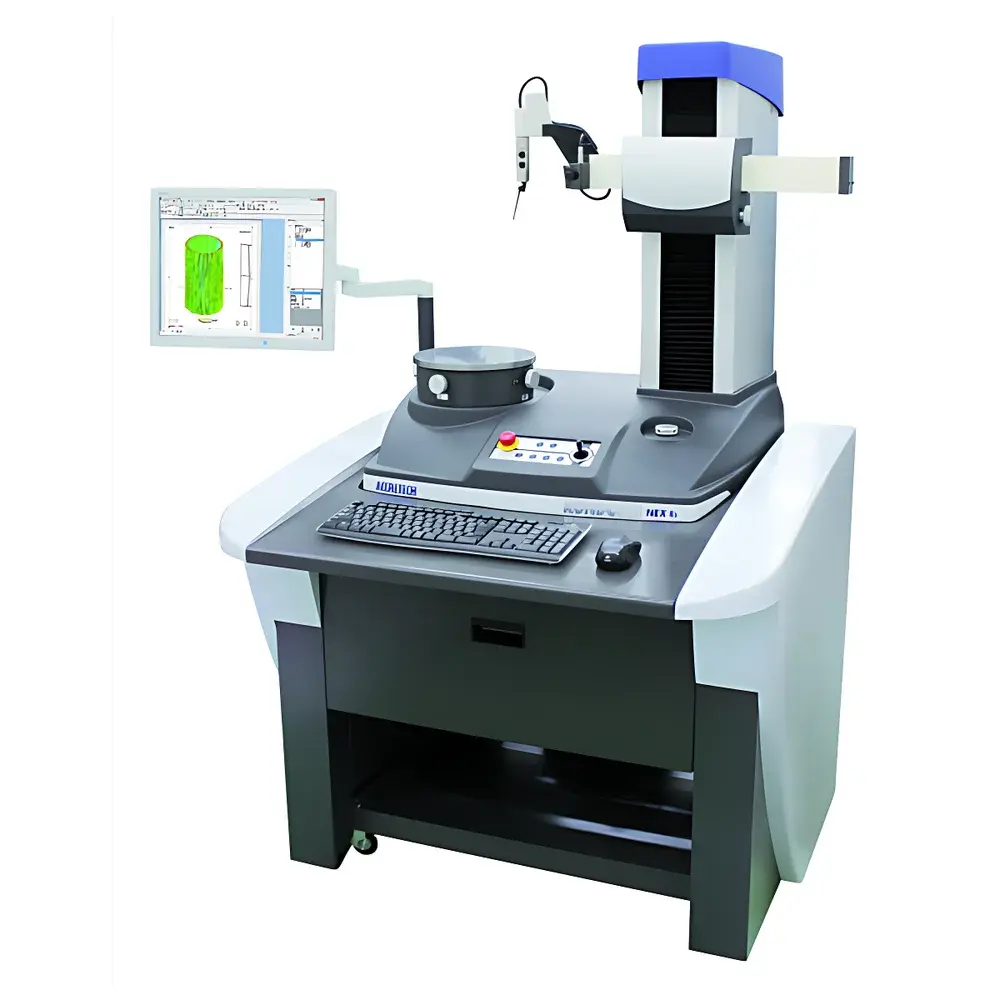
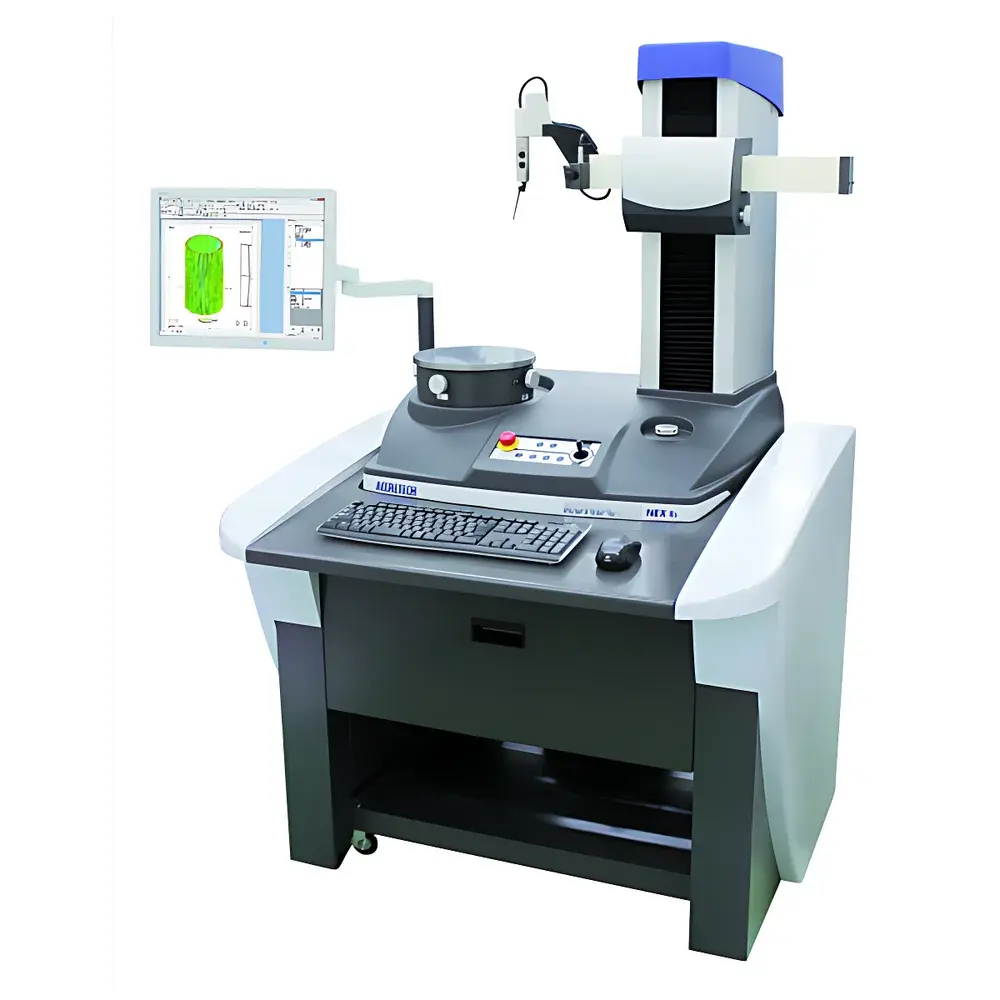
Accretech RONDCOM 60A Precision Roundness and Cylindricity Measuring System
| Brand | Accretech |
|---|---|
| Origin | Japan |
| Model | RONDCOM 60A |
| Measurement Projects | Roundness, Cylindricity, Straightness (axial & radial), Parallelism, Perpendicularity, Coaxiality, Concentricity, Taper, Diameter, Radial Runout, Total Radial Runout, Generatrix Straightness of Cylinders, Face Straightness, Face Runout, Flatness, Wall Thickness Variation, Angular Deviation, Short Arc Radius, Piston Profile Analysis |
| Structural Materials | Granite Base, Column & R-Axis Carriage |
| Bearing Technology | Air Bearings on Z- and R-Axes |
| Motion Control | CNC Programmable Axes (θ, Z, R) |
| Diameter Measurement | Integrated R-Axis Linear Scale (requires optional calibration standard) |
| Data Reanalysis | Up to 40 Cross-Sections with Recalculation under Modified Reference Axis or Filtering Conditions |
| Compliance | CE Marked, Designed for In-Line Production Metrology Environments |
| Applications | Precision Inspection of Engine Components (pistons, fuel injectors), Rolling Element Bearings (ball, fluid, magnetic drums), Aerospace Turbine Parts, and High-Tolerance Machined Surfaces |
Overview
The Accretech RONDCOM 60A is a high-precision, air-bearing-based roundness and cylindricity measuring system engineered for metrological-grade geometric evaluation in demanding production and quality assurance environments. Utilizing a dual-axis air-bearing architecture—on both the vertical (Z) axis and radial (R) axis—the instrument eliminates mechanical friction, ensuring long-term stability, minimal hysteresis, and exceptional repeatability across thermal and operational cycles. Its granite base, column, and R-axis carriage provide inherent dimensional stability and resistance to creep or aging-related drift—critical for compliance with ISO 1101, ASME Y14.5, and JIS B 7451 geometric tolerance standards. The system operates on the principle of high-resolution angular displacement sensing (θ-axis) combined with precisely synchronized linear position feedback (Z and R axes), enabling full 3D surface deviation mapping of rotationally symmetric parts. Designed explicitly for line-side deployment, it meets CE safety and electromagnetic compatibility requirements while supporting rigorous traceability protocols required under ISO/IEC 17025-accredited laboratories.
Key Features
- Air-bearing Z- and R-axes delivering sub-micron motion fidelity and zero-contact wear over extended service life
- Integrated R-axis linear scale for simultaneous diameter measurement during roundness evaluation (calibration standard sold separately)
- CNC-controlled multi-section scanning: automated centering, leveling, multi-plane acquisition, and report generation per ISO 10360-4
- Post-measurement reanalysis engine supporting up to 40 cross-sectional profiles; enables iterative reference axis selection (least-squares, minimum zone, maximum inscribed, minimum circumscribed) and filter parameter adjustment without re-scanning
- Granite structural platform ensuring thermal inertia, vibration damping, and long-term geometric integrity
- Dual-directional filtering: configurable digital Gaussian or 2RC filters for rotational (15–500 cyc/rev) and axial (0.025–8 mm cutoff) domains
- Real-time graphical display of polar plots, unfolded profiles, 3D surface maps, and GD&T-compliant deviation overlays
Sample Compatibility & Compliance
The RONDCOM 60A accommodates workpieces up to Ø680 mm in diameter and 700 mm in height (for coaxiality measurement), with a maximum load capacity of 60 kg. It supports both external and internal geometry evaluation—including bore surfaces, stepped shafts, tapered rollers, and complex piston crown profiles—using interchangeable stylus configurations (standard 1.6 mm tungsten carbide sphere, optional custom tips). The system complies with JIS B 7451:1997 for rotary accuracy (0.020 + 6H/10000 µm), ISO 230-2 for linear axis straightness (0.1 µm/100 mm Z-axis, 0.5 µm/200 mm R-axis), and EN 61326-1 for EMC in industrial settings. All measurement data logs include timestamped audit trails, operator ID, environmental condition tags (optional sensor integration), and full GD&T parameter metadata—supporting FDA 21 CFR Part 11 electronic record requirements when paired with validated software configuration.
Software & Data Management
Equipped with Accretech’s proprietary RONDAC software suite, the RONDCOM 60A provides full GD&T evaluation per ISO 1101 and ASME Y14.5, including composite controls, datum feature simulation, and profile tolerancing. Measurement programs are stored as encrypted XML files with version control and user-access permissions. Raw point-cloud data (θ, Z, R) is exportable in ASCII, CSV, or STEP AP214 format for third-party CAE integration. The software includes built-in statistical process control (SPC) modules compliant with AIAG SPC-2, automatic out-of-tolerance flagging, and customizable inspection report templates aligned with IATF 16949 PPAP requirements. Audit logs record every parameter change, calibration event, and result export—enabling full GLP/GMP traceability.
Applications
The RONDCOM 60A serves critical metrology functions across automotive powertrain manufacturing (piston ring grooves, fuel injector nozzles, camshaft lobes), bearing industry QA (ball groove roundness, raceway cylindricity, cage runout), precision hydraulics (spool valve concentricity), and medical device component verification (orthopedic implant stems, dental abutment tapers). Its non-contact capability—via optional capacitive or eddy-current probes—extends usability to delicate surfaces such as magnetic drum substrates and thin-walled aluminum housings. The system is routinely deployed in Tier-1 supplier labs conducting AIAG Core Tools validation and OEM-approved first-article inspections.
FAQ
Does the RONDCOM 60A support automated calibration routines?
Yes—it includes programmable auto-centering (±5 mm range) and auto-leveling (±10 arcmin tilt compensation), with optional motorized worktable for full CNC alignment sequences.
Is diameter measurement traceable to national standards?
Diameter functionality requires an NIST-traceable calibration artifact (sold separately); the R-axis scale itself is certified to ±(2 + L/220) µm per JIS B 7451 Annex B.
Can measurement data be integrated into enterprise MES or QMS platforms?
Yes—via OPC UA server interface or direct SQL database export; all GD&T results include ISO 10303-21 (STEP) metadata for unambiguous interpretation.
What environmental conditions are recommended for optimal performance?
Controlled lab environment: 20 ± 1 °C, <50% RH, vibration isolation per ISO 25378 Class 2, and stable AC supply with surge suppression.
Is the system compatible with ISO/IEC 17025 accreditation documentation requirements?
Yes—the software generates full uncertainty budgets per GUM (JCGM 100), including contributions from thermal expansion, stylus tip radius error, and axis orthogonality deviations.