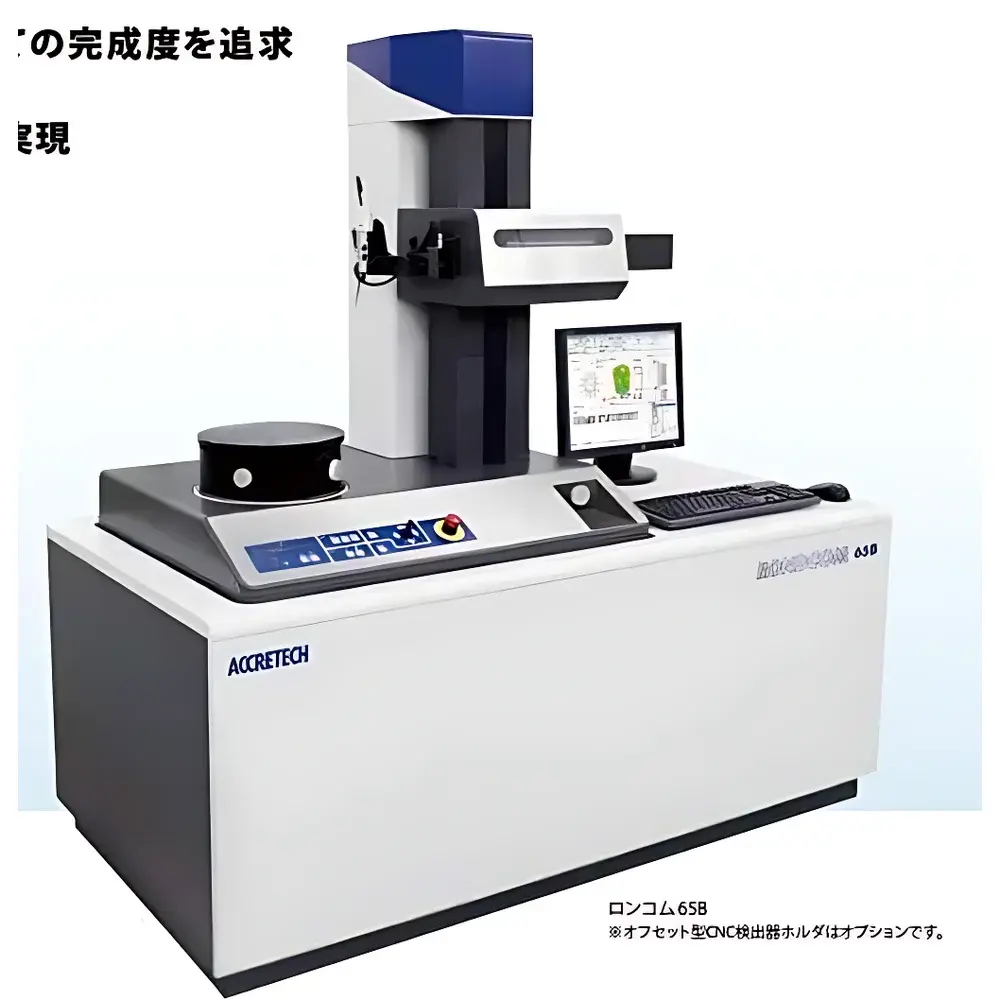
ACCRETECH Rondcom 65B High-Precision Roundness and Cylindricity Measuring Instrument
| Brand | ACCRETECH |
|---|---|
| Origin | Switzerland |
| Manufacturer Type | Authorized Distributor |
| Category | Imported Precision Geometric Measurement Instrument |
| Model | Rondcom 65B |
| Measurement Capabilities | Roundness, Cylindricity, Straightness (axial & radial), Parallelism, Perpendicularity, Coaxiality, Concentricity, Taper, Diameter, Radial Runout, Total Radial Runout, Generatrix Straightness of Cylinders, Face Straightness, Face Runout, Flatness, Wall Thickness Variation, Angular Deviation, Short Arc Evaluation, Piston Profile Analysis |
| Spindle Accuracy | (0.01 + 4H/10000) µm (radial, per JIS B 7451:1997) |
| Bearing Type | Air-bearing Spindle |
| Max. External Diameter | 420 mm |
| Rotational Speed | 2–10 rpm (up to 20 rpm during rapid positioning) |
Overview
The ACCRETECH Rondcom 65B is a high-precision, air-bearing roundness and cylindricity measuring instrument engineered for metrological-grade evaluation of rotational symmetry and geometric form deviations in precision-engineered components. Operating on the principle of ultra-stable axis-of-rotation referencing, the system utilizes a kinematically constrained air-bearing spindle to establish a nanoscale reference axis—enabling traceable, repeatable assessment of form errors per ISO 1101, ISO 12181 (roundness), ISO 12180 (cylindricity), and JIS B 7451:1997. Designed for integration into certified quality laboratories and advanced manufacturing cells, the Rondcom 65B delivers sub-micron angular and axial metrology stability under controlled environmental conditions (20 ± 1°C, <50% RH). Its granite-based structural architecture minimizes thermal drift and mechanical hysteresis, ensuring long-term measurement integrity across extended calibration cycles.
Key Features
- Air-bearing spindle with radial accuracy of (0.01 + 4H/10000) µm (H = height from table in mm), compliant with JIS B 7451:1997 and aligned with ISO 230-7 for rotary axis performance verification.
- Granite base and column construction providing exceptional rigidity and vibration damping—critical for low-noise signal acquisition during high-resolution profilometry.
- Motorized Z-axis (500 mm travel) and R-axis (220 mm radial stroke) with programmable feed rates (0.6–6 mm/s), enabling automated multi-section scanning of complex cylindrical geometries.
- Adjustable turntable with ±5 mm centering range and ±1° tilt capability, supporting precise alignment of off-center or inclined features without manual re-fixturing.
- Digital filtering suite including Gaussian, 2RC, spline, and proprietary “009” filters—configurable per ISO 16610-21 and ASME B46.1 standards for separation of roughness, waviness, and form components.
- Multi-algorithm form evaluation engine supporting MZC (Minimum Zone Center), LSC (Least Squares Center), MIC (Maximum Inscribed Circle), MCC (Minimum Circumscribed Circle), and N.C. (No Correction) methods—fully traceable to NIST SP 1250-1 and ISO 1101 Annex D.
Sample Compatibility & Compliance
The Rondcom 65B accommodates workpieces up to Ø420 mm in diameter and 780 mm in height, with maximum load capacity of 60 kg. It supports contact measurement using stylus probes with selectable tip radii (standard φ1.6 mm, 53 mm length) and adjustable measuring force (30–100 mN, continuously variable). Compliance extends to international regulatory frameworks including FDA 21 CFR Part 11 (with optional audit trail and electronic signature modules), ISO/IEC 17025:2017 (for accredited calibration labs), and automotive OEM requirements (e.g., VDA 5, AIAG CQI-11). All measurement data are generated in accordance with GLP/GMP documentation protocols, with full metadata logging—including environmental sensor inputs (temperature, humidity, air pressure)—to support formal validation reports.
Software & Data Management
Equipped with ACCRETECH’s proprietary Rondcom OS v5.x, the system provides real-time shape visualization (unwrapped polar plots, 3D surface rendering, contour maps, amplitude distribution histograms, and power spectral density analysis). CNC programming supports parametric routines for batch inspection of families of parts, with automatic centering, tilt compensation, and feature-based alignment. Raw profile data are stored in ASCII and XML formats compliant with ISO 230-10 and STEP AP242, enabling seamless import into third-party GD&T analysis platforms (e.g., PolyWorks, Q-DAS, Metrolog X4). Optional networked deployment allows centralized database archiving, role-based user access control, and integration with MES/QMS systems via OPC UA or RESTful API interfaces.
Applications
The Rondcom 65B serves critical metrology functions across aerospace (turbine shafts, bearing races), medical device manufacturing (orthopedic implants, stent mandrels), precision hydraulics (valve spools, pump cylinders), and automotive powertrain (crankshafts, camshafts, piston pins). Its ability to quantify taper, generatrix straightness, face runout, and wall thickness variation makes it indispensable for validating tight-tolerance cylindrical components where functional performance depends on form fidelity—not just dimensional conformance. The system is routinely deployed in supplier certification audits for Tier-1 OEMs requiring full geometric tolerance stack-up verification per ASME Y14.5–2018 and ISO GPS standards.
FAQ
What standards does the Rondcom 65B comply with for roundness and cylindricity evaluation?
It conforms to ISO 12181-1 (roundness), ISO 12180-1 (cylindricity), JIS B 7451:1997, and ANSI/ASME B89.3.4M, with traceability to national metrology institutes via factory calibration certificates.
Can the system perform automated GD&T reporting per ASME Y14.5?
Yes—through integrated GD&T evaluation modules and customizable report templates supporting true position, profile of a surface, and orientation controls.
Is air supply conditioning required for stable operation?
Yes—a clean, dry, oil-free compressed air source (0.4 MPa operating pressure, 0.5–0.7 MPa supply) with ISO 8573-1 Class 2:2:2 filtration is mandatory to maintain air-bearing integrity and measurement repeatability.
Does the system support multi-sensor integration (e.g., optical probes)?
Standard configuration uses tactile probing; non-contact options (e.g., laser displacement sensors) are available as factory-installed upgrades subject to mechanical interface compatibility and metrological validation.
What is the recommended calibration interval under ISO/IEC 17025 conditions?
Annual calibration is advised, supplemented by daily verification using certified master artifacts (e.g., hemispherical standards, precision cylinders) per ISO 17025 Clause 7.7.