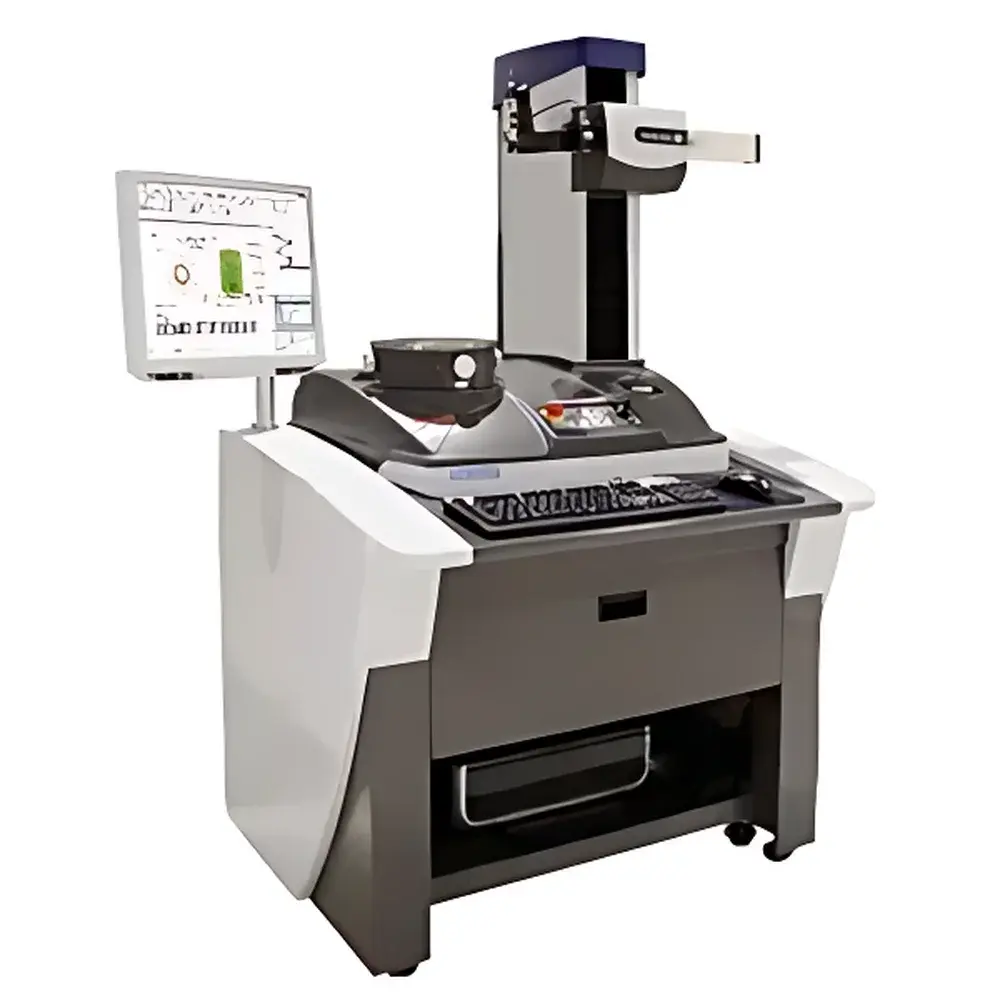
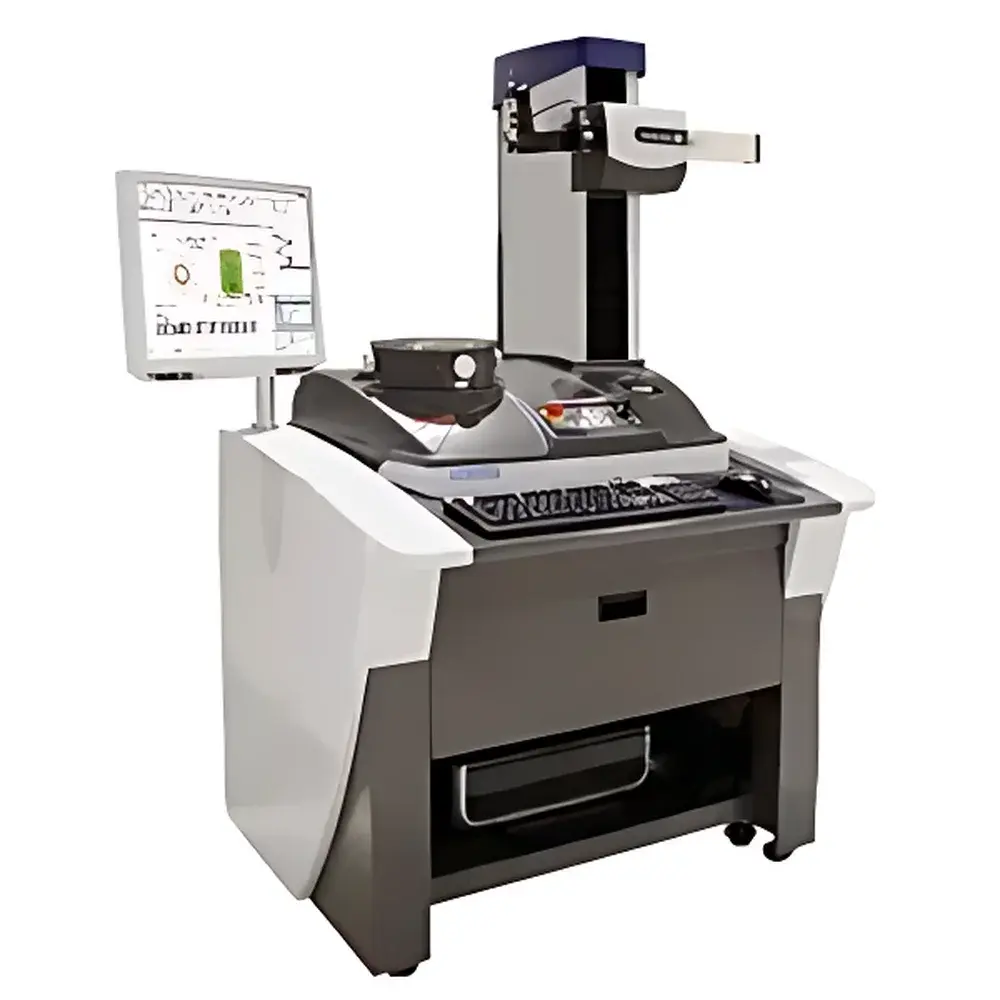
ACCRETECH RONDCOM NEX CNC Rotational Roundness and Cylindricity Measuring System
| Brand | ACCRETECH |
|---|---|
| Origin | Japan |
| Model | NEX |
| Measurement Range (Max. Diameter) | Φ300 mm |
| Max. Height | 500 mm |
| Spindle Radial Accuracy | (0.02 + 3.2H/10000) µm (per JIS B 7451-1997) |
| Z-axis Straightness | 0.23 µm/500 mm |
| R-axis Straightness | 0.7 µm/180 mm |
| Table Load Capacity | 30 kg |
| Table Diameter | Φ235 mm |
| Rotational Speed (θ-axis) | 1–10 rpm |
| Z/R-axis Traverse Speed | 0.5–10 mm/s |
Overview
The ACCRETECH RONDCOM NEX is a high-precision, CNC-controlled rotational roundness and cylindricity measuring system engineered for metrology laboratories and advanced manufacturing quality control environments. Designed and manufactured in Japan by Tokyo Seimitsu Co., Ltd., the NEX platform implements a precision air-bearing rotary table architecture combined with high-resolution linear displacement sensors and thermally stable granite base construction. Its measurement principle relies on synchronous multi-axis motion control—where the workpiece rotates on a master spindle while a tactile probe traces surface deviations in radial (R), axial (Z), and angular (θ) coordinates—enabling traceable, ISO/IEC 17025-compatible evaluation of geometric form errors including roundness, cylindricity, straightness, parallelism, concentricity, runout, and profile of a line/surface. The system complies with JIS B 7451-1997 for spindle accuracy verification and supports calibration traceability to national metrology institutes via certified reference artifacts.
Key Features
- Precision air-bearing spindle with radial accuracy of (0.02 + 3.2H/10,000) µm—verified per JIS B 7451-1997—ensuring sub-micron repeatability across full height range up to 500 mm.
- Integrated R-axis surface-following function enabling high-fidelity Z-direction straightness measurement even on steeply tapered or conical geometries exceeding conventional sensor stroke limits.
- Dual-diameter measurement mode for simultaneous high-accuracy evaluation of internal and external diameters using calibrated probe reversal and thermal drift compensation algorithms.
- Spiral scanning trajectory capability for comprehensive cylindricity assessment—capturing full 3D surface deviation data without interpolation gaps—critical for bearing races, hydraulic spools, and precision shafts.
- Modular column configuration (DX/SD variants) supporting extended vertical travel (up to 500 mm) and large-part handling (max. part diameter Φ580 mm, weight ≤30 kg).
- Real-time motion synchronization between θ, Z, and R axes with programmable feed rates (Z/R: 0.5–10 mm/s; θ: 1–10 rpm), optimized for both rapid setup and metrologically rigorous slow-scan acquisition.
Sample Compatibility & Compliance
The RONDCOM NEX accommodates rotationally symmetric components common in aerospace, automotive powertrain, medical device, and precision bearing industries—including turbine blades, piston pins, valve guides, ceramic liners, and injection-molded optical housings. Its Φ235 mm air-bearing table and 30 kg load capacity support fixtures for chucks, collets, and custom kinematic mounts. All measurement algorithms adhere to ISO 1101 (Geometrical Product Specifications), ISO 12181 (Roundness), and ISO 12180 (Cylindricity), with built-in filtering per Gaussian, 2CR, or phase-corrected filters as specified in ISO 16610-21. The system is compatible with GLP/GMP documentation workflows and supports audit-ready reporting compliant with FDA 21 CFR Part 11 when integrated with validated software modules.
Software & Data Management
The proprietary RONDCOM Navigator software provides full GUI-based CNC programming, real-time deviation visualization, automated GD&T evaluation, and customizable report generation (PDF, CSV, XML). It features embedded statistical process control (SPC) tools, multi-part comparison overlays, and batch measurement scripting. Raw point-cloud data is stored in vendor-neutral ASCII format with metadata headers containing environmental conditions (temperature, humidity), calibration timestamps, operator ID, and instrument configuration. Software validation documentation—including IQ/OQ protocols and change control logs—is available for regulated environments. Data export interfaces support integration with MES and PLM systems via OPC UA or RESTful API extensions.
Applications
- Validation of cylindrical grinding and honing processes for engine cylinder bores and hydraulic cylinders.
- Form error analysis of ball screw shafts and lead screws used in semiconductor lithography stages.
- Conformance testing of orthopedic implant stems per ASTM F2714 and ISO 14630.
- Root cause analysis of vibration-induced wear patterns in turbocharger rotors via harmonic decomposition (up to 50th order).
- Verification of additive-manufactured metal parts where layer-wise build geometry affects roundness symmetry.
- Calibration of reference standards for national metrology labs requiring uncertainty budgets below 0.05 µm (k=2).
FAQ
What international standards does the RONDCOM NEX comply with for roundness and cylindricity evaluation?
It conforms to ISO 12181-1 (roundness), ISO 12180-1 (cylindricity), JIS B 7451-1997 (spindle accuracy), and ISO 1101 (GD&T tolerancing), with filter settings aligned to ISO 16610-21.
Can the system measure non-circular profiles such as cam lobes or elliptical bores?
Yes—using user-defined polar coordinate templates and harmonic analysis, it supports non-rotational symmetry evaluation within its Z-R-θ measurement envelope.
Is thermal drift compensation available during long-duration measurements?
Yes—the system integrates dual-point temperature monitoring (spindle housing and granite base) with real-time correction of axis position data based on material-specific CTE models.
Does the NEX support automated pass/fail decision logic based on tolerance zones?
Yes—Navigator software allows definition of composite GD&T callouts with hierarchical tolerance stacks and automatic flagging of violations with annotated deviation maps.
What maintenance intervals are recommended for the air-bearing spindle?
Annual preventive maintenance is advised, including compressed dry air filtration verification, bearing gap inspection, and recalibration against traceable step gauges and hemispherical artifacts.