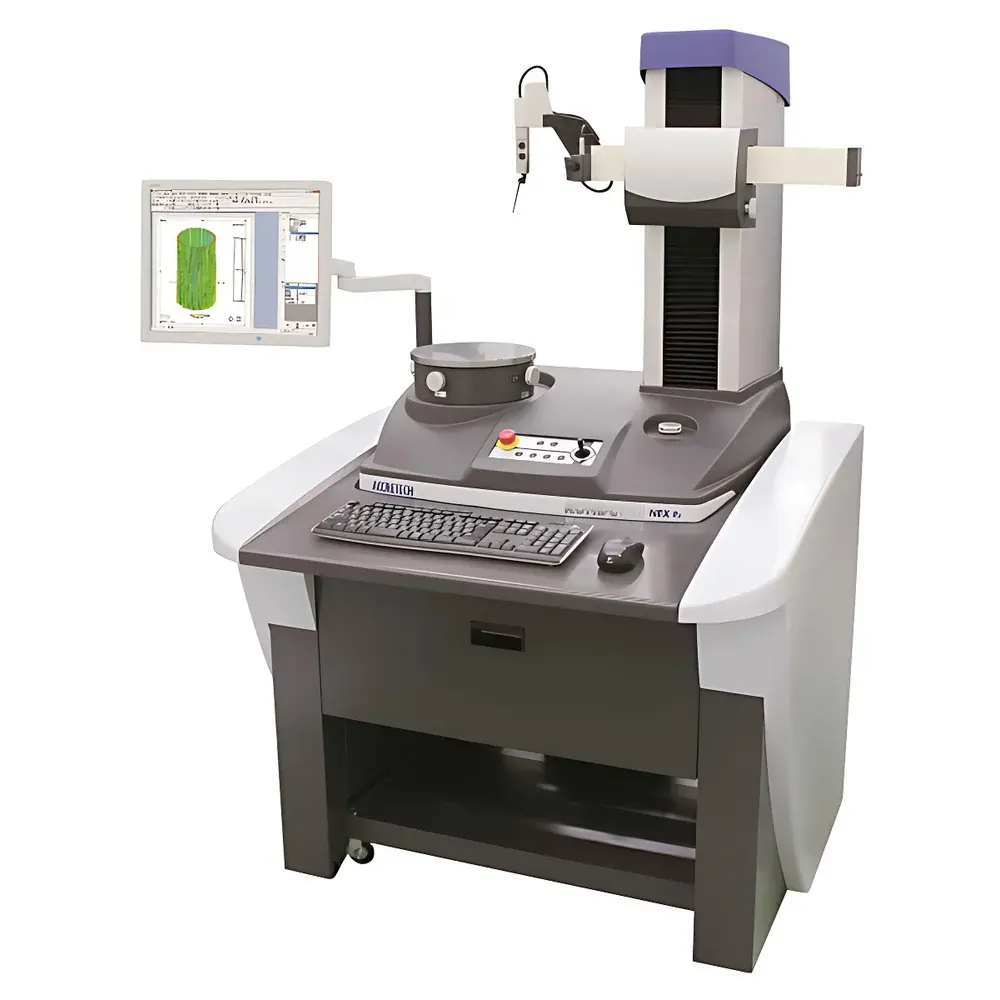
Accretech RONDCOM NEX Roundness and Cylindricity Measuring Instrument
| Brand | Accretech |
|---|---|
| Origin | Japan |
| Model | RONDCOM NEX |
| Measurement Capabilities | Roundness, Cylindricity, Straightness (axis & surface), Parallelism, Perpendicularity, Coaxiality, Concentricity, Taper, Diameter, Radial Runout, Total Radial Runout, Straightness of Cylindrical Generatrix, Face Straightness, Face Runout, Flatness, Wall Thickness Variation, Angular Deviation, Small-Arc Radius, Piston Profile Geometry |
| Compliance | ISO 1101, ISO 12181, ISO 12180, ASME Y14.5, JIS B 0621 |
Overview
The Accretech RONDCOM NEX is a high-precision, motorized roundness and cylindricity measuring instrument engineered for metrological-grade geometric error evaluation of rotationally symmetric parts. Utilizing a precision air-bearing rotary table and a vertically aligned, high-resolution linear displacement sensor mounted on a thermally stable granite column, the system operates on the principle of axis-of-rotation referencing—where the workpiece is rotated about its own central axis while the stylus traces radial deviations in multiple cross-sections. This enables traceable, repeatable quantification of form errors per international standards including ISO 12180 (cylindricity), ISO 12181 (roundness), and ISO 1101 (geometrical tolerancing). Designed for integration into regulated manufacturing environments—including automotive powertrain, aerospace turbine components, and precision hydraulic systems—the RONDCOM NEX delivers sub-micron resolution and long-term stability essential for first-article inspection, process capability studies (Cp/Cpk), and GD&T validation.
Key Features
- Precision air-bearing main spindle with angular repeatability better than ±0.05 arcsec and radial runout < 0.02 µm, ensuring minimal kinematic error during high-speed rotation (up to 10 rpm).
- Dual-axis CNC-controlled sensor carriage featuring R-axis (radial) tracking capability, enabling real-time compensation for taper or conical geometry during continuous scanning—critical for evaluating tapered shafts, bearing races, and sealing surfaces.
- Offset-type CNC sensor holder accommodates probes with varying overhang lengths and tip angles, supporting both contact (diamond stylus) and non-contact (capacitive or optical) sensing configurations without mechanical reconfiguration.
- Integrated multi-section measurement mode: simultaneous acquisition of up to 16 axial sections per rotation, with synchronized Z-axis positioning for full 3D cylindrical form reconstruction.
- Thermal drift compensation via embedded temperature sensors and granite base structure, minimizing environmental influence on dimensional stability over extended measurement cycles.
Sample Compatibility & Compliance
The RONDCOM NEX accepts workpieces ranging from Ø3 mm to Ø400 mm in diameter and up to 500 mm in height (with optional extension column). Fixturing supports chucks, collets, V-blocks, and custom mandrels for internal/external diameters, stepped shafts, and thin-walled components. All measurement algorithms and reporting outputs conform to ISO/IEC 17025–accredited calibration practices and support full traceability to NIST-traceable artifacts. The system meets requirements for GD&T verification under ASME Y14.5–2018 and is routinely deployed in facilities operating under IATF 16949, ISO 9001, and AS9100 quality management frameworks. Optional audit trail logging and user access control modules ensure compliance with FDA 21 CFR Part 11 when used in pharmaceutical or medical device manufacturing settings.
Software & Data Management
Equipped with Accretech’s proprietary RONDCOM Navigator software, the instrument provides intuitive workflow-driven operation—from setup and alignment (auto-centering, tilt correction) to analysis and reporting. The software includes preconfigured templates aligned with ISO and ASME standards, customizable tolerance zones (e.g., minimum zone, least-squares, maximum inscribed circle), and vector-based deviation mapping. Raw data is stored in vendor-neutral ASCII or XML formats; export options include PDF reports with annotated deviation plots, CSV datasets for SPC integration, and STEP AP242 files for CAD-based comparison. Version-controlled software updates are delivered through secure HTTPS channels, and all measurement sessions retain immutable timestamps, operator IDs, and environmental metadata—enabling full GLP/GMP audit readiness.
Applications
The RONDCOM NEX serves as a reference-grade platform for critical geometric inspections across industries: crankshaft journals and cam lobes in engine manufacturing; turbine blade root profiles and seal grooves in aerospace; piston ring grooves and cylinder bores in hydraulic systems; bearing inner/outer raceways in precision motion systems; and optical lens mounts requiring strict coaxiality and face runout control. It is also employed in R&D labs for validating additive manufacturing post-processing, assessing wear-induced form degradation in tribological testing, and qualifying micro-machined components where traditional CMMs lack sufficient sensitivity to rotational form errors.
FAQ
What standards does the RONDCOM NEX comply with for roundness and cylindricity evaluation?
ISO 12181-1 (roundness), ISO 12180-1 (cylindricity), ISO 1101 (geometrical tolerancing), and ASME Y14.5–2018.
Can the system measure internal geometries such as bores or blind holes?
Yes—using specialized retractable or miniature stylus probes with calibrated tip radii down to 2 µm, supported by optional internal diameter measurement kits.
Is thermal compensation built into the hardware or handled solely in software?
Both: real-time temperature monitoring at key structural nodes feeds into adaptive algorithmic correction, while the granite base and low-thermal-expansion column provide passive stability.
Does the system support automated pass/fail decision-making against GD&T specifications?
Yes—through configurable tolerance limits, statistical process control (SPC) overlays, and binary result flagging integrated into report generation workflows.
What is the typical recalibration interval recommended for ISO 17025 compliance?
Annually, using certified master cylinders, hemispheres, and straight edges traceable to national metrology institutes; interim verification checks are performed daily or per shift using artifact standards.