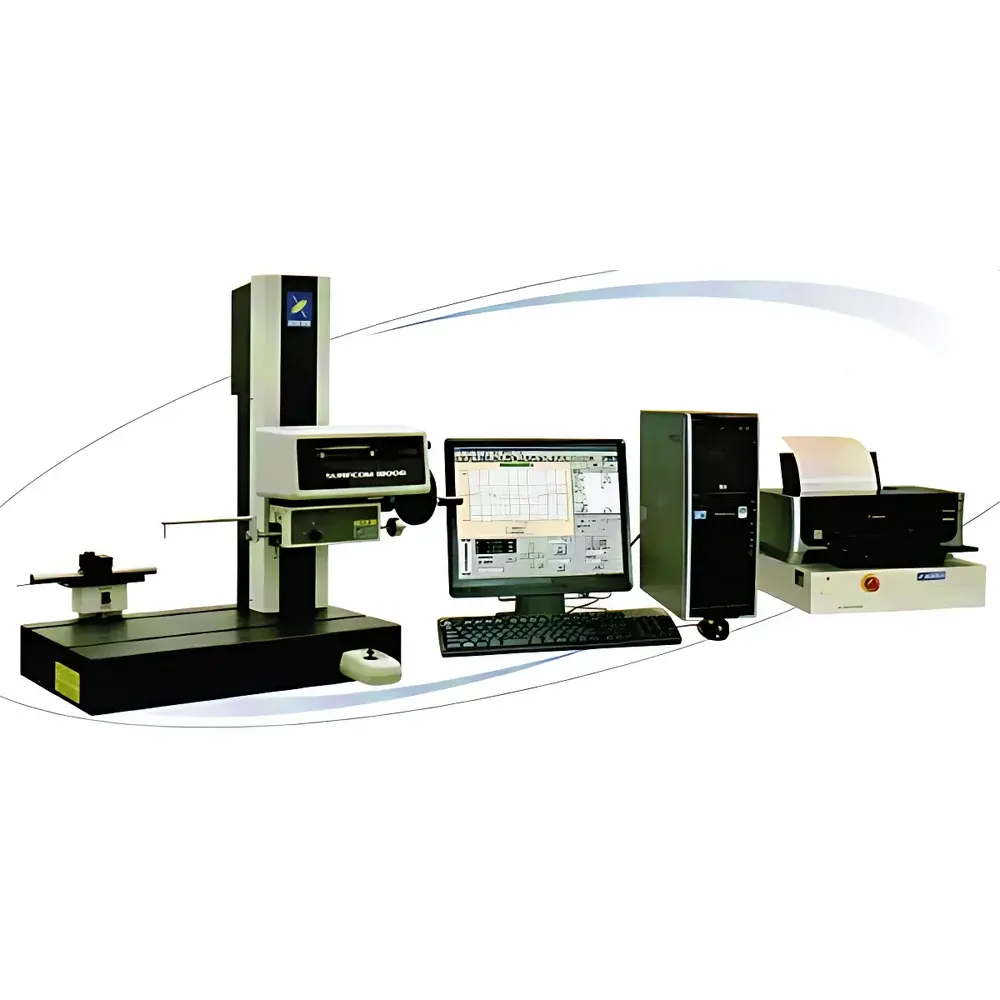
Accretech SURFCOM 1800G Integrated Profilometer & Surface Roughness Tester
| Brand | Accretech (Tokyo Seimitsu) |
|---|---|
| Origin | Japan |
| Model | SURFCOM 1800G |
| Z-axis Range | 800 mm (Profile) / 50 mm (Roughness) |
| X-axis Range | 100 mm (standard), up to 200 mm (optional -22 system) |
| Z-axis Indication Accuracy | ±0.25% FS (±4 µm within 5 mm range) |
| Z-axis Resolution | 0.1 µm (±2.5 mm), 0.4 µm (10 mm), 1 µm (±25 mm) |
| X-axis Indication Accuracy | ±(1 + 2L/100) µm (L in mm) |
| Straightness Accuracy | (0.05 + 1.5L/1000) mm |
| Measurement Principle | Differential Voltage (Z), Moiré Interferometric Scale (X) |
| Stylus Force | 0.75 mN (roughness), ≤30 mN (profile) |
| Stylus Radius | 2 µm (roughness), 25 µm (profile) |
| Stylus Material | Diamond (roughness), Tungsten Carbide (profile) |
| Vertical Feed Direction | Upward/Downward |
| Horizontal Feed Direction | Pull/Push |
| Filtering Standards | JIS B 0601:2001, ISO 4287, ISO 13565, ASME B46.1, DIN 4768, CNOMO |
| Roughness Parameters | Ra, Rq, Rz, Rmax, Rt, Rv, Rp, Rc, R3z, Sm, S, RDa, RDq, Rla, Rlq, Til, TA, lr, Pc, Rmr, tp2, Rmr2, Rdc, AVH, Hmax, Hmin, AREA, NCRX, R, Rx, AR, NR, CPM, SR, SAR |
| Profile Evaluation | Coordinate transformation, symmetry analysis, intersection detection (line-line, line-circle, circle-circle, etc.), GD&T deviation mapping with on-graph dimensioning, shape synthesis, CNC measurement replay, AI-assisted feature recognition |
| Software Compliance | Supports audit trail, user access control, and data integrity per FDA 21 CFR Part 11 requirements for regulated environments |
Overview
The Accretech SURFCOM 1800G is a high-precision, dual-mode integrated profilometer engineered for simultaneous surface roughness and contour geometry evaluation in metrology laboratories and precision manufacturing QA/QC environments. It operates on a hybrid sensing architecture: vertical displacement (Z-axis) is measured via differential voltage transduction—optimized for sub-micron resolution in roughness analysis—while horizontal positioning (X-axis) employs a Moiré interferometric scale for nanometer-level linear fidelity over extended travel ranges. This design enables traceable, repeatable characterization of both micro-topographic features (e.g., Ra < 0.01 µm) and macro-geometric forms (e.g., cam profiles, gear tooth flanks, turbine blade sections) within a single instrument platform. The system conforms to international standards including ISO 4287 (roughness), ISO 1101 (GD&T), JIS B 0601:2001, and ASME B46.1, supporting full compliance workflows in aerospace, medical device, and automotive supply chain applications subject to AS9100, ISO 13485, or IATF 16949.
Key Features
- Dual-mode operation with one-touch switching between roughness and profile measurement modes via intuitive ACCTee graphical interface icons.
- AI-assisted automatic condition setup (patented): system selects optimal stylus force, speed, filter cutoff, and sampling interval based on surface material and geometry.
- Full CNC measurement replay: records and replays complete motion sequences—including column vertical movement, probe approach/retract, and multi-segment scanning—ensuring procedural reproducibility across operators and shifts.
- Automated geometric feature recognition: identifies points, lines, circles, ellipses, and symmetric element pairs without manual point selection; calculates GD&T deviations (e.g., position, concentricity, parallelism) and overlays annotated dimension lines directly onto the measured profile plot.
- Shape synthesis capability: compensates for stylus tip angle-induced projection errors, extending effective analysis range beyond mechanical probe constraints—particularly critical for steep slopes (>70°) and deep grooves.
- Multi-standard filtering engine: supports standard 2RC, phase-corrected 2RC, and Gaussian filters with selectable cutoff wavelengths (0.025–25 mm, 7 discrete steps + arbitrary values), compliant with ISO 13565-1/-2 for functional surface analysis.
Sample Compatibility & Compliance
The SURFCOM 1800G accommodates a broad spectrum of industrial components—from silicon wafers and optical lenses to forged crankshafts and injection-molded polymer housings. Its modular stylus system allows rapid exchange between low-force diamond tips (2 µm radius, 0.75 mN) for delicate surfaces and robust tungsten carbide probes (25 µm radius, ≤30 mN) for hardened steels and ceramics. Vertical measurement range spans 50 mm for fine roughness and extends to 800 mm for large-scale contouring (e.g., rail profiles, extrusion dies). All measurement data are timestamped, user-logged, and stored with full metadata—including environmental conditions (optional sensor integration), calibration history, and operator ID—satisfying GLP/GMP documentation requirements. System software includes configurable electronic signatures, change logs, and export controls aligned with FDA 21 CFR Part 11 Annex 11 and EU GMP Annex 11 validation frameworks.
Software & Data Management
ACCTee software provides a unified environment for acquisition, analysis, reporting, and archival. Raw profile traces and roughness spectra are stored in vendor-neutral ASCII and CSV formats, while native .acp files retain full parametric metadata for reprocessing. The software implements role-based access control (RBAC), session audit trails, and immutable measurement records—enabling full compliance with regulatory data integrity principles (ALCOA+). Advanced analysis modules include power spectral density (PSD), bearing area (Abbott-Firestone), amplitude distribution, and motif analysis per ISO 12085. Automated report generation supports customizable templates with embedded graphics, statistical summaries (Cp/Cpk), and pass/fail flagging against tolerance limits defined in CAD models or engineering drawings. Data export interfaces include OPC UA and RESTful API for integration into MES and PLM systems.
Applications
- Aerospace: Blade root profile verification, turbine disk runout assessment, and thermal barrier coating roughness quantification per AMS 2430.
- Medical Devices: Surface texture validation of orthopedic implants (ISO 14644-1 cleanroom-compatible operation), stent strut geometry, and dental abutment taper conformity.
- Automotive: Cylinder bore cross-hatch angle and depth analysis, fuel injector nozzle orifice geometry, and transmission gear flank deviation mapping.
- Optics & Semiconductors: Mold insert surface fidelity checks, wafer edge profile metrology, and MEMS structure height uniformity assessment.
- Research & Development: Correlation studies between surface topography parameters (e.g., Rsk, Rku) and functional performance (friction, wear, adhesion).
FAQ
What standards does the SURFCOM 1800G support for roughness and profile evaluation?
It fully implements JIS B 0601:2001, ISO 4287, ISO 13565-1/-2, ASME B46.1, DIN 4768, and CNOMO—covering amplitude, spacing, and hybrid parameters, as well as motif-based analysis.
Can the system perform automated GD&T evaluation on complex freeform surfaces?
Yes—its AI-driven feature recognition identifies nominal geometry from CAD-imported references and computes real-world deviations (e.g., flatness, circularity, profile of a surface) with on-screen dimensioning and statistical process control outputs.
Is the software validated for use in FDA-regulated environments?
ACCTee supports 21 CFR Part 11 compliance through electronic signature enforcement, audit trail logging, and data immutability controls—validated per IQ/OQ protocols supplied with the system.
What is the maximum allowable slope angle for accurate profile measurement?
Using shape synthesis compensation, the system maintains traceable accuracy up to 85° slope angles—verified via NIST-traceable wedge artifacts.
Does the system support integration with factory automation networks?
Yes—OPC UA server functionality enables real-time data streaming to SCADA, MES, and cloud-based analytics platforms; REST API supports custom workflow orchestration.