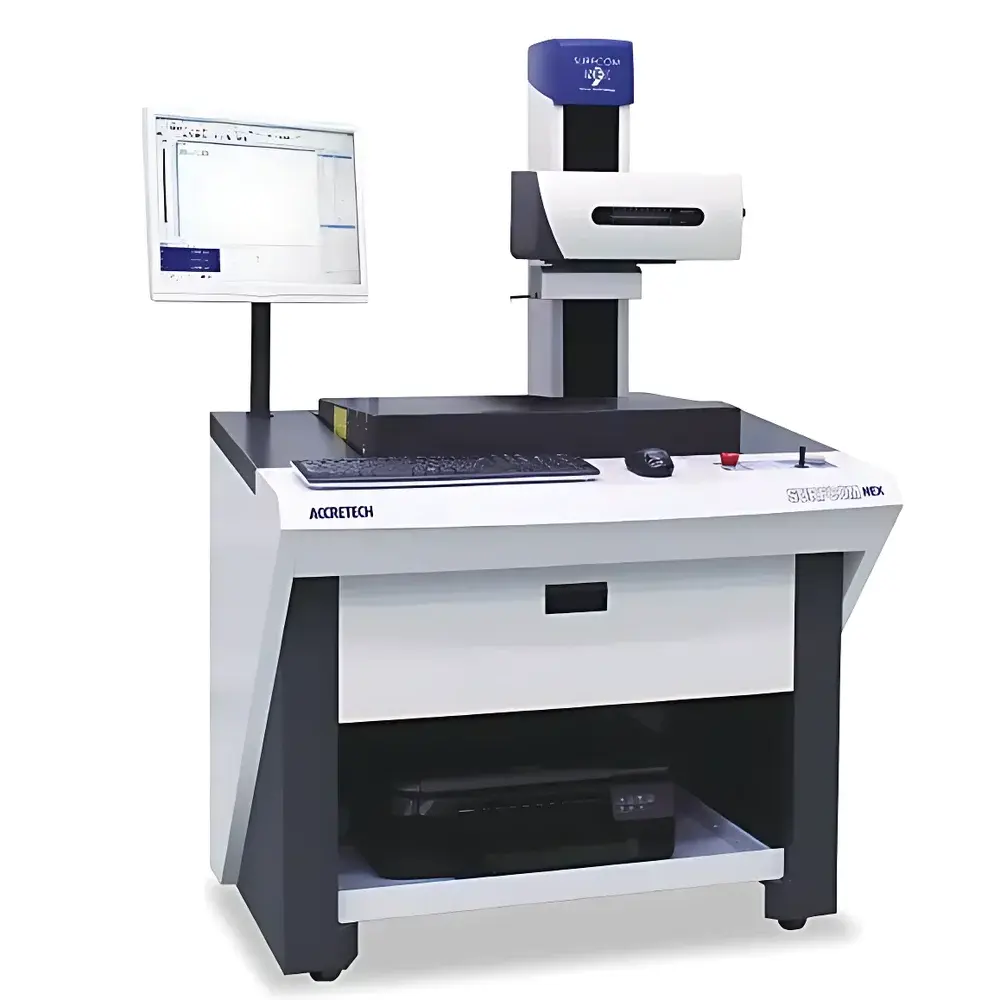
Accretech SURFCOM NEX Contact Profilometer
| Brand | Accretech |
|---|---|
| Origin | Japan |
| Model | SURFCOM NEX |
| Type | Contact Stylus Profilometer |
| Measurement Principle | Mechanical Stylus Tracing (ISO 3274, ISO 4287 compliant) |
| Vertical Resolution | Sub-nanometer (typical ≤0.1 nm) |
| Vertical Range | ±5 mm |
| Scan Length | Up to 100 mm (standard), extendable to 200 mm |
| Stylus Tip Radius | 2 µm (standard diamond tip, 90° included angle) |
| Force | Adjustable from 0.5 mN to 15 mN |
| Surface Roughness Parameters | Ra, Rz, Rq, Rp, Rv, Rt, Rsk, Rku, Rmr, etc. (per ISO 4287/ISO 25178-2) |
| Profile Analysis | Form error, waviness, slope, radius, step height, angle, bearing ratio (Abbott-Firestone curve) |
| Compliance | Fully supports ISO, JIS, ASME B46.1, and DIN standards |
| Software | SURFPAK-SV with GLP/GMP-compliant audit trail, user permission levels, and 21 CFR Part 11-ready electronic signatures |
Overview
The Accretech SURFCOM NEX is a high-precision contact stylus profilometer engineered for metrological-grade surface topography characterization in R&D laboratories, precision manufacturing QA/QC environments, and accredited calibration facilities. Operating on the principle of mechanical stylus tracing—where a diamond-tipped probe physically traverses the surface under controlled force—the system captures vertical displacement with sub-nanometer resolution while maintaining traceability to national and international length standards. Unlike optical methods, the SURFCOM NEX delivers direct, unambiguous height data unaffected by surface reflectivity, transparency, or material homogeneity, making it indispensable for measuring machined metals, ceramics, silicon wafers, hardened tool steels, and coated substrates where quantitative form and roughness must be validated against ISO 13565, ISO 25178-2, and ASME B46.1 specifications.
Key Features
- Modular mechanical design with thermally stable granite base and air-bearing linear stage, minimizing vibration-induced noise and thermal drift during long-range profiling (up to 200 mm).
- Motorized Z-axis with closed-loop piezoelectric actuator enabling real-time force compensation and adaptive tracking across steep slopes (±75°) and discontinuous features such as steps, grooves, and micro-milled edges.
- Interchangeable stylus holders supporting standardized 2 µm radius diamond tips (90° included angle) and optional 0.5 µm or 5 µm variants for specialized applications including MEMS and bearing surface analysis.
- Programmable measurement force (0.5–15 mN) with dynamic load regulation ensures consistent tip–surface interaction across soft polymers, brittle oxides, and ultra-hard coatings without ploughing or deformation artifacts.
- Integrated environmental monitoring (temperature, humidity, air pressure) feeds into real-time compensation algorithms embedded in SURFPAK-SV software, enhancing measurement repeatability under non-climate-controlled lab conditions.
Sample Compatibility & Compliance
The SURFCOM NEX accommodates samples up to 300 × 300 × 150 mm (W × D × H) on its adjustable sample stage, with optional vacuum chucks and custom fixturing for cylindrical, curved, or irregular geometries. All roughness and profile parameters are calculated per ISO 4287:1997, ISO 25178-2:2021, and JIS B 0601, with full support for filter selection (Gaussian, Spline, Robust Gaussian), cutoff wavelengths (λc = 0.08–25 mm), and evaluation lengths. The system meets requirements for ISO/IEC 17025-accredited laboratories, including documented uncertainty budgets, calibration certificate traceability to NMIJ (National Metrology Institute of Japan), and hardware-level interlock mechanisms preventing unauthorized parameter overrides during certified measurements.
Software & Data Management
SURFPAK-SV v8.x provides a validated, audit-ready platform compliant with FDA 21 CFR Part 11 and EU Annex 11. It features role-based user access control (Administrator, Operator, Reviewer), immutable electronic records with timestamped metadata, and automatic generation of PDF reports containing raw profile traces, parameter tables, statistical summaries, and annotated cross-sections. Raw data is stored in vendor-neutral ASCII format with full header documentation, ensuring long-term archival integrity and third-party interoperability. Optional modules include GD&T analysis (flatness, parallelism, circularity), multi-scan stitching for large-area mapping, and automated pass/fail decision logic linked to enterprise MES or LIMS systems.
Applications
- Precision machining: Verification of turned, ground, and EDM surfaces against geometric tolerances and functional roughness criteria (e.g., Rz < 1.6 µm for hydraulic valve seats).
- Semiconductor packaging: Step height measurement of solder bumps, die attach layers, and underfill interfaces with ≤5 nm repeatability (k = 2).
- Bearing and tribology research: Quantification of bearing area ratio (Rmr), core roughness depth (Rvk), and valley void volume (Vvv) per ISO 13565-2 for lubrication performance modeling.
- Medical device manufacturing: Surface texture validation of orthopedic implants (Ti-6Al-4V, CoCr) per ASTM F2792 and ISO 14644-1 cleanliness-related finish requirements.
- Academic metrology: Reference instrumentation for inter-laboratory comparison studies and development of new surface characterization protocols aligned with emerging ISO 25178-6 draft standards.
FAQ
What standards does the SURFCOM NEX comply with for roughness reporting?
It fully implements ISO 4287, ISO 25178-2, JIS B 0601, ASME B46.1, and DIN EN ISO 3274 for parameter calculation, filtering, and reporting.
Can the system measure surfaces with high aspect-ratio features, such as deep grooves or narrow trenches?
Yes—the 2 µm stylus with 90° tip angle and programmable low-force mode (0.5–2 mN) enables reliable tracing of features down to 5 µm width and >20:1 depth-to-width ratios.
Is SURFPAK-SV qualified for regulated industries requiring electronic record integrity?
Yes—version 8.2+ includes 21 CFR Part 11 compliance packages with audit trail, electronic signatures, and configurable retention policies.
How is traceability maintained for calibration and measurement uncertainty?
Each instrument ships with NMIJ-traceable calibration certificates for vertical scale and linearity; uncertainty budgets follow ISO/IEC Guide 98-3 (GUM) and are customizable per application.
Does the system support automated batch measurement for production floor deployment?
Yes—via SCRIPTER automation module, users can define measurement sequences, pass/fail thresholds, and auto-export results to shared network folders or SQL databases.