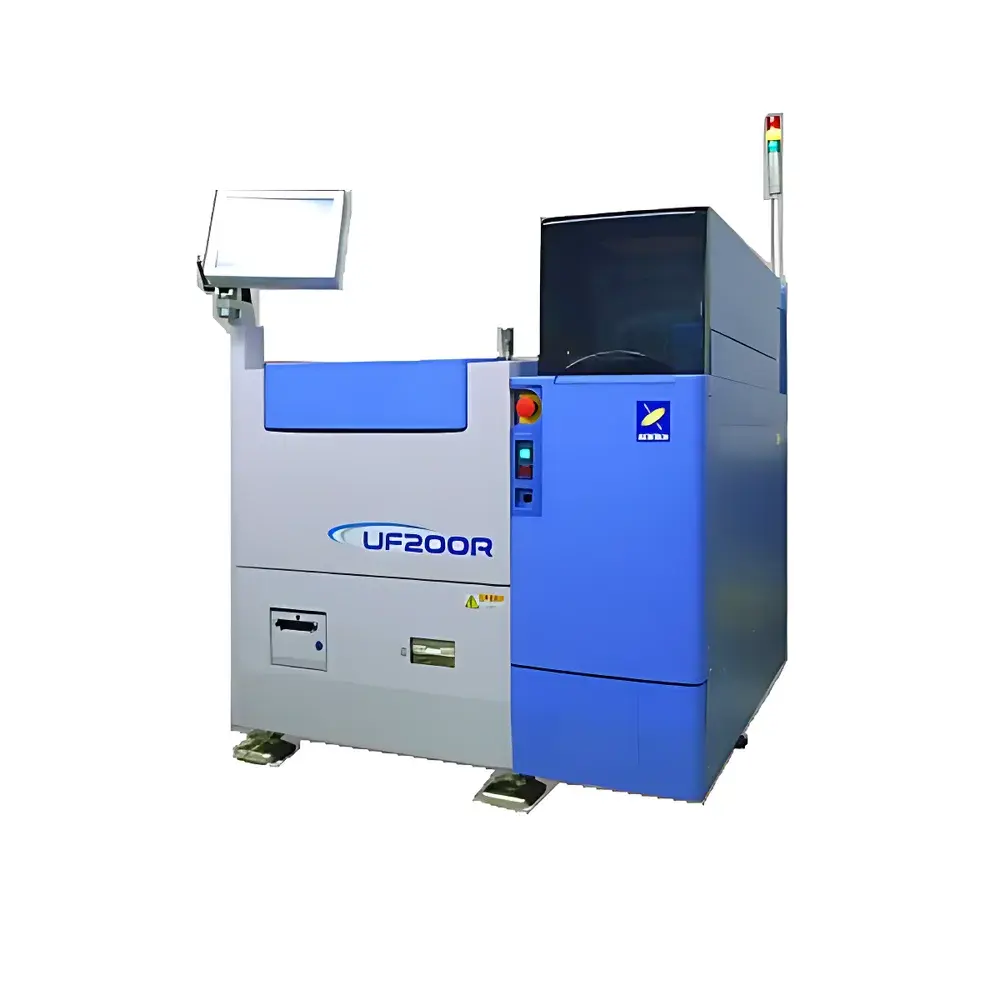
ACCRETECH UF190R / UF200R Fully Automated Probe Station
| Brand | ACCRETECH (Tokyo Seimitsu) |
|---|---|
| Origin | Japan |
| Model | UF190R / UF200R |
| Automation Level | Fully Automatic |
| Wafer Size Compatibility | 200 mm (8″) and 300 mm (12″) |
| Control Interface | Full-color TFT touchscreen HMI |
| Alignment System | Motorized auto-probe alignment with sub-micron repeatability |
| Compliance | Designed for Class 100–1000 cleanroom environments |
Overview
The ACCRETECH UF190R and UF200R are fully automated, high-precision probe stations engineered for advanced semiconductor wafer-level testing in R&D, process development, and high-volume production environments. Based on Tokyo Seimitsu’s proven mechanical architecture and motion control platform, these systems implement a dual-stage, air-bearing XY-theta stage with closed-loop servo feedback, enabling nanometer-level positioning stability and thermal drift compensation. The probe station operates on the principle of controlled physical contact between calibrated microprobes and device under test (DUT) pads—enabling DC parametric characterization (Id-Vg, Id-Vd), RF S-parameter measurements, and reliability stress testing (e.g., TDDB, HCI) under ambient, thermal, or vacuum conditions. Designed for seamless integration into automated test ecosystems, the UF-series supports standard SECS/GEM communication protocols and is compatible with industry-leading parametric test systems (e.g., Keysight B1500A, Keithley 4200-SCS) via GPIB, USB-TMC, and Ethernet-based SCPI command sets.
Key Features
- Fully automated operation with integrated vision-guided probe alignment: real-time image capture, pattern recognition, and closed-loop motorized Z-axis probing with force-sensing feedback (0.1–100 mN range, ±0.5% full-scale accuracy)
- Dual-wafer compatibility: configurable chuck modules support both 200 mm (8″) and 300 mm (12″) silicon, SiC, GaN, and compound semiconductor wafers—equipped with electrostatic or vacuum chucks, temperature control (−60°C to +300°C optional), and ESD-safe grounding
- Modular probe card interface: accommodates passive and active probe cards (e.g., Cascade Summit, FormFactor P7000 series) with standardized kinematic mounts and quick-release mechanisms
- Full-color 15.6″ capacitive touchscreen HMI: intuitive graphical workflow navigation, recipe-driven test sequencing, and real-time probe tip status monitoring (contact confirmation, wear indication, cleaning alerts)
- Robust mechanical design: granite base with vibration isolation, precision-ground linear guides, and thermally stable aluminum frame—validated per SEMI S2/S8 safety and ergonomics standards
- Integrated environmental monitoring: built-in humidity, particle count (optional), and chamber pressure sensors with data logging compliant with ISO 14644-1 Class 100/1000 cleanroom requirements
Sample Compatibility & Compliance
The UF190R and UF200R are qualified for use with front-side and back-side probing of planar and 3D-stacked ICs, MEMS devices, power modules, and advanced packaging substrates (e.g., fan-out wafer-level packaging, silicon interposers). Supported materials include Si, SiC, GaAs, GaN-on-Si, and thin-film metal/oxide stacks. All electrical interfaces comply with IEC 61000-4 electromagnetic immunity standards. Mechanical safety conforms to ISO 13857 and JIS B 9741. Software audit trails, user access levels, and electronic signature support align with FDA 21 CFR Part 11 and EU Annex 11 requirements when configured with optional validation packages.
Software & Data Management
The native ACCRETECH ProStation software provides unified control of motion, vision, probe contact, and external instrumentation. It features recipe-based test automation, multi-site mapping (including die-level coordinate referencing), and automatic probe-to-pad registration using machine vision algorithms trained on standard alignment marks (e.g., crosshair, L-shape, bullseye). Data export supports CSV, XML, and STDF formats; raw measurement logs include timestamp, environmental metadata (temperature, humidity), and probe contact force history. Optional integration with MES platforms (e.g., Applied Materials EnduraLink, PDF Solutions Exensio) enables traceability from wafer map to yield analysis.
Applications
- Parametric characterization of FinFET, GAA, and CFET transistor structures during process ramp-up
- High-frequency RF testing of 5G mmWave PA modules and phased-array antenna ICs up to 110 GHz
- Reliability qualification of wide-bandgap power devices under bias-temperature stress (HTGB, HTRB)
- Failure analysis correlation between electrical anomalies and SEM/FIB cross-sectioning sites
- Automated wafer acceptance testing (WAT) for foundry process control monitors (PCM)
- Low-temperature cryogenic probing of quantum dot arrays and superconducting qubit test structures
FAQ
What wafer sizes does the UF190R/UF200R support?
The system natively supports 200 mm (8″) and 300 mm (12″) wafers via interchangeable chuck assemblies. Custom configurations for 150 mm or non-standard substrates are available upon request.
Is thermal chuck capability available as a factory option?
Yes—both liquid-cooled and thermo-electric (Peltier) temperature-controlled chucks are offered, covering −60°C to +300°C with ±0.1°C stability over 24 hours.
Can the probe station be integrated into an existing ATE environment?
Absolutely—the UF-series supports standard SECS/GEM, SCPI, and TCP/IP-based remote control. Driver libraries for LabVIEW, Python (PyVISA), and MATLAB are provided.
Does the system meet cleanroom certification requirements?
All standard configurations are rated for ISO Class 5 (Class 100) cleanroom operation. Optional HEPA filtration, ionization, and stainless-steel enclosure upgrades satisfy ISO Class 4 (Class 10) specifications.
What level of service and calibration support is provided outside Japan?
ACCRETECH maintains certified service centers in the US, Germany, Singapore, and Taiwan. Preventive maintenance contracts include annual on-site calibration traceable to NIST and JCSS standards.