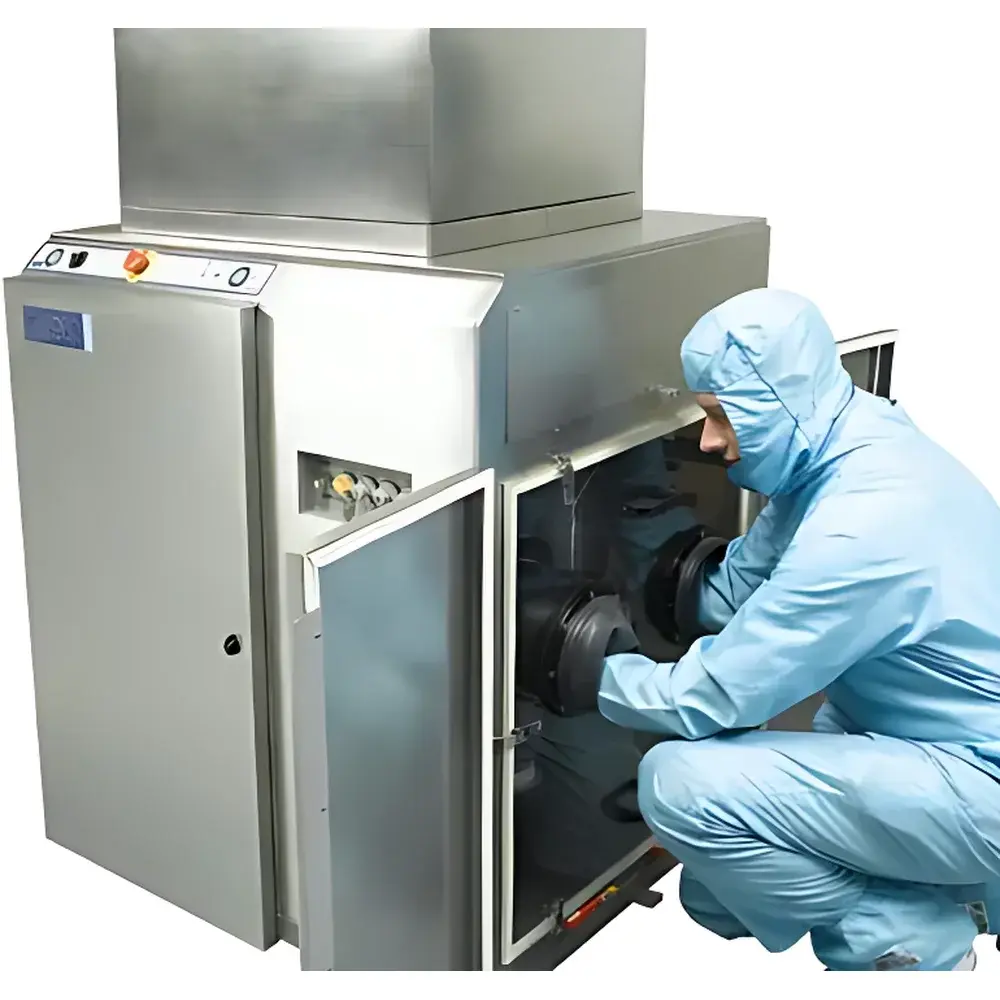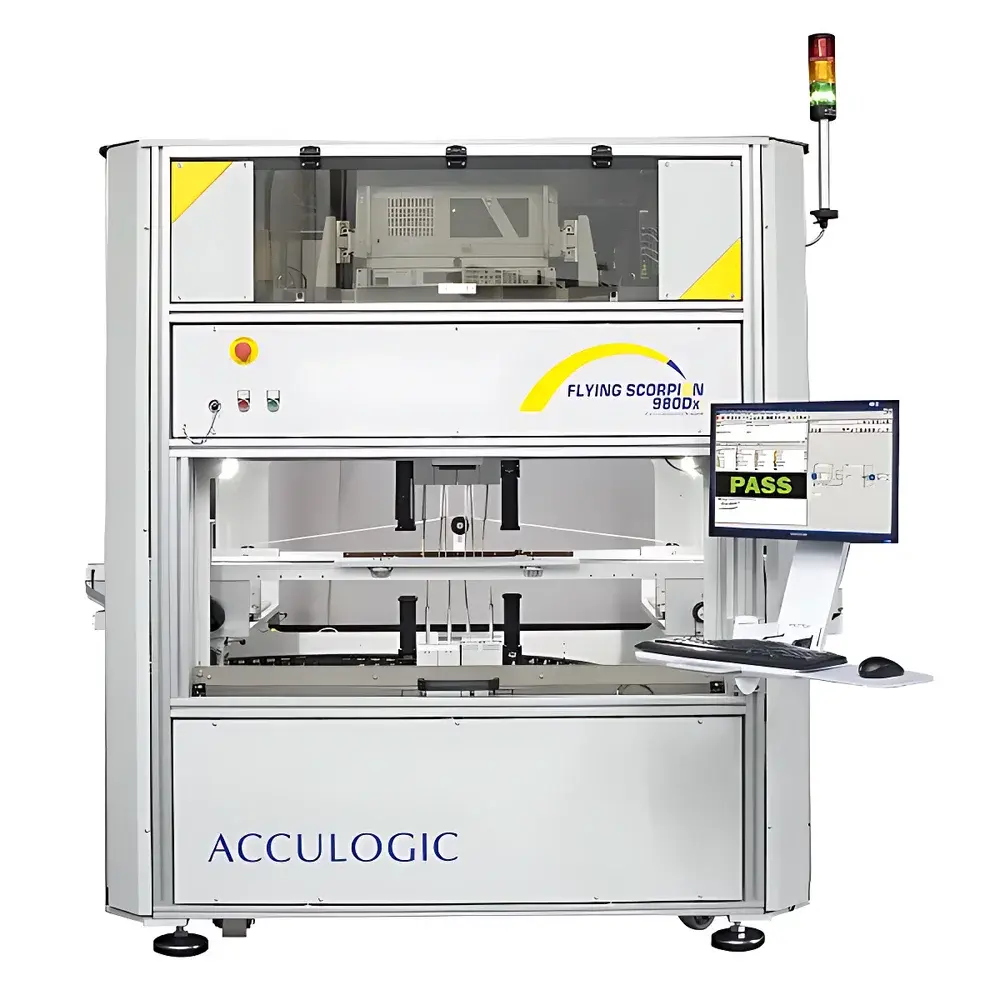
Acculogic FLS980 Series III Flying Probe Test System
| Brand | Acculogic |
|---|---|
| Origin | Canada |
| Model | FLS980 Series III |
| Positioning Repeatability | ±10 µm |
| Minimum Step Resolution | 1 µm |
| Max. Configurable Probes | 22 (dual-sided) |
| Programmable Probe Tilt Angle | ±6° |
| Max. PCB Size | 813 × 965 mm (32″ × 38″) |
| Max. Component Height | 85 mm |
| Max. Probe Tip Radius Range | 50–500 µm |
| Analog Measurement Speed | up to 1000 measurements/sec |
| Test Channel Count (non-multiplexed) | up to 128 |
| Laser-Based Board Warpage Compensation | Yes |
| Vision System | High-resolution fiducial camera with advanced image processing |
| Compliance | Designed for GLP/GMP-aligned test environments |
Overview
The Acculogic FLS980 Series III Flying Probe Test System is an industrial-grade, dual-sided automated test platform engineered for high-precision electrical verification of printed circuit board assemblies (PCBAs) in low-to-medium volume, high-mix manufacturing and engineering validation environments. Unlike traditional bed-of-nails ICT systems, the FLS980 employs a closed-loop, linear motor-driven shuttle architecture combined with programmable-angle probe modules to perform contact-based electrical measurements without requiring custom fixturing. Its core measurement methodology integrates four-wire Kelvin sensing, boundary-scan (IEEE 1149.x), NetScan™ functional net analysis, and real-time warpage-compensated probing—enabling reliable access to densely populated, ultra-fine-pitch (e.g., 01005, 0201) components and solder joints on warped or thermally unstable boards. The system is purpose-built for applications where physical test access is constrained by miniaturization trends—including chip-scale packaging (CSP), flip-chip interconnects, and embedded passives—where conventional ICT fixtures are economically or physically infeasible.
Key Features
- Closed-loop linear motor shuttles with ±10 µm positioning repeatability and 1 µm minimum step resolution, eliminating mechanical wear and ensuring long-term metrological stability.
- Dual-sided probing architecture supporting up to 22 independently controlled flying probes (top and bottom), enabling single-pass testing of complex multilayer assemblies.
- Programmable probe tilt mechanism with ±6° continuous angular adjustment, allowing optimal probe approach vectors to mitigate skid-induced pad damage and improve contact reliability on warped substrates.
- Integrated high-resolution fiducial vision system coupled with LaserScan™ warpage mapping, delivering real-time X/Y/Z coordinate compensation across the full 813 × 965 mm test area.
- High-speed analog measurement subsystem capable of up to 1000 measurements per second, supporting 2-wire, true 4-wire, and proprietary quasi-4-wire configurations for precision resistance, capacitance, inductance, diode, transistor, and IC parametric testing.
- Modular probe module options: APM 800 (fully programmable tilt), BPM 700 (fixed +6° tilt), and VPM 600 (vertical-only); all configurable in mixed arrangements to optimize coverage and throughput.
- Non-multiplexed test resource architecture supporting up to 128 dedicated test channels via mechanical fasteners—eliminating signal crosstalk and timing skew associated with multiplexed backplanes.
Sample Compatibility & Compliance
The FLS980 accommodates PCBAs ranging from prototype-level hand-assembled boards to production-representative SMT assemblies with component heights up to 85 mm and probe-accessible features as small as 100 µm. It supports rigid, flex-rigid, and ceramic substrates, including those exhibiting thermal expansion-induced warpage up to ±0.5 mm across the board surface. Probe tip geometries (conical, cup-shaped, domed) and radii (50–500 µm) are selected based on target pad material, finish (ENIG, immersion silver, OSP), and reliability requirements. From a regulatory standpoint, the system’s hardware architecture and optional Integrator™ software framework are designed to support compliance with ISO/IEC 17025 laboratory accreditation criteria, ASTM F2622 for electronic assembly verification, and FDA 21 CFR Part 11 when deployed with validated electronic signature and audit-trail configurations. Its deterministic motion control and traceable calibration pathways align with GLP and GMP test documentation expectations for medical device and aerospace electronics validation.
Software & Data Management
The FLS980 operates under Acculogic’s Integrator™ software platform—a modular, Windows-based environment integrating motion planning, stimulus generation, measurement acquisition, and diagnostic reporting. The software supports import of industry-standard CAD data (IPC-2581, ODB++, Gerber + centroid), automatic fiducial recognition, and intelligent probe path optimization to minimize travel time while maintaining mechanical safety margins. All measurement results—including raw voltage/current values, pass/fail thresholds, and environmental metadata (temperature, humidity, operator ID)—are stored in structured SQLite or SQL Server databases with configurable retention policies. Audit trails record every user action, parameter change, and calibration event with timestamp, IP address, and digital signature where enabled. Export formats include CSV, PDF test reports, and XML for MES/ERP integration. Optional plugins enable JTAG chain configuration, BSDL parsing, and IEEE 1149.6 AC-excitation testing for high-speed serial interfaces.
Applications
- Engineering validation of next-generation PCB designs prior to fixture investment.
- Low-volume/high-mix manufacturing of automotive ECUs, avionics LRUs, and medical diagnostics platforms.
- Failure analysis labs performing root-cause investigation of solder joint defects, latent opens, and parametric drift.
- Contract manufacturers requiring flexible test coverage across diverse customer portfolios without dedicated ICT infrastructure.
- Reverse engineering support via non-invasive node access, net continuity mapping, and functional stimulus-response characterization.
- Process qualification studies involving thermal cycling, humidity exposure, or mechanical shock—where repeated, identical probe placement is essential for longitudinal data integrity.
FAQ
What is the smallest component pitch the FLS980 can reliably test?
The system achieves repeatable contact on 01005 (0.4 mm × 0.2 mm) passive components using 50 µm-radius conical probes and optimized tilt angles; performance is verified per IPC-A-610 Class 3 acceptance criteria.
Does the FLS980 support powered functional testing?
Yes—integrated voltage regulation modules and isolated stimulus sources enable live-board testing of DC-DC converters, op-amps, and microcontroller peripherals at operating voltages up to 60 V and frequencies up to several GHz via RF-capable probe variants.
How is board warpage compensated during probing?
LaserScan™ acquires >1000 Z-height points across the PCB surface; this topographic map is fused with real-time camera-based fiducial tracking to dynamically adjust probe trajectory in all three axes before each touchdown.
Can the system be integrated into an automated SMT line?
While primarily a standalone test station, the FLS980 supports SECS/GEM and Modbus TCP interfaces for host-directed job loading, status reporting, and MES-triggered test execution—enabling semi-automated inline deployment.
Is calibration traceable to national standards?
Acculogic provides NIST-traceable calibration certificates for position encoders, force sensors, and analog measurement subsystems; annual recalibration services include full mechanical and electrical verification per ISO 17025 procedures.