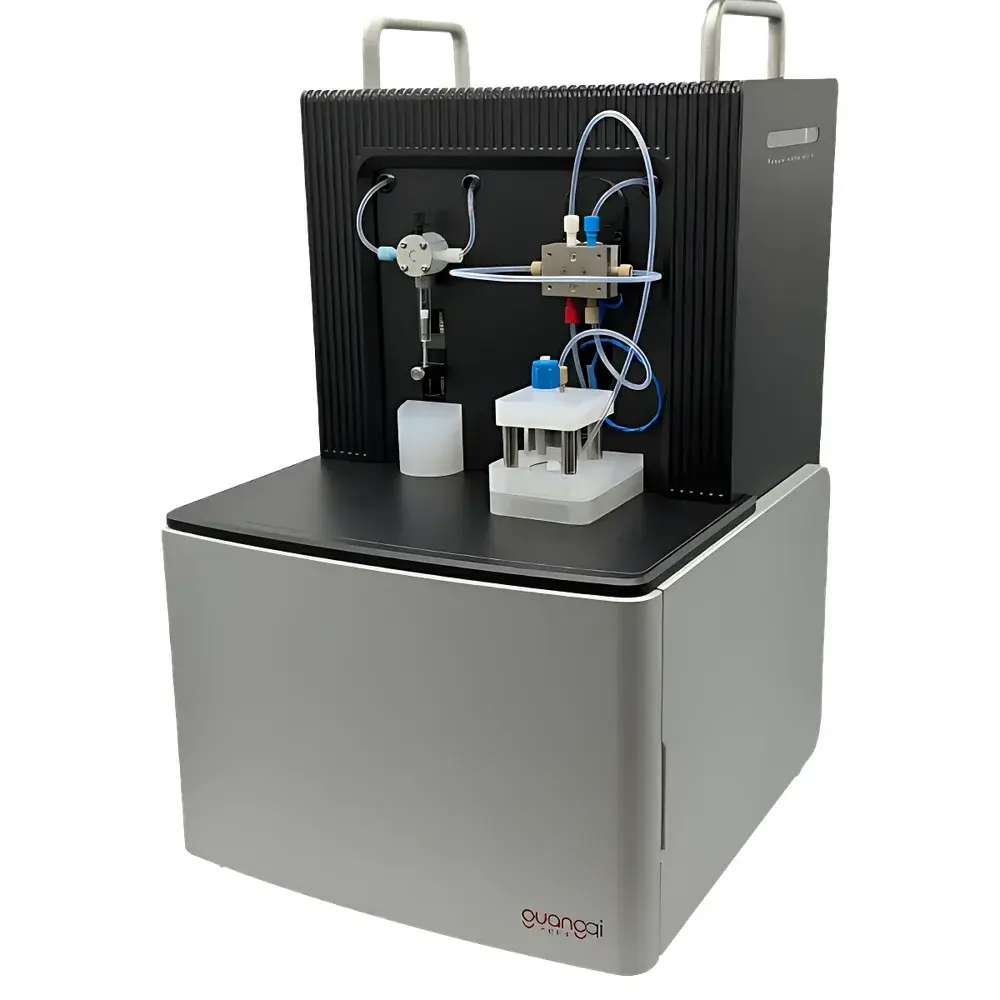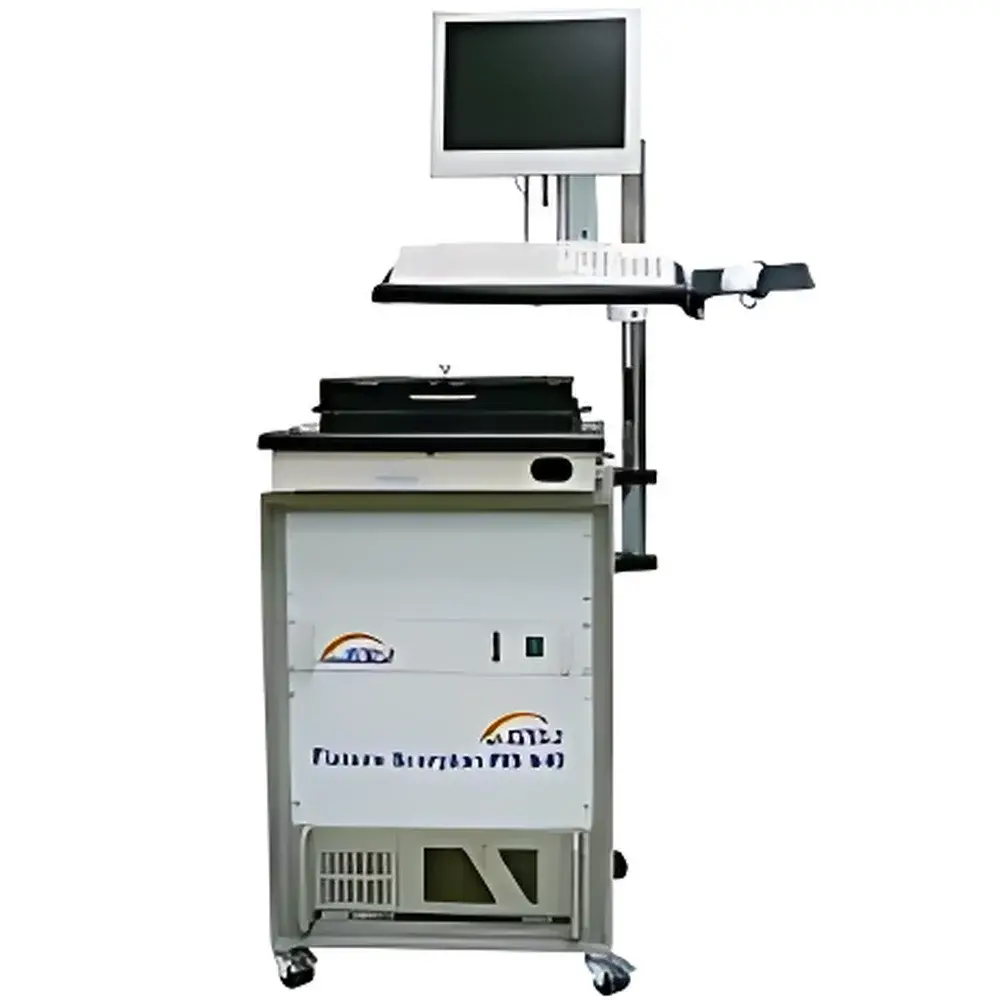
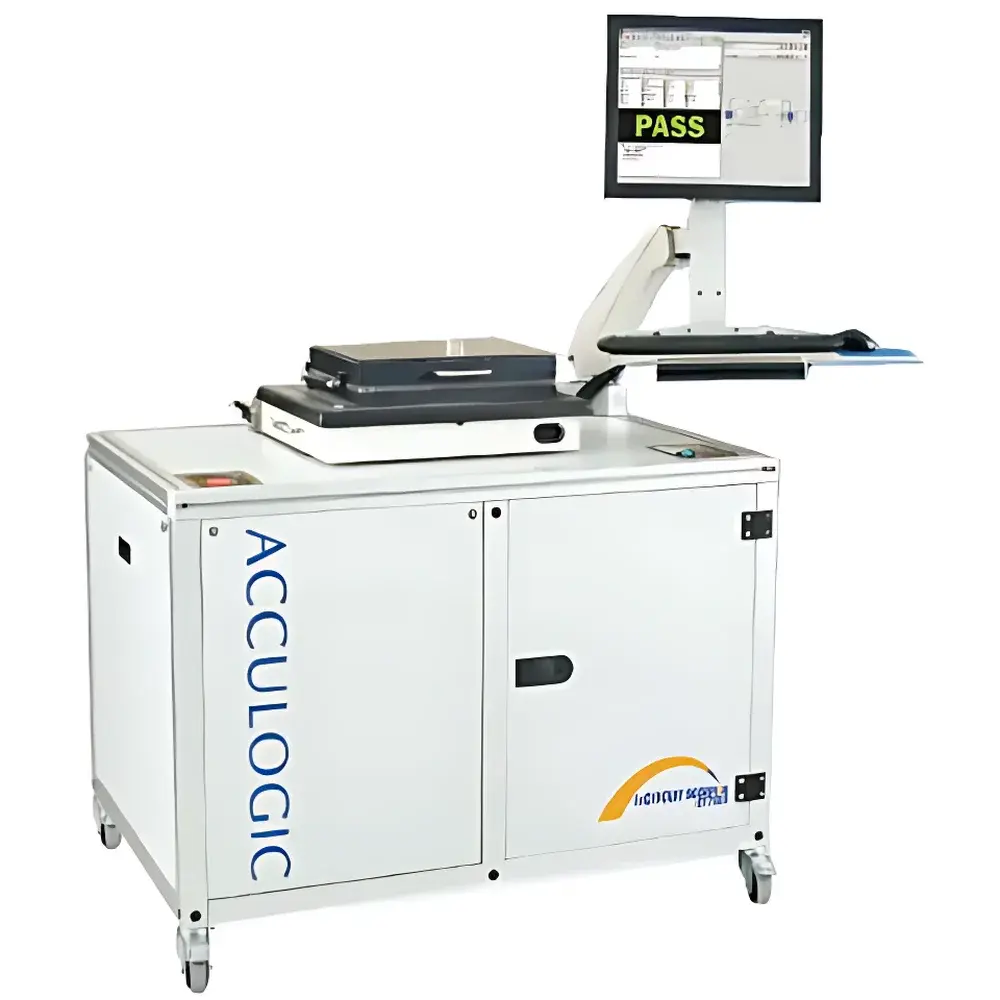
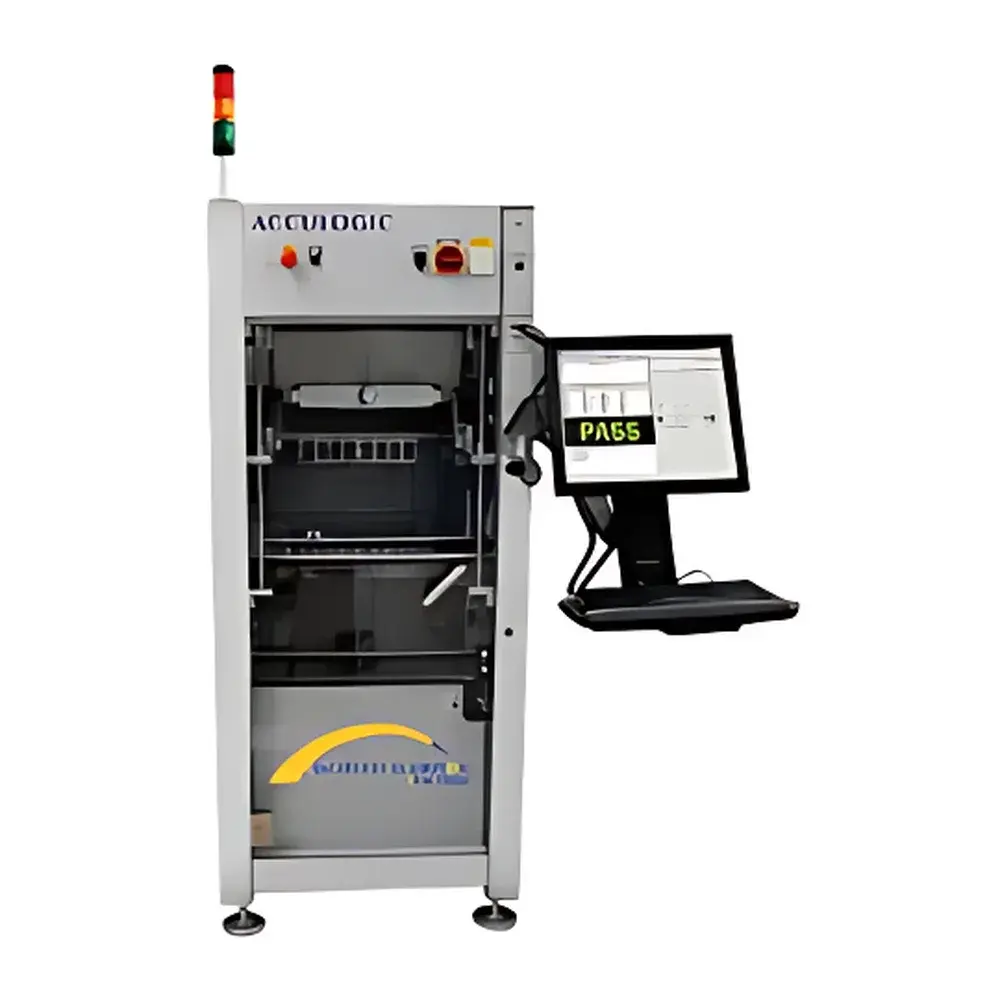
Acculogic SCORPION FiS 640 In-Circuit Tester
| Brand | Acculogic |
|---|---|
| Origin | Canada |
| Model | SCORPION FiS 640 |
| Maximum Test Points | 1024 |
| Board Size Capacity | 350 mm × 400 mm |
| Fixture Change Time | < 60 s |
| Operating System | Windows-based |
| Embedded Network Analyzer | Yes |
| Software Compatibility | Compatible with Acculogic Flying Probe Test (FPT) platforms |
| Footprint | 1050 mm × 1050 mm |
| Fixture Reusability | Supports legacy SCORPION iCT7000 fixtures |
| Programmable Power Supply Integration | Up to 4 external iTH 7000-grade units (optional) |
Overview
The Acculogic SCORPION FiS 640 is a modular, scalable in-circuit tester engineered for high-reliability functional and parametric verification of printed circuit assemblies (PCBAs) in mid-to-high volume electronics manufacturing environments. Based on the proven SCORPION platform architecture, the FiS 640 implements fixed-pin, bed-of-nails test methodology—leveraging precision-machined spring probes and low-impedance signal routing to ensure stable contact resistance (< 50 mΩ typical) and minimal signal distortion across DC to 100 MHz bandwidths. Its embedded vector network analyzer (VNA) module enables real-time impedance measurement, TDR-based trace continuity validation, and passive component characterization without requiring external instrumentation. Designed for seamless integration into SMT line-down or offline test cells, the system operates under a deterministic Windows 10 IoT Enterprise environment, supporting deterministic timing control, audit-trail logging, and native support for industry-standard communication protocols including SMEMA, SECS/GEM, and Modbus TCP.
Key Features
- Scalable pin count up to 1024 test points—expandable via modular backplane architecture without firmware reflash
- Single-fixture bilateral testing capability—supports top-side, bottom-side, or simultaneous dual-sided access using one mechanical fixture
- Sub-60-second fixture swap—enabled by standardized mechanical interface, optical alignment markers, and auto-calibrating probe registration
- Maximum board handling: 350 mm × 400 mm (13.8″ × 15.7″), accommodating Class III HDI and mixed-technology PCBAs
- Integrated VNA module with 100 kHz–100 MHz sweep range, ±0.5 dB amplitude accuracy, and 0.1° phase resolution
- Automatic test program generation (ATPG) from IPC-D-356 netlists and ODB++ design data—outputting IEEE 1149.1-compliant boundary-scan sequences where applicable
- Native software compatibility with Acculogic’s FLYER series flying probe platforms—enabling shared test plan libraries, failure mode taxonomy, and defect root-cause correlation
- Compact footprint: 1050 mm L × 1050 mm W × 1850 mm H—designed for space-constrained production floors and cleanroom-adjacent deployment
- Backward compatibility with existing SCORPION iCT7000 fixture tooling—reducing capital expenditure on new mechanical interfaces
- Optional integration of up to four iTH 7000-series programmable DC power supplies (±32 V / 10 A per channel, 16-bit resolution)
Sample Compatibility & Compliance
The SCORPION FiS 640 supports rigid, rigid-flex, and multilayer PCBAs ranging from 0.4 mm to 6.0 mm thickness, with minimum pad size of 0.3 mm diameter and solder mask defined (SMD) or non-solder mask defined (NSMD) land patterns. It complies with IPC-A-610 Class 2 and Class 3 visual inspection reference criteria for contact reliability assessment. Electrical safety conforms to IEC 61010-1:2010 (Edition 3) for measurement, control, and laboratory equipment. The Windows-based runtime environment meets FDA 21 CFR Part 11 requirements when configured with electronic signature enforcement, audit trail retention (≥18 months), and role-based access control (RBAC). All test logs are timestamped, digitally signed, and exportable in CSV, XML, and PDF/A-1b formats for GLP/GMP traceability.
Software & Data Management
The SCORPION TestStudio™ software suite provides full lifecycle management—from test plan authoring and simulation to execution, statistical process monitoring (SPC), and failure analytics. It features built-in DOE (Design of Experiments) support for test parameter optimization, integrated JMP-compatible statistical engines for yield trend analysis, and RESTful API endpoints for MES/ERP integration (e.g., SAP ME, Siemens Opcenter). All test programs include version-controlled revision history, change justification fields, and mandatory reviewer sign-off prior to deployment. Data storage adheres to ISO/IEC 27001-aligned encryption standards (AES-256 at rest, TLS 1.2+ in transit), with optional on-premise NAS or private cloud archival.
Applications
- Final functional verification of automotive ECUs (ISO 26262 ASIL-B compliant test sequences)
- High-speed digital board validation—including DDR4/DDR5 memory subsystems and PCIe Gen4 interconnects
- Power electronics module testing—IGBT gate drive integrity, isolated DC-DC converter regulation, and thermal derating validation
- Aerospace avionics line replaceable unit (LRU) acceptance testing per RTCA DO-254 and DO-160G sections
- Medical device PCBAs subject to IEC 62304 software lifecycle and IEC 60601-1 electrical safety requirements
- Consumer electronics production ramp support—enabling rapid test program migration from FPT to ICT as volumes scale
FAQ
Does the SCORPION FiS 640 support boundary-scan (JTAG) testing?
Yes—the system includes IEEE 1149.1-compliant boundary-scan controller hardware and supports BSDL file import, chain validation, and INTEST/EXTEST instruction execution.
Can legacy SCORPION iCT7000 fixtures be reused without modification?
Yes—all mechanical and electrical interfaces are backward-compatible; only minor calibration updates may be required after installation.
Is remote diagnostics and firmware update supported over standard Ethernet?
Yes—secure remote access is enabled via SSHv2 and HTTPS-managed firmware update channels, with configurable firewall rules and VLAN segmentation support.
What is the mean time between failures (MTBF) for the probe card assembly?
The modular probe head assembly has an MTBF of ≥15,000 hours under continuous operation at 25°C ambient, per Telcordia SR-332 Issue 4 predictions.
How does the system handle thermal drift during extended functional test cycles?
Onboard temperature sensors monitor critical analog signal paths; automatic gain/offset compensation is applied every 30 minutes or per test sequence, traceable in the audit log.