
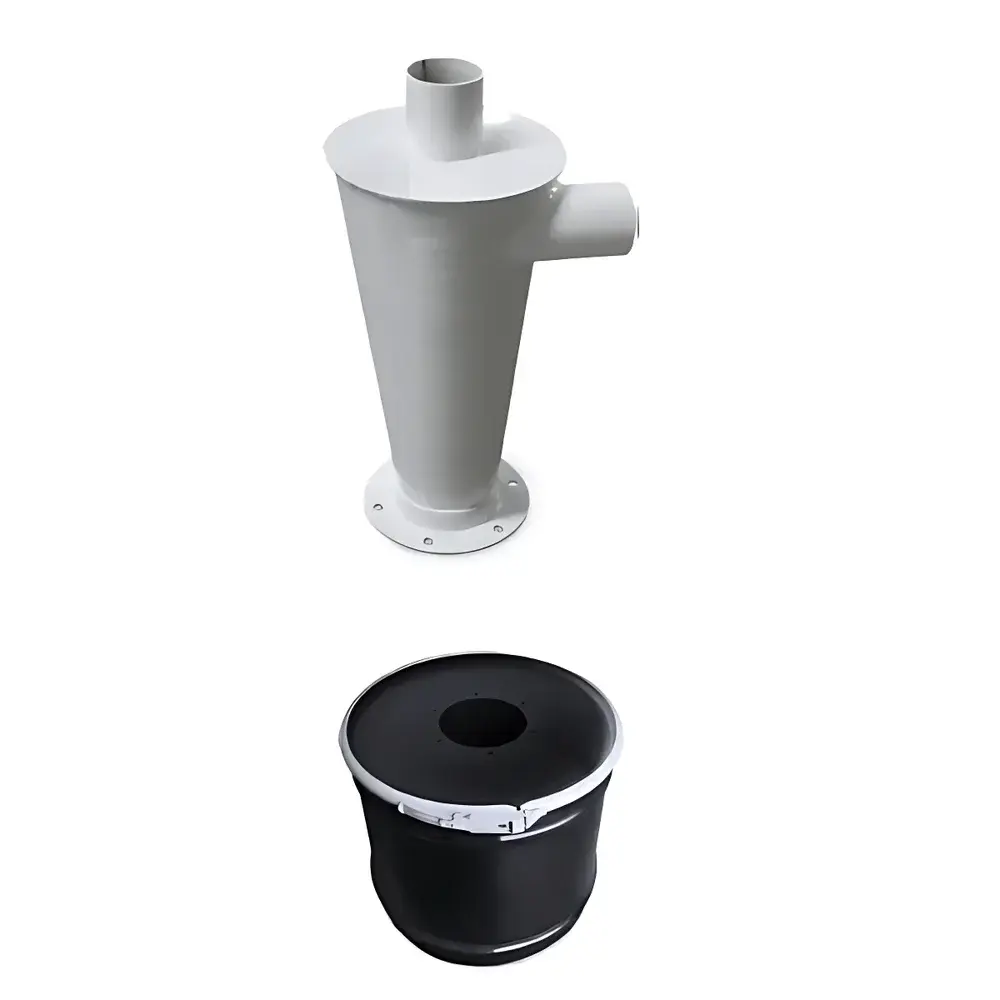
Accurate Thermal Systems ATS2017 Fluidized Sand Bath Cyclonic Separator and Collection Vessel Assembly
| Brand | Accurate Thermal Systems |
|---|---|
| Origin | USA |
| Manufacturer Type | Authorized Distributor |
| Origin Category | Imported |
| Model | ATS2017 |
| Price | Upon Request |
| Cyclone Height | 14 in (35 cm) |
| Cyclone Diameter | 8 in (20 cm) |
| Cyclone Weight | 4 lb (1.8 kg) |
| Inlet/Outlet OD | 2 in (5 cm) |
| Filtration Efficiency | 95–99% (at 250–350 CFM) |
| Collection Vessel Diameter | 15 in (37.5 cm) |
| Collection Vessel Height | 18 in (45 cm) |
| Collection Vessel Weight | 8 lb (3.6 kg) |
| Max Operating Temperature | 250 °F (121 °C) |
| Particle Capture Threshold | ≥325 mesh (≤44 µm) |
Overview
The Accurate Thermal Systems ATS2017 Fluidized Sand Bath Cyclonic Separator and Collection Vessel Assembly is an engineered air-solid separation system designed for continuous particulate recovery from high-temperature fluidized bed exhaust streams—specifically targeting alumina (Al₂O₃) media used in thermal testing, calibration, and material stability evaluation. Unlike general-purpose air purifiers, the ATS2017 operates on inertial separation principles: exhaust gas enters the cyclone tangentially, generating a high-velocity vortex that forces denser particles outward against the wall via centrifugal force. These particles spiral downward into the conical base and discharge into the integrated collection vessel, while cleaned air exits axially through the top outlet. This design eliminates reliance on disposable filter media, enabling closed-loop reuse of recovered alumina—critical for maintaining bath composition integrity and minimizing operational consumables in regulated thermal test environments.
Key Features
- Robust powder-coated carbon steel construction rated for continuous operation up to 121 °C (250 °F), ensuring structural stability under sustained thermal load from adjacent fluidized sand baths.
- Cyclone geometry optimized for Reynolds numbers typical of 250–350 CFM airflow, delivering consistent 95–99% capture efficiency for alumina particles ≥44 µm (325 mesh).
- Modular assembly includes pre-aligned mounting hardware for direct integration with standard ATS fluidized sand bath exhaust ports and ducting systems.
- Collection vessel features a wide-diameter (37.5 cm), vertically oriented cylindrical design with smooth internal contours to minimize particle adhesion and facilitate complete media evacuation.
- Integrated inlet/outlet connections with 5 cm OD flanged interfaces support seamless integration with ANSI B16.5 Class 150 ductwork and variable-speed exhaust fans equipped with balancing dampers or gate valves.
Sample Compatibility & Compliance
The ATS2017 is validated for use with inert, non-reactive, thermally stable granular media—including calcined alumina, silica sand, and zirconia—commonly employed in ASTM E1530 (Standard Test Method for Measuring the Resistance to Flame Penetration of Materials), ISO 834 fire resistance testing, and USP <1211> sterilization validation protocols. It complies with OSHA 29 CFR 1910.94 requirements for local exhaust ventilation (LEV) system performance when operated within its specified airflow envelope (250–350 CFM). While not a standalone HEPA-grade device, its cyclonic stage serves as a primary particulate control element upstream of secondary filtration (e.g., bag filters or cartridge collectors) required for sub-44 µm fines—supporting facility-level adherence to NIOSH RELs and ACGIH TLVs for respirable crystalline silica and alumina dust.
Software & Data Management
The ATS2017 is a passive mechanical system with no embedded electronics, firmware, or data logging capability. Its performance verification relies on external instrumentation: differential pressure manometers across the cyclone inlet/outlet, anemometer-based CFM validation at the fan intake, and gravimetric analysis of collected media per ASTM D1896. For laboratories operating under FDA 21 CFR Part 11 or GLP/GMP frameworks, documented commissioning reports—including airflow mapping, leak testing, and particulate mass balance studies—are recommended prior to routine use. Maintenance logs must record vessel emptying frequency, visual inspection of coating integrity, and verification of gasket seal condition at all flanged joints.
Applications
- Recovery and recirculation of alumina media from fluidized sand baths used in thermal shock, heat transfer coefficient, and dielectric heating studies.
- Primary particulate abatement in materials testing labs conducting ASTM E119, UL 263, or EN 1363 fire endurance evaluations.
- Pre-filtration stage ahead of HEPA or MERV-16 secondary filters in cleanroom-adjacent thermal processing suites.
- Engineering controls for reducing fugitive emissions during periodic bath replenishment or media conditioning cycles.
- Supporting sustainability objectives by extending alumina service life and reducing disposal volume per ISO 14001 environmental management system requirements.
FAQ
What particle size range does the ATS2017 effectively capture?
The cyclone achieves 95–99% collection efficiency for particles ≥44 µm (325 mesh). Particles smaller than 44 µm—comprising less than 5% of total alumina mass—exhibit reduced capture (~25% efficiency) and require downstream filtration.
Is the collection vessel compatible with automated media return systems?
Yes—the vessel’s bottom port and standardized 5 cm OD interface allow connection to pneumatic or gravity-fed conveyance lines for direct reintroduction into the fluidized bath reservoir.
Can the ATS2017 be installed in vertical or horizontal orientation?
It is engineered exclusively for vertical installation; horizontal mounting compromises vortex formation and significantly degrades separation efficiency.
Does the powder coating meet NEMA 4X or IP65 specifications?
The coating provides corrosion resistance suitable for indoor laboratory environments but is not certified to NEMA 4X or IP65; external weatherproof enclosures are required for outdoor or washdown applications.
What maintenance intervals are recommended for optimal performance?
Inspect gaskets and coating integrity quarterly; clean interior surfaces after every 200 hours of cumulative operation or when pressure drop exceeds 0.5 in. w.c. across the cyclone.



