
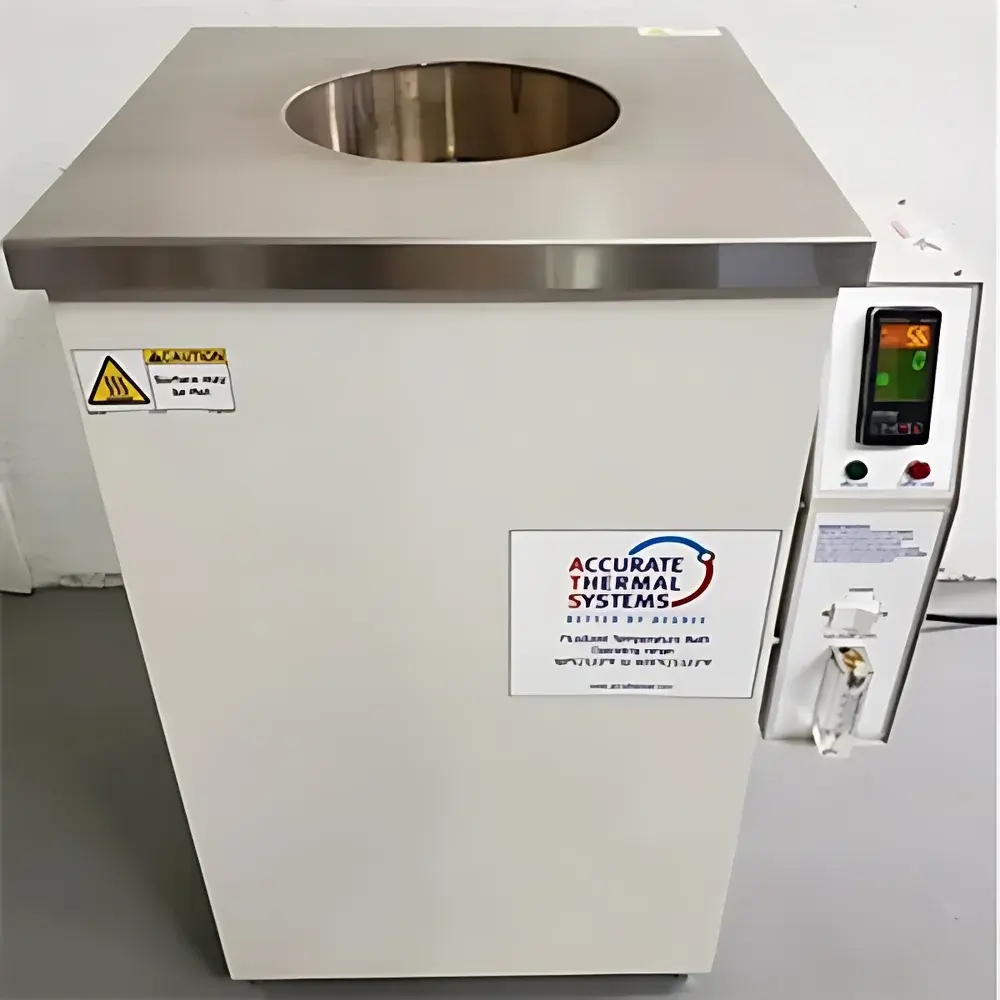
Accurate Thermal Systems FTBLL12 Fluidized Bed Temperature Bath
| Brand | Accurate Thermal Systems |
|---|---|
| Origin | USA |
| Model | FTBLL12 |
| Power Supply | 220–240 VAC, 50/60 Hz, 20 A |
| Max Heating Capacity | 6800 W |
| Operating Temperature Range | Ambient to 600 °C (1112 °F) |
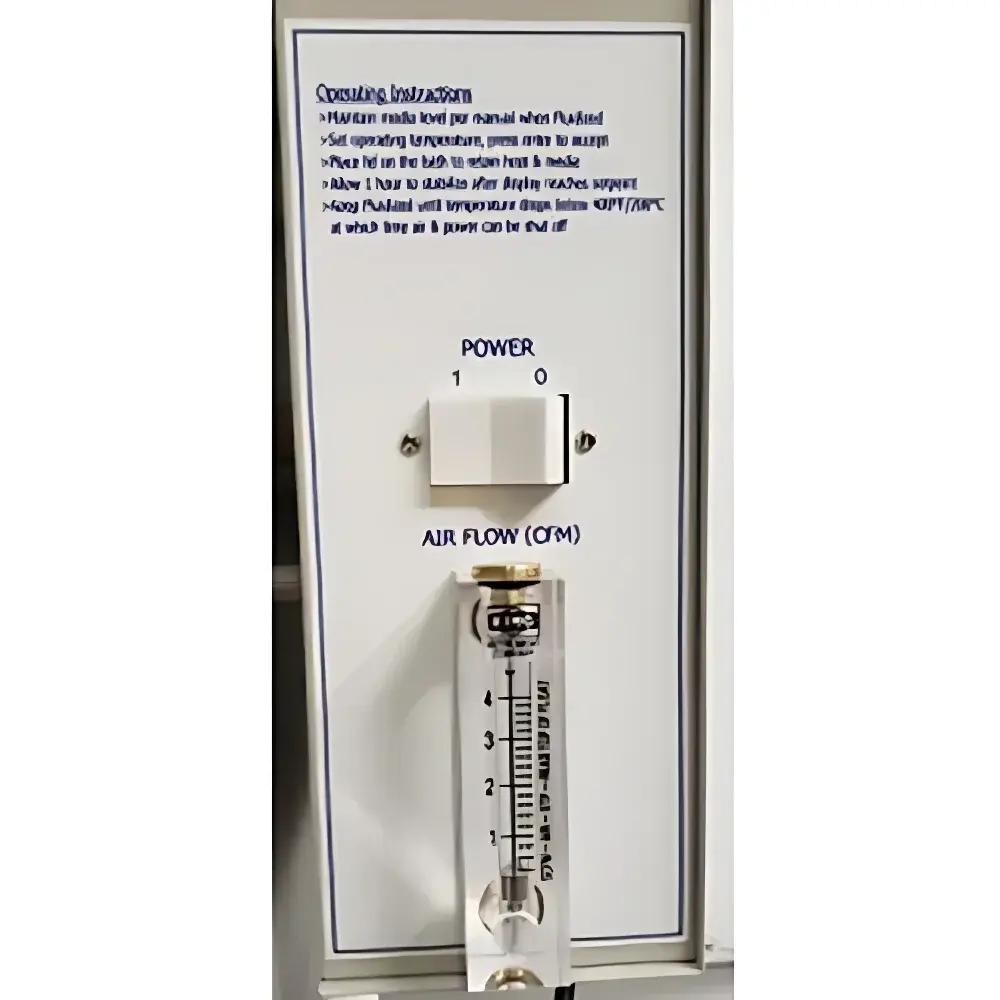
| Fluidization Air Requirement | Clean, dry air at 50 PSI, up to 8.0 CFM |
| Safety Cut-off | Independent overtemperature protection at 615 °C (1140 °F) |
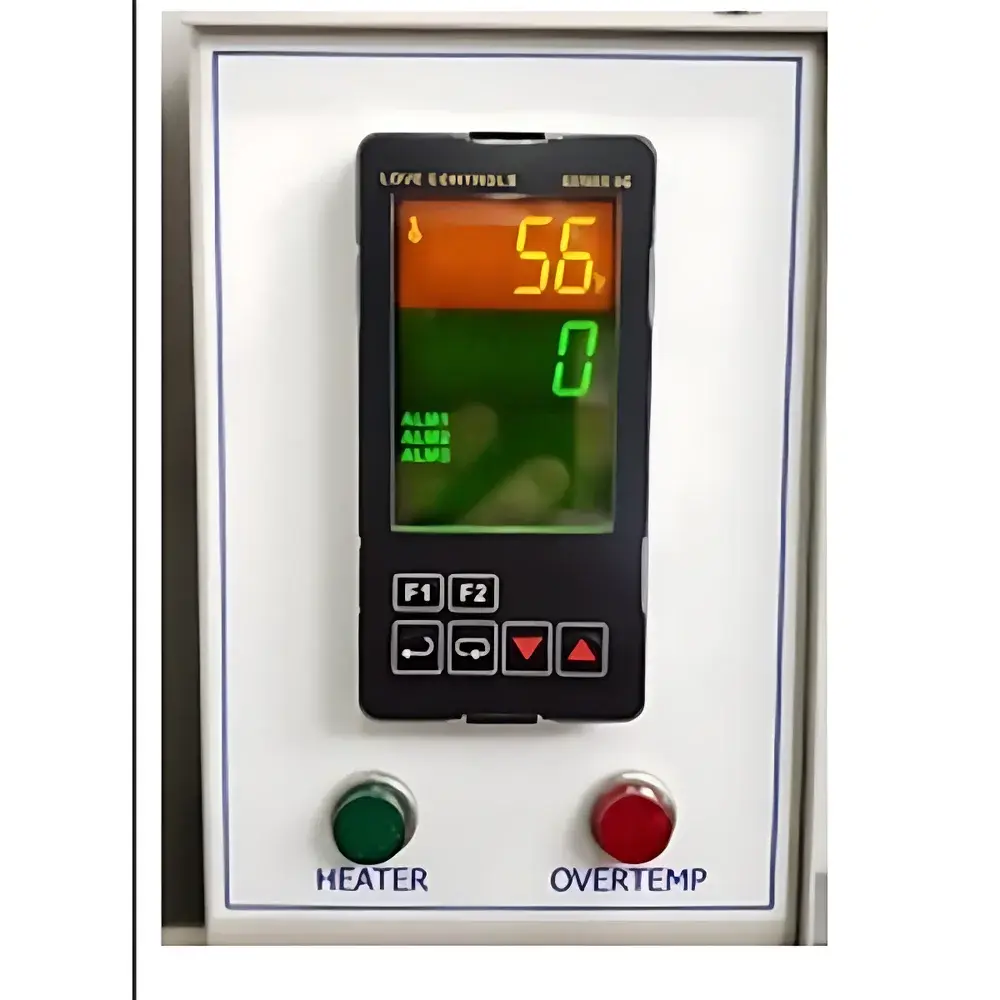
| Control System | Quad-zone PID temperature controller with RS485 interface |
| Chamber Dimensions | Ø312 mm × 660 mm (12.3″ × 26″) |
| Compliance | CE-certified |
| Included | Al₂O₃ fluidization medium, operator manual |
Overview
The Accurate Thermal Systems FTBLL12 Fluidized Bed Temperature Bath is an industrial-grade thermal cleaning and heat-treatment system engineered for precision, repeatability, and operational safety in high-demand manufacturing environments. It operates on the principle of fluidized bed heat transfer—where finely graded aluminum oxide (Al₂O₃) particles are suspended in a controlled upward stream of clean, dry air, creating a homogeneous, low-thermal-mass pseudo-fluid medium. This enables rapid, uniform heat transfer to immersed components without mechanical abrasion or thermal shock. Unlike conventional oven-based or pyrolytic cleaning methods, the FTBLL12 delivers non-oxidizing, non-grinding thermal decomposition of organic residues—including thermoset polymers, elastomers, epoxies, adhesives, coatings, and carbonized resins—at temperatures up to 600 °C (1112 °F). Its design reflects over 30 years of refinement in fluidized sand bath technology and aligns with established thermal cleaning practices adopted by Fortune 500 polymer processing facilities worldwide.
Key Features
- Quad-zone PID temperature controller with independent tuning per heating zone for enhanced thermal stability and reduced overshoot during ramp-and-soak cycles
- Automated four-stage fluidization air control—dynamically modulating airflow during heat-up, soak, cool-down, and standby phases to optimize particle suspension and energy efficiency
- Dual redundant safety architecture: independent overtemperature cut-off at 615 °C (1140 °F) plus dual fusing to meet IEC 61000-6-2 and IEC 61000-6-4 immunity requirements
- CE-marked enclosure with integrated 127 mm (5″) exhaust port and front-panel calibrated airflow meter for real-time verification of fluidization integrity
- Robust stainless-steel chamber construction with optimized insulation for consistent thermal performance and minimal ambient heat loss
- RS485 serial interface supporting Modbus RTU protocol for integration into plant-level SCADA or MES systems, enabling traceable temperature logging and remote diagnostics
Sample Compatibility & Compliance
The FTBLL12 accommodates tooling and components commonly used in extrusion, injection molding, blow molding, and composite processing—including breaker plates, nozzle assemblies, die heads, screen packs, feed screws, manifold blocks, and metal filtration elements. Its non-corrosive Al₂O₃ medium ensures compatibility with ferrous and non-ferrous alloys, hardened steels, and nickel-based tooling without surface degradation. The system complies with CE Directive 2014/35/EU (Low Voltage Directive) and 2014/30/EU (EMC Directive), and its operational methodology supports adherence to ISO 9001:2015 quality management requirements for thermal process validation. While not inherently GLP/GMP-certified, the RS485 interface and stable thermal profile support audit-ready data capture when paired with compliant third-party software meeting FDA 21 CFR Part 11 electronic record requirements.
Software & Data Management
The FTBLL12 does not include proprietary PC software but provides native Modbus RTU register mapping for seamless integration with industry-standard HMI platforms (e.g., Ignition, Siemens WinCC, Rockwell FactoryTalk). Critical parameters—including setpoint, actual chamber temperature, fluidization air pressure, and fault status—are accessible via discrete registers. Users may configure automated data logging, alarm notifications, and trend analysis using external supervisory systems. All temperature profiles can be exported in CSV format for statistical process control (SPC) evaluation. Firmware updates are performed via secure USB interface under technical support guidance; version history and calibration logs are retained onboard for traceability.
Applications
Primary applications include thermal cleaning of polymer-processing tooling in regulated and non-regulated production settings. The FTBLL12 is routinely deployed for residue removal from extrusion dies prior to requalification, post-run cleaning of injection mold cavities to prevent contamination in medical-grade resin runs, and regeneration of static mixers used in reactive polymer compounding. Secondary uses encompass pre-bake conditioning of metal substrates prior to coating, stress-relief annealing of machined components, and controlled thermal aging of elastomeric seals. Its ability to achieve full organic decomposition without ash formation makes it suitable for laboratories requiring residue-free sample preparation prior to SEM-EDS or FTIR analysis.
FAQ
What types of organic residues can the FTBLL12 effectively remove?
It thermally decomposes thermoplastics, thermosets, silicones, polyurethanes, acrylics, phenolics, and cured epoxy resins—leaving only inert inorganic ash or metallic residue.
Is the aluminum oxide medium consumable?
No—Al₂O₃ is chemically inert and thermally stable up to 1800 °C; it requires only periodic sieving to remove fines and maintain optimal fluidization characteristics.
Can the FTBLL12 be validated for use in regulated pharmaceutical or medical device manufacturing?
Yes—when integrated with qualified data acquisition systems and operated under documented SOPs, it supports IQ/OQ/PQ protocols aligned with ISO 13485 and ASTM F2621 standards for thermal cleaning validation.
What maintenance is required beyond routine cleaning?
Annual verification of thermocouple accuracy, inspection of air filter elements, and functional testing of overtemperature cutoff circuits constitute the recommended preventive maintenance schedule.
Does the system require ventilation to outside air?
Yes—an exhaust duct connected to a dedicated fume hood or central exhaust system is mandatory to evacuate volatile decomposition byproducts in accordance with OSHA 1910.1200 and local industrial hygiene regulations.



