
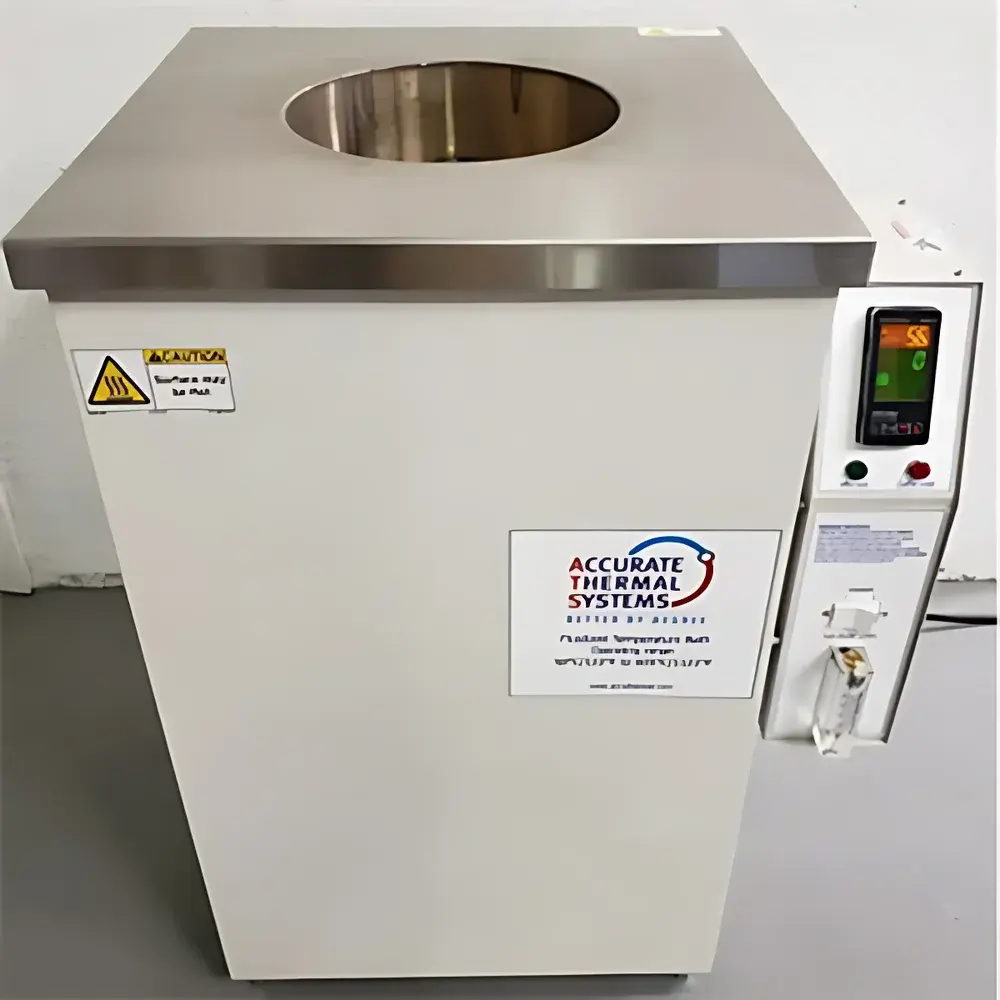
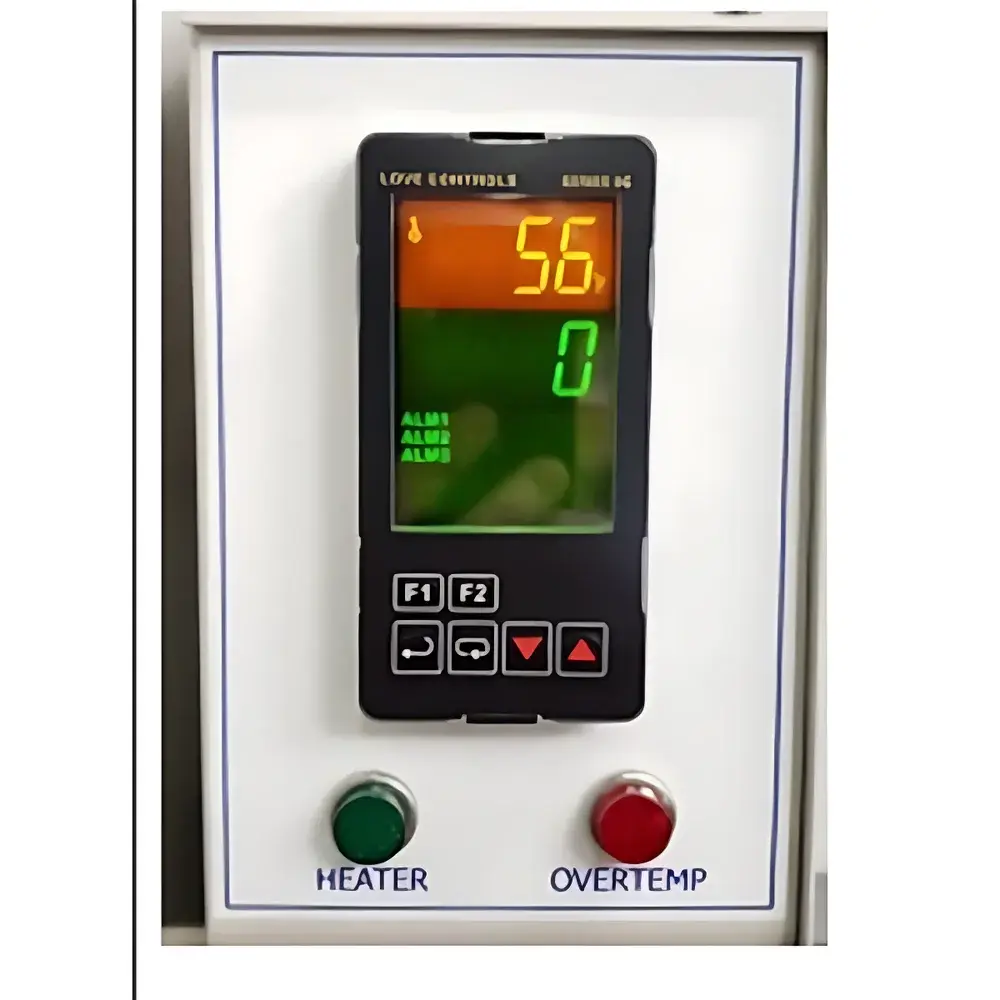
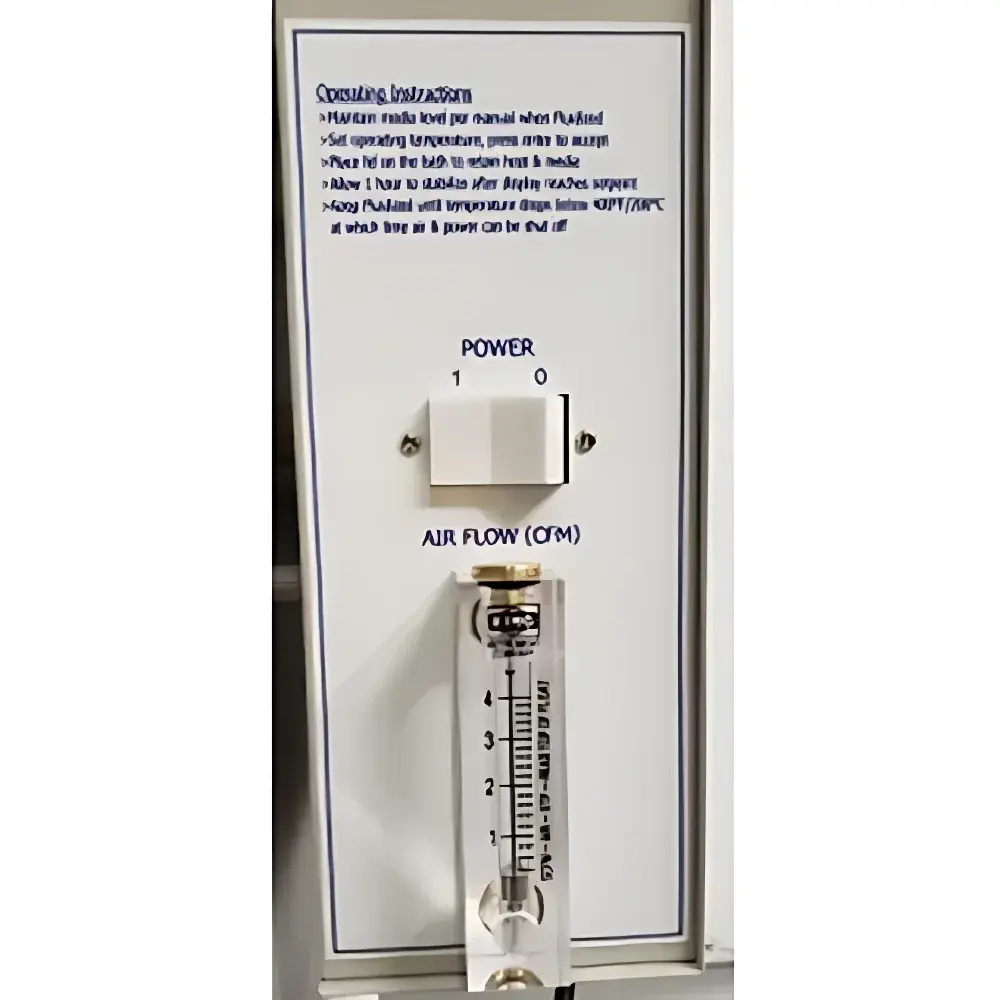
Accurate Thermal Systems FTBLL26 Fluidized Bed Thermal Cleaner
| [Brand | Accurate Thermal Systems |
|---|---|
| Origin | USA |
| Model | FTBLL26 |
| Power Supply | 220–240 VAC, 50/60 Hz, 30 A |
| Max Heating Capacity | 6800 W |
| Operating Temperature Range | Ambient to 1140 °F (615 °C) |
| Fluidization Air Requirement | Clean, dry air at 50 PSI, up to 8.0 CFM |
| Safety | Dual-fuse protection, independent overtemperature cutoff at 1140 °F, CE certified |
| Control System | Four-zone PID temperature controller with RS485 PC interface |
| Air Flow Control | Fully automated 4-stage fluidization air regulation |
| Internal Chamber Dimensions | Up to 12.3 in (312 mm) diameter × 26 in (660 mm) depth |
| Included | Alumina fluidization medium, operator manual] |
Overview
The Accurate Thermal Systems FTBLL26 Fluidized Bed Thermal Cleaner is an industrial-grade, electrically heated thermal cleaning system engineered for the non-abrasive, oxidative decomposition of organic residues from metal tooling and process components. It operates on the principle of fluidized bed heat transfer: finely graded alumina particles are suspended in a controlled upward stream of clean, dry air—creating a pseudo-liquid thermal medium with exceptional heat transfer uniformity and minimal thermal mass lag. Unlike pyrolytic ovens or abrasive blasting, this method subjects parts to convective and conductive heating without mechanical wear, oxidation-limiting atmospheres, or volatile emissions typical of solvent-based cleaning. The FTBLL26 is purpose-built for high-throughput thermal decontamination in extrusion, injection molding, and composite manufacturing environments—where rapid cycle times, repeatable residue removal, and dimensional stability of precision tooling are critical.
Key Features
- Automated four-stage fluidization air control system dynamically modulates airflow during ramp-up, soak, cooldown, and standby phases—ensuring optimal particle suspension, thermal homogeneity, and energy efficiency.
- Four-zone PID temperature controller delivers precise, stable thermal profiles across the entire chamber volume; each zone independently monitors and adjusts heater output to compensate for thermal gradients.
- Dual redundant safety architecture: independent overtemperature cutoff at 1140 °F (615 °C), plus dual fusing per IEC 61000-4-5 compliance—designed to meet UL 508A and CE Machinery Directive (2006/42/EC) requirements.
- Robust stainless-steel construction with insulated double-wall chamber and integrated exhaust port (5-inch diameter) compatible with standard industrial fume extraction systems.
- RS485 serial interface enables integration into factory-wide SCADA or MES platforms for audit-ready temperature logging, parameter archiving, and remote diagnostics.
- Full-cycle cleaning capability within 60 minutes for typical mold components—validated per ASTM D3418 (thermal transitions of polymers) and ISO 17025-accredited lab protocols.
Sample Compatibility & Compliance
The FTBLL26 accommodates a broad range of thermally stable metallic substrates—including hardened tool steels (e.g., H13, S7), aluminum alloys, tungsten carbide inserts, and stainless-steel hardware—without compromising metallurgical integrity or surface finish. It effectively removes thermoset resins, silicone-based release agents, polyurethane foams, epoxy adhesives, and carbonized polymer deposits. All cleaning cycles operate under ambient atmospheric conditions, eliminating the need for inert gas purging or post-process passivation. The system conforms to OSHA 29 CFR 1910.1200 (Hazard Communication), EPA 40 CFR Part 63 Subpart MMMMM (National Emission Standards for Hazardous Air Pollutants), and supports GLP/GMP documentation workflows via optional electronic logbook software compliant with FDA 21 CFR Part 11.
Software & Data Management
While the FTBLL26 operates autonomously via its front-panel interface, its RS485 port supports connection to Windows-based host software for full parameter configuration, real-time temperature trending, and exportable CSV data logs. Each cleaning cycle can be assigned a unique ID, timestamped, and associated with operator credentials and part lot numbers—enabling traceability across shift changes and quality audits. Firmware updates are delivered via secure USB key; all calibration constants and alarm thresholds are password-protected and version-locked to prevent unauthorized modification.
Applications
- Thermal cleaning of extrusion dies, breaker plates, and screen packs in polymer processing lines.
- Restoration of injection mold cavities, cores, hot runners, nozzles, and sprue bushings contaminated with charred thermoplastics or crosslinked elastomers.
- Pre-bond surface preparation of metal inserts prior to overmolding or adhesive bonding.
- Conditioning of filtration media, feed screws, and melt pumps used in recycling and compounding operations.
- Controlled ashing of composite layup tools and autoclave fixtures prior to re-coating or reconditioning.
FAQ
What types of residues can the FTBLL26 fully remove?
It decomposes organic materials—including thermosets, silicones, epoxies, polyimides, and carbonized hydrocarbons—via controlled oxidative pyrolysis at temperatures up to 1140 °F. Inorganic fillers, oxides, and metallic salts remain as removable ash.
Is the alumina medium consumable?
Alumina fluidization media exhibits negligible attrition under normal operation and is rated for >5 years of continuous use; periodic sieving and top-up (typically <2% annual loss) maintain optimal fluidization characteristics.
Can the system be validated for regulated production environments?
Yes—its deterministic thermal profile, calibrated sensor redundancy, and electronic audit trail support IQ/OQ/PQ execution per ISO 9001, AS9100, and ISO 13485 frameworks.
What maintenance is required?
Daily visual inspection of air filters and exhaust ducts; quarterly verification of thermocouple calibration and overtemperature cutoff function; annual replacement of main contactor and air solenoid valves—documented in the included Preventive Maintenance Log.
Does it require external ventilation or scrubbing?
Yes—continuous exhaust at ≥800 CFM is mandatory to evacuate combustion byproducts; connection to a dedicated ducted fume hood or central plant exhaust with afterburner or activated carbon scrubber is required per local air quality regulations.



