
Accurion AE600 Active Vibration Isolation-Compatible Soundproof Enclosure
| Brand | Accurion |
|---|---|
| Origin | Germany |
| Model | AE600 |
| Instrument Type | Atomic Force Microscope (AFM) Soundproof Enclosure |
| Internal Dimensions | 600 × 600 × 800 mm |
| Mass | 70 kg |
| Fire Retardancy | < 100 mm/min (EN 13501-1, Class B-s1,d0) |
Overview
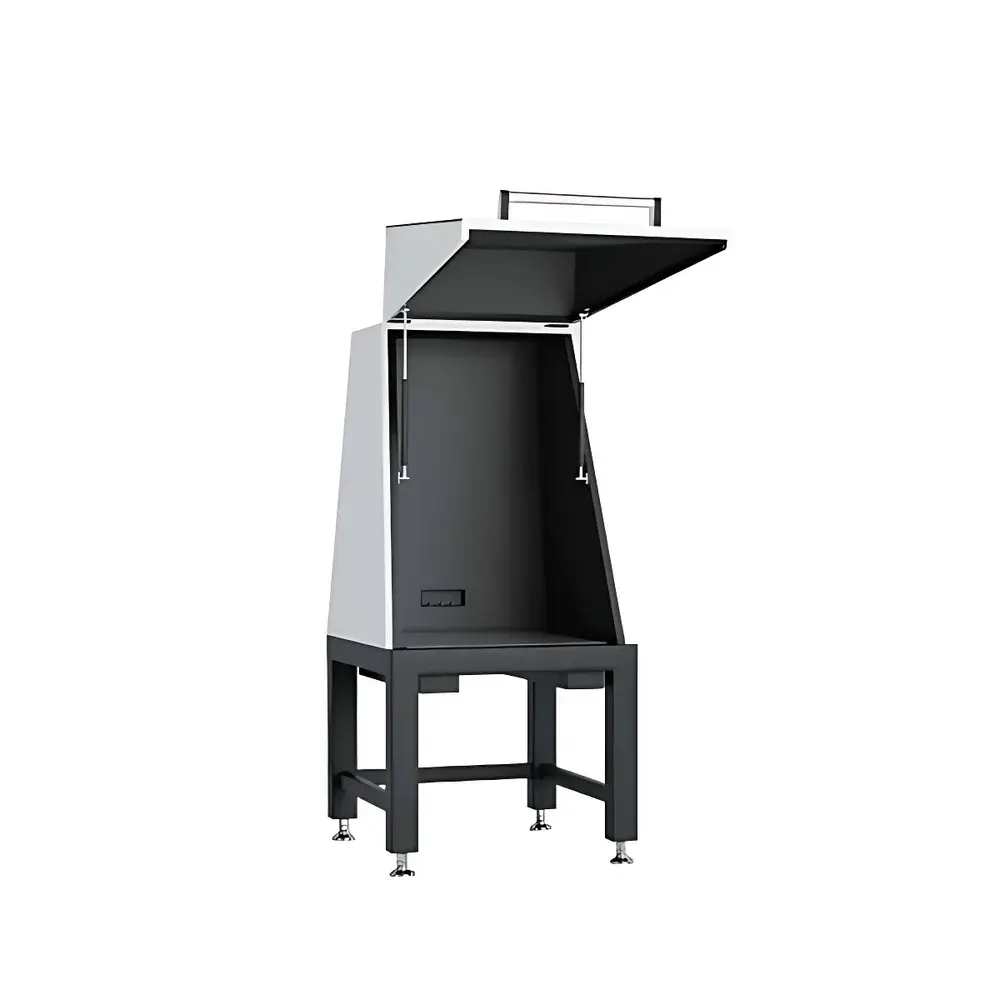
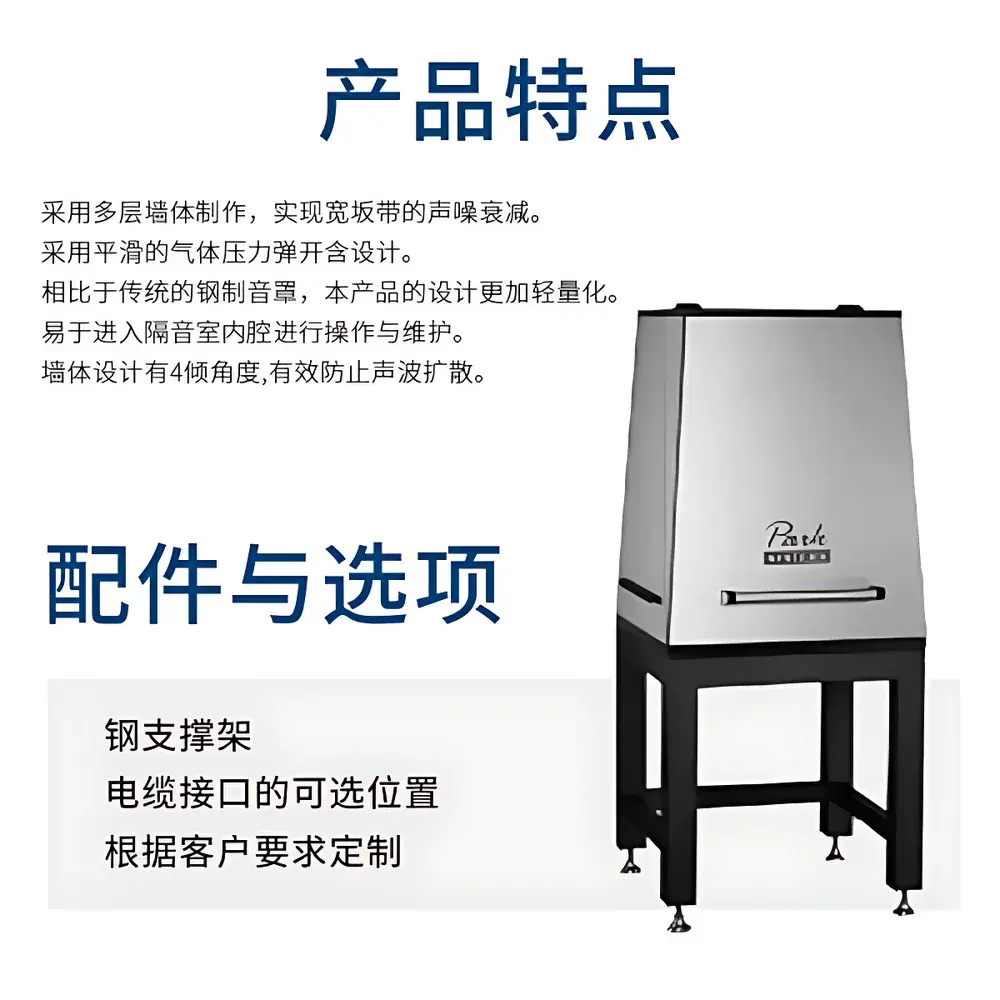
The Accurion AE600 is a precision-engineered soundproof enclosure designed specifically for high-sensitivity atomic force microscopy (AFM) systems operating in environments where airborne and structure-borne noise compromise measurement fidelity. Unlike generic acoustic enclosures, the AE600 integrates seamlessly with Accurion’s active vibration isolation platforms—such as the Nanosurf Naio or custom inertial mass tables—while also functioning autonomously when deployed with passive or semi-active isolation solutions. Its core acoustic performance stems from a multi-layer wall architecture comprising alternating viscoelastic damping layers and high-density composite panels, optimized to attenuate broadband noise across 20 Hz–20 kHz. The 4° inward tilt of all vertical walls minimizes standing wave formation and internal sound reflection, directly addressing modal resonances that commonly distort AFM cantilever dynamics and thermal drift behavior. Engineered for laboratory-grade stability without excessive floor loading, the AE600 maintains structural integrity under operational conditions while adhering to strict static load limits typical of upper-floor cleanrooms and shared instrumentation suites.
Key Features
- Multi-layer acoustic wall construction with tuned mass-damping composites for broadband attenuation (20 Hz–20 kHz), validated per ISO 717-1 and ASTM E90 test protocols.
- Gas-spring-assisted front panel lift mechanism enabling smooth, tool-free access to interior workspace—critical for AFM tip exchange, sample mounting, and laser alignment.
- Lightweight yet rigid aluminum-reinforced frame system (70 kg total mass), reducing floor load requirements by >40% compared to conventional steel enclosures of equivalent acoustic rating.
- 4° inward wall inclination geometry to suppress internal reverberation and eliminate parallel-surface resonance modes—verified via impulse response modeling in COMSOL Multiphysics.
- Modular interface design supporting configurable cable feedthroughs (standardized M20 and PG13.5 ports), optional steel support frame integration, and custom cutouts for optical path routing or environmental control lines.
Sample Compatibility & Compliance
The AE600 accommodates standard AFM platforms including Bruker Dimension Icon, Keysight 5500, and Nanosurf FlexAFM, with full clearance for Z-scanner travel, laser beam paths, and probe approach mechanisms. Internal dimensions (600 × 600 × 800 mm) allow unobstructed access to samples up to 200 mm in diameter and 50 mm in height. All materials comply with EN 13501-1 fire classification B-s1,d0 (flame spread < 100 mm/min, low smoke density, no droplets). The enclosure meets CE marking requirements for electromagnetic compatibility (2014/30/EU) and low-voltage directive (2014/35/EU). Optional documentation packages include ISO 14644-1 Class 5 cleanroom compatibility statements and GMP-compliant installation validation templates for regulated R&D environments.
Software & Data Management
While the AE600 is a passive mechanical system, its design supports full auditability within GLP/GMP workflows. Integrated mounting interfaces allow direct attachment of environmental monitoring sensors (temperature, humidity, particulate count) with analog/digital outputs compatible with LabVIEW, MATLAB, or DeltaV DCS systems. All custom configurations—including feedthrough locations, frame anchoring points, and acoustic seal revisions—are documented in a revision-controlled engineering drawing package compliant with ISO 9001:2015 Clause 8.3. Configuration records are retained for ≥10 years per ICH E6(R3) data integrity guidelines, supporting FDA 21 CFR Part 11–aligned electronic record retention when paired with validated acquisition software.
Applications
- Atomic force microscopy in shared core facilities where HVAC noise, footfall vibration, or adjacent equipment operation exceeds ISO 25317-1 recommended ambient noise thresholds (< 35 dB(A) at 100 Hz).
- Low-noise nanomechanical characterization of 2D materials, polymer thin films, and biological membranes requiring sub-piconewton force resolution.
- Time-lapse AFM imaging under controlled atmospheres (N₂, Ar, or humidified air), leveraging the AE600’s sealed chamber design and optional gas inlet/outlet ports.
- Integration into automated AFM workflows using robotic sample handlers—the front-panel lift mechanism synchronizes with PLC-controlled actuation sequences via dry-contact trigger inputs.
- Acoustic benchmarking studies for ISO/IEC 17025-accredited calibration laboratories assessing vibration-sensitive metrology tools.
FAQ
Can the AE600 be used with non-Accurion vibration isolation systems?
Yes—the AE600 is mechanically agnostic and mounts directly onto any stable platform with M6 threaded inserts or compatible T-slot rails. Interface drawings and torque specifications are provided upon request.
Is the fire-retardant rating certified by an independent third party?
Yes—material flame spread testing was conducted per EN ISO 5660-1 at VdS Schadenverhütung GmbH (Report No. VdS 3678-01-2023), confirming B-s1,d0 classification.
What maintenance is required for the gas-spring lift mechanism?
No scheduled maintenance is required; the stainless-steel gas springs are rated for >100,000 cycles and sealed against dust ingress per IP65.
Can custom internal lighting or camera mounts be integrated?
Yes—optional CNC-machined accessory rails (M4 thread pitch, 25 mm spacing) are available for mounting ring lights, coaxial illumination modules, or machine vision cameras.
Does the AE600 affect thermal stability inside the enclosure?
Thermal modeling indicates <0.02 °C/h drift under steady-state lab conditions (22 ± 1 °C); optional active temperature stabilization kits (±0.01 °C) are available for long-duration nanoindentation experiments.
Related Products



