
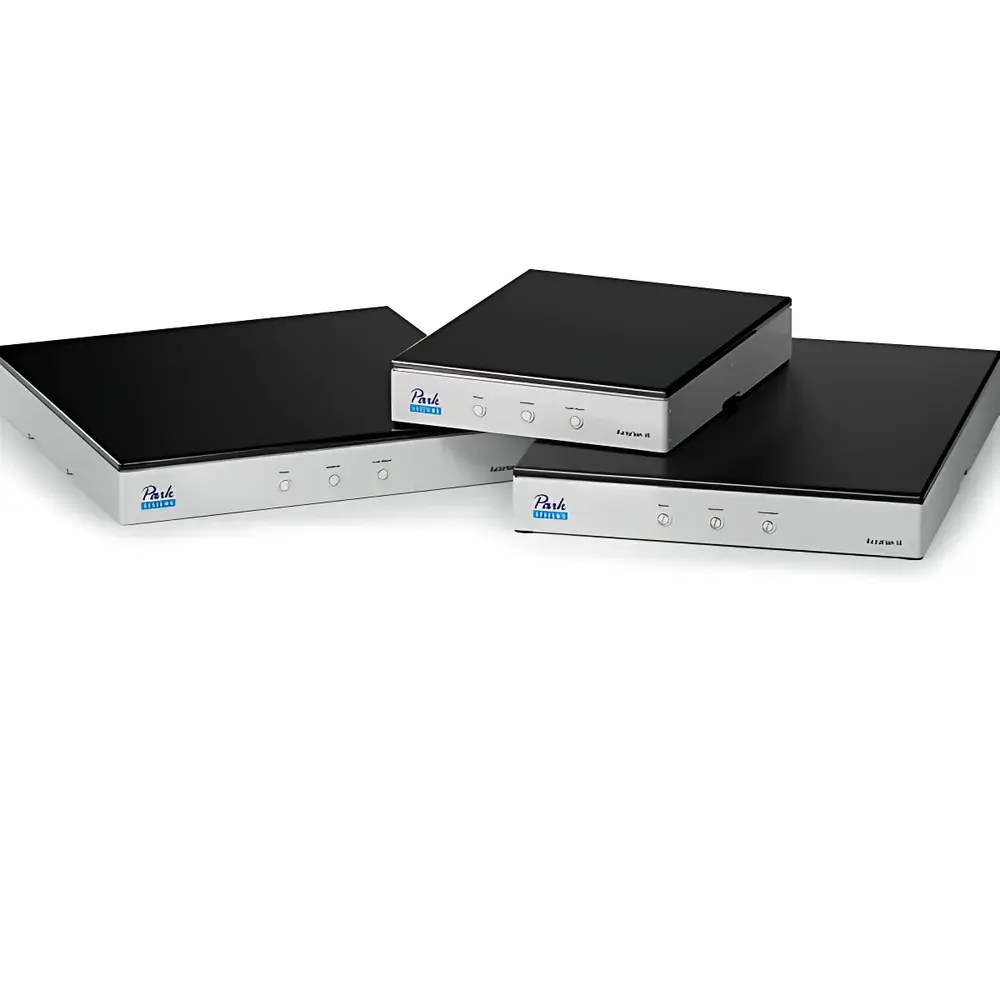
Accurion i4 Active Vibration Isolation Table
| Brand | Accurion |
|---|---|
| Origin | Germany |
| Model | i4 |
| Dimensions | 400 × 500 × 90 mm |
| Payload Capacity | 0–120 kg |
| Active Isolation Bandwidth | 0.6/1 Hz to 200 Hz |
| Degrees of Freedom | 6-DOF |
| Settling Time | ≤ 0.3 s |
| Power Supply | Standard AC Mains (No Compressed Air Required) |
| Inherent Stiffness at 1 Hz | 20–30× Higher Than Typical Passive Isolation Tables |
Overview
The Accurion i4 Active Vibration Isolation Table is an engineered solution for high-sensitivity laboratory instrumentation requiring sub-micron positional stability under ambient mechanical disturbances. Unlike passive isolation systems—such as air-spring or elastomeric tables—the i4 employs real-time, closed-loop inertial sensing and electromagnetic actuation across all six degrees of freedom (6-DOF) to actively suppress vibrational energy. Its core principle relies on continuous measurement of table motion via integrated accelerometers and position sensors, followed by instantaneous generation of counteracting forces through voice-coil actuators. This architecture eliminates low-frequency resonance peaks inherent in passive systems, delivering consistent attenuation from as low as 0.6 Hz (or 1 Hz, depending on configuration) up to 200 Hz—encompassing building-borne vibrations (e.g., HVAC-induced floor noise at 4–16 Hz), footfall excitation (1–8 Hz), and higher-frequency acoustic coupling. Designed specifically for tabletop integration, the i4 serves as a foundational platform for scanning probe microscopes (SPM), optical interferometers, nanoindenters, laser-based metrology tools, and other resolution-critical instruments where thermal drift and mechanical perturbation must be decoupled from measurement integrity.
Key Features
- True 6-degree-of-freedom active vibration cancellation—simultaneous suppression of translational (X, Y, Z) and rotational (pitch, yaw, roll) modes.
- Ultra-fast settling time of ≤ 0.3 seconds following step disturbances—more than two orders of magnitude faster than conventional pneumatic or mechanical passive isolators (typically 30–60 s).
- High inherent stiffness at 1 Hz—20 to 30 times greater than standard passive air tables—enabling exceptional static and dynamic positional stability without sacrificing isolation performance.
- Compact form factor (400 × 500 × 90 mm) optimized for benchtop deployment; no external infrastructure required—operates directly from standard AC mains power, eliminating dependency on compressed air lines or dedicated utility rooms.
- Intuitive push-button interface with status LED indicators—no software installation or calibration training needed for basic operation.
- Robust mechanical architecture compliant with ISO 10816-1 (vibration severity evaluation) and aligned with best practices for GLP/GMP-compliant environments where instrument stability must be documented and auditable.
Sample Compatibility & Compliance
The i4 supports payloads ranging from 0 to 120 kg, accommodating a broad spectrum of analytical and metrological equipment—including atomic force microscopes (AFM), white-light interferometers, confocal Raman systems, and high-magnification optical profilers. Its flat, non-magnetic stainless-steel top plate (standard finish) ensures compatibility with vacuum-compatible accessories and facilitates secure mounting via M4 or M6 threaded holes (customizable per application). The system complies with CE marking requirements (EMC Directive 2014/30/EU and Low Voltage Directive 2014/35/EU) and meets IEC 61000-6-2 immunity standards for industrial environments. While not certified to ISO 22477-1 (for geotechnical testing) or ASTM E1776 (for vibration testing laboratories), its performance envelope satisfies the operational prerequisites outlined in ISO 14644-1 Class 5 cleanroom vibration criteria and aligns with recommendations in ISO/IEC 17025:2017 for uncertainty control in dimensional metrology.
Software & Data Management
The i4 operates autonomously via embedded firmware and requires no host PC for core functionality. Optional USB- or Ethernet-connected diagnostic software (Accurion VIBControl Suite) enables advanced monitoring—including real-time FFT spectral analysis, time-domain waveform logging, bandwidth tuning, and event-triggered data capture. All system logs—including actuator duty cycle, sensor health status, and environmental temperature—are timestamped and exportable in CSV format for traceability. Audit trails comply with FDA 21 CFR Part 11 requirements when used in regulated QC/QA workflows, supporting electronic signatures and user-access controls upon integration with enterprise LIMS platforms.
Applications
- Nanoscale surface characterization using AFM, STM, and SNOM—where sub-nanometer Z-axis stability is essential.
- Optical coherence tomography (OCT) and digital holographic microscopy—requiring phase stability over multi-second acquisition windows.
- Precision laser alignment in quantum optics setups, including cavity ring-down spectroscopy and cold atom trapping.
- In-process metrology during semiconductor wafer inspection or mask alignment, where vibration-induced blur compromises feature recognition.
- Calibration laboratories performing ISO 10360-compliant CMM verification, where environmental vibration contributes measurably to length measurement uncertainty budgets.
FAQ
Does the i4 require compressed air or external cooling?
No. The i4 is fully self-contained and powered solely by standard AC mains voltage (100–240 VAC, 50/60 Hz). It generates no significant heat load and operates silently without auxiliary utilities.
Can the i4 be integrated into a cleanroom or ISO Class 5 environment?
Yes. Its sealed electronics, non-outgassing materials, and absence of pneumatic components make it suitable for ISO 14644-1 Class 5 and higher cleanrooms. Optional epoxy-coated top plates are available for enhanced corrosion resistance.
Is remote monitoring or network control supported?
Yes—via optional Ethernet interface and VIBControl Suite, enabling SNMP-based alerts, RESTful API access, and integration with facility SCADA systems.
What maintenance is required over its service life?
None beyond periodic visual inspection of mounting hardware and verification of power supply integrity. The solid-state actuation and sensor architecture have no consumables or wear-prone mechanical elements.
How does the i4 compare to hybrid (active + passive) isolation solutions?
Unlike hybrid systems that rely on passive elements for low-frequency support and active correction only above ~5 Hz, the i4 delivers full-bandwidth active control down to 0.6 Hz—eliminating the “gap” in performance where most building vibrations reside.



