
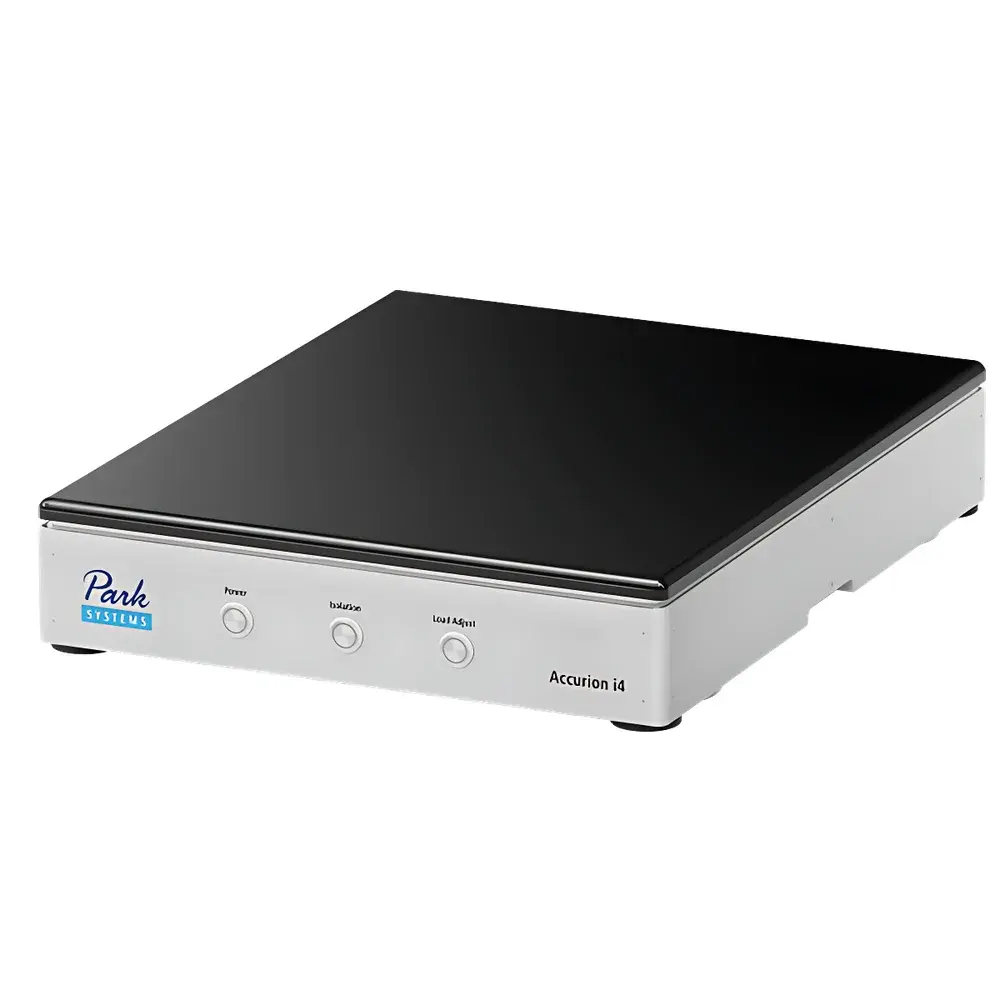
Accurion i4 Medium Active Vibration Isolation Table
| Brand | Accurion |
|---|---|
| Origin | Germany |
| Model | i4 Medium |
| Dimensions | 600 × 600 × 90 mm |
| Load Capacity | 0–105 kg or 40–150 kg (dual-range configuration) |
| Active Isolation Bandwidth | up to 200 Hz |
| Settling Time | ≤ 0.3 s |
| Degrees of Freedom | 6-DOF (all axes actively controlled) |
| Power Supply | Standard AC mains (no compressed air required) |
| Inherent Stiffness at 1 Hz | 20–30× higher than typical pneumatic passive tables |
Overview
The Accurion i4 Medium is a high-performance, compact active vibration isolation table engineered for precision laboratory environments where sub-micron stability and rapid dynamic response are critical. Unlike passive pneumatic or elastomeric isolation systems—which rely on mechanical compliance and exhibit problematic low-frequency resonances—the i4 Medium employs real-time, closed-loop inertial sensing and electromagnetic actuation across all six degrees of freedom (6-DOF). This architecture enables continuous, adaptive counter-force generation to suppress ground-borne vibrations from building infrastructure, HVAC systems, footfall, and nearby machinery—particularly in the 0.5–200 Hz range where most environmental disturbances occur and where passive systems fail catastrophically. Designed specifically for desktop integration, the i4 Medium delivers exceptional positional stability (< 1 nm RMS vertical drift at 1 Hz) without requiring external utilities such as compressed air, making it suitable for cleanrooms, metrology labs, optical interferometry setups, and nanoscale surface characterization platforms including AFM, SEM, and optical profilometers.
Key Features
- True 6-DOF active vibration cancellation—simultaneous suppression of translational (X, Y, Z) and rotational (pitch, yaw, roll) disturbances
- Ultra-fast settling time of ≤ 0.3 seconds following step disturbances—enabling rapid repositioning and minimizing measurement downtime
- Isolation bandwidth extending to 200 Hz—covering both low-frequency structural vibrations and mid-frequency mechanical noise
- No low-frequency resonance modes—eliminates the “ringing” and prolonged decay characteristic of pneumatic isolators
- High inherent stiffness at 1 Hz (20–30× greater than standard pneumatic tables), ensuring minimal static deflection under load and superior long-term positional repeatability
- Plug-and-play operation—powered via standard 100–240 V AC input; no external air supply, plumbing, or vacuum lines required
- Compact footprint (600 × 600 × 90 mm) with dual-load configurations (0–105 kg or 40–150 kg) to accommodate diverse instrument footprints and mass distributions
- Intuitive front-panel push-button interface for power, mode selection, and system status indication—no software installation needed for basic operation
Sample Compatibility & Compliance
The i4 Medium is compatible with a broad spectrum of high-sensitivity instrumentation, including scanning probe microscopes (SPM), laser interferometers, white-light interferometers, confocal microscopes, nanoindention systems, and ultra-low-noise electronic test benches. Its rigid aluminum honeycomb tabletop ensures excellent thermal stability and flatness (≤ ±5 µm over full surface), while non-magnetic construction prevents interference with electron beam or magnetic field-sensitive experiments. The system complies with ISO 2631-1 (human exposure to vibration), ISO 10816-1 (vibration severity assessment), and meets mechanical safety requirements per EN 61000-6-2 (immunity) and EN 61000-6-4 (emissions). While not certified for medical device use, its design supports GLP and GMP-aligned lab workflows through deterministic performance, traceable calibration protocols, and absence of consumables or maintenance-dependent components.
Software & Data Management
The i4 Medium includes optional USB- and Ethernet-enabled digital control software (i4 Control Suite) for advanced monitoring, parameter tuning, and diagnostic logging. Users can visualize real-time vibration spectra, monitor actuator effort, adjust gain profiles per axis, and export time-series data in CSV format for post-acquisition analysis. Audit-trail functionality records all configuration changes with timestamps and user identifiers—supporting compliance with FDA 21 CFR Part 11 requirements when deployed in regulated quality control laboratories. Firmware updates are delivered via secure HTTPS, and system health diagnostics—including sensor integrity checks and thermal monitoring—are logged automatically for preventive maintenance planning.
Applications
- Nanoscale surface imaging and force spectroscopy using atomic force microscopy (AFM)
- Sub-nanometer displacement metrology in optical interferometric alignment systems
- Vibration-sensitive optical coherence tomography (OCT) and holographic setups
- Low-noise electrical characterization of 2D materials and quantum devices
- Stable platform for laser-based particle tracking and dynamic light scattering (DLS) instrumentation
- Calibration reference stations for coordinate measuring machines (CMM) and stylus profilometers
- Research-grade micro-manipulation and patch-clamp electrophysiology rigs requiring mechanical quiescence
FAQ
Does the i4 Medium require compressed air or other auxiliary utilities?
No—it operates solely on standard AC power and contains no pneumatic components.
Can the i4 Medium support instruments with asymmetric mass distribution or extended footprints?
Yes—its 6-DOF control architecture compensates for off-center loads and moment imbalances; custom mounting plates and leveling feet are available upon request.
What is the recommended floor vibration specification for optimal performance?
For best results, floor vibration should not exceed 100 µm/s RMS between 1–100 Hz; the system remains effective even on moderately damped concrete slabs or upper-floor laboratory spaces.
Is remote monitoring or integration into LabVIEW possible?
Yes—TCP/IP and SCPI-compatible command sets enable seamless integration with third-party automation frameworks and data acquisition software.
How often does the system require recalibration or maintenance?
No routine recalibration is required; factory calibration remains valid over the product lifetime under normal operating conditions. Annual verification using supplied test signals is recommended for ISO/IEC 17025-compliant labs.



