
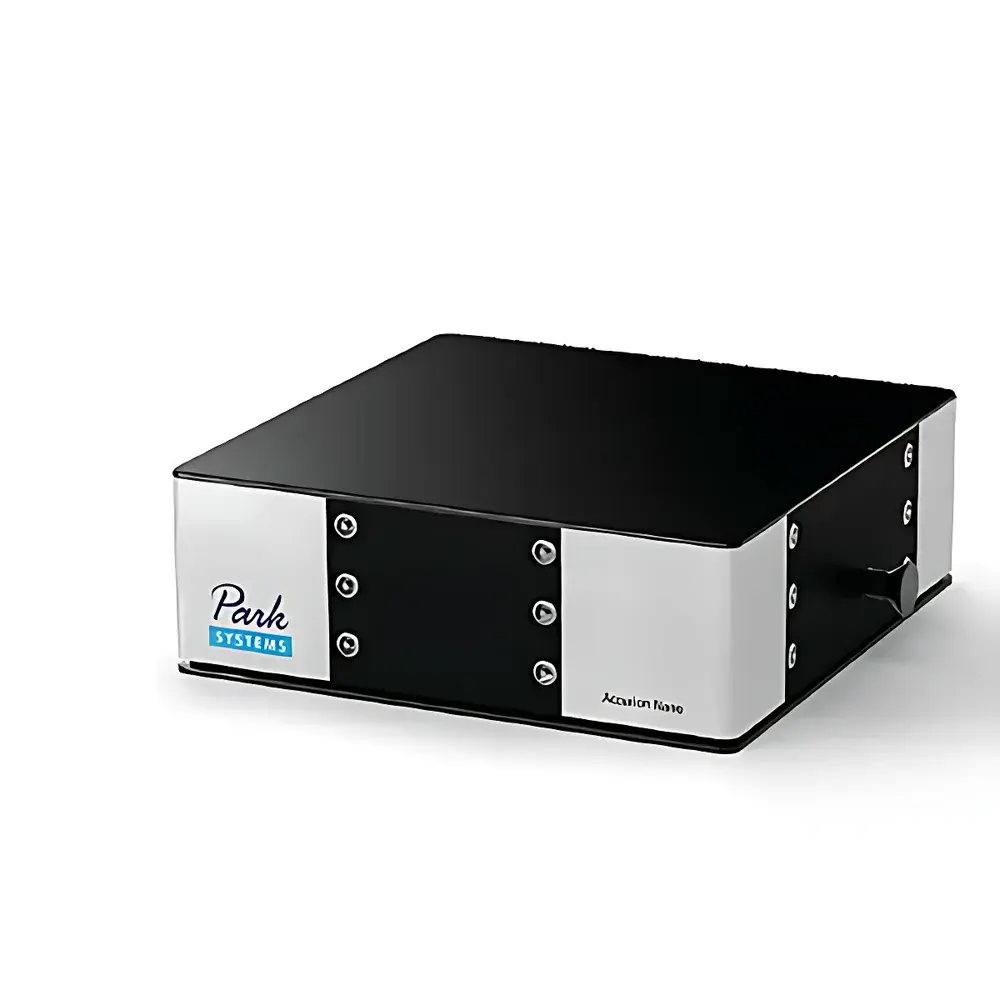
Accurion Nano Series Compact Active Vibration Isolation Platform
| Brand | Accurion |
|---|---|
| Origin | Beijing, China |
| Manufacturer Type | Authorized Distributor |
| Product Origin | Domestic (China) |
| Model | Nano Series |
| Pricing | Available Upon Request |
Overview
The Accurion Nano Series Compact Active Vibration Isolation Platform is an engineered solution for high-precision optical and nanoscale measurement environments where sub-micron stability is non-negotiable. Unlike passive isolation systems—such as pneumatic or elastomeric supports—the Nano Series employs real-time, closed-loop active vibration cancellation across all six degrees of freedom (6-DOF): vertical (Z), lateral (X, Y), pitch, yaw, and roll. Its core principle relies on continuous sensing of ambient acceleration via ultra-sensitive piezoelectric accelerometers, followed by real-time signal processing and dynamic counter-force generation through electromagnetic actuators. This architecture eliminates low-frequency resonance modes inherent in air-isolated tables—particularly critical below 5 Hz—where building-borne vibrations (typically 0.5–30 Hz vertically and horizontally) and mechanical equipment noise (10–500 Hz) most severely degrade interferometric, AFM, ellipsometric, or profilometric measurements. Designed specifically for compact benchtop integration, the Nano Series delivers laboratory-grade isolation performance without requiring compressed air, external cooling, or structural anchoring—making it ideal for cleanroom-constrained setups, university teaching labs, and R&D prototyping stations.
Key Features
- True 6-DOF active vibration isolation with real-time feedback control (bandwidth: 0.6 Hz to 200 Hz)
- No low-frequency resonance peak—superior performance below 5 Hz compared to pneumatic isolators
- Sub-second stabilization time: ≤ 0.3 s after perturbation (vs. 30–60 s for conventional passive platforms)
- High static stiffness at 1 Hz: 20–30× greater than equivalent passive systems, ensuring exceptional positional stability
- Compact footprint and modular design—optimized for space-limited optical benches and metrology workstations
- Plug-and-play operation: powered solely by standard AC mains; no compressed air, vacuum lines, or external controllers required
- Integrated tactile interface with single-button activation and status LED indicators
- Scalable platform variants (Nano 20, Nano 30) supporting payloads from 0–8 kg up to 10–30 kg
Sample Compatibility & Compliance
The Nano Series is compatible with a broad range of high-resolution instruments including imaging ellipsometers (e.g., Accurion i4-Large), 3D optical profilers, confocal microscopes, laser interferometers, and nanoindentation systems. Its rigid, low-thermal-drift aluminum alloy construction meets ISO 10360-7 (coordinate measuring machine environmental requirements) and aligns with best practices outlined in ISO/IEC 17025 for calibration laboratories. While not certified to specific regulatory standards (e.g., FDA 21 CFR Part 11), its deterministic control loop and audit-ready operational logs support GLP/GMP-aligned documentation workflows when integrated into validated measurement processes. All units undergo factory calibration per ASTM E177 (Standard Practice for Use of the Terms Precision and Bias in ASTM Test Methods) and include traceable verification reports.
Software & Data Management
The Nano Series operates autonomously via embedded firmware—no host PC or proprietary software is required for basic functionality. Optional USB-C connectivity enables diagnostic monitoring, firmware updates, and real-time vibration spectrum logging using Accurion’s NanoControl Suite (Windows/macOS). The suite provides FFT-based spectral analysis, time-domain waveform capture, and export in CSV or HDF5 formats for post-processing in MATLAB, Python (SciPy), or LabVIEW. All system events—including power-on sequence, actuator saturation alerts, and sensor health diagnostics—are timestamped and stored internally for ≥30 days, facilitating root-cause analysis during QA/QC investigations or equipment qualification (IQ/OQ/PQ).
Applications
- Stabilization of imaging ellipsometers (e.g., i4-Large) for monolayer-thickness quantification in thin-film R&D
- Vibration suppression for white-light interferometry and confocal profilometry in surface topography metrology
- Enabling stable scanning probe microscopy (SPM) operation on upper-floor lab spaces with elevated floor vibration
- Supporting high-magnification optical alignment in quantum optics experiments involving trapped ions or cold atoms
- Facilitating repeatable nanoimprint lithography (NIL) tool calibration under non-basement facility conditions
- Providing isolation for portable optical coherence tomography (OCT) systems deployed in clinical or field settings
FAQ
Does the Nano Series require compressed air or external vacuum sources?
No. It operates exclusively on standard 100–240 VAC power and contains no pneumatic components.
What is the maximum payload capacity for the Nano 30 model?
The Nano 30 supports two rated configurations: 5–25 kg (standard) or 10–30 kg (high-load variant), depending on mounting interface and center-of-gravity constraints.
Can the platform be integrated into a GMP-compliant manufacturing environment?
Yes—its deterministic response, internal event logging, and absence of consumables (e.g., air filters, desiccants) make it suitable for regulated environments when included in a documented risk assessment and periodic performance verification protocol.
Is remote monitoring or network control supported?
Not natively. However, optional USB-C telemetry can be routed through industrial gateways for integration into SCADA or MES platforms via custom API wrappers.
How often does the system require recalibration?
Factory calibration is valid for 24 months under normal operating conditions. Annual verification using NIST-traceable shaker excitation is recommended for ISO/IEC 17025-accredited labs.



