
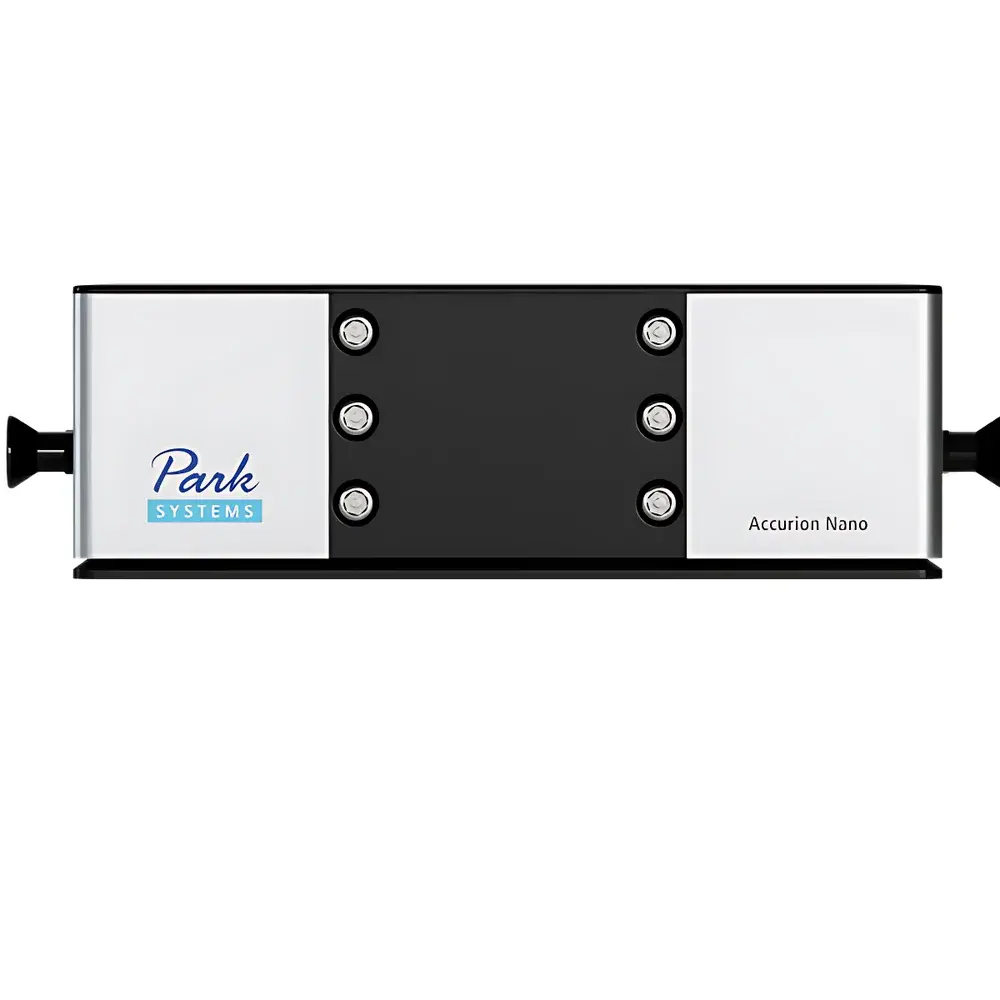
Accurion Nano20 Active Vibration Isolation Table
| Brand | Accurion |
|---|---|
| Origin | Germany |
| Model | Nano20 |
| Dimensions | 204 × 204 × 69 mm |
| Payload Capacity | 0–8 kg |
| Active Isolation Bandwidth | 0.6/1 Hz to 200 Hz |
| Degrees of Freedom | 6-DOF |
| Settling Time | ≤ 0.3 s |
| Power Supply | Standard AC Mains |
| Compressed Air Required | No |
Overview
The Accurion Nano20 Active Vibration Isolation Table is an electromechanically controlled, six-degree-of-freedom (6-DOF) platform engineered for high-stability operation of sensitive microscale and nanoscale instrumentation in non-ideal laboratory environments. Unlike passive pneumatic isolators—which rely on mechanical compliance and exhibit resonant amplification below ~2–5 Hz—the Nano20 employs real-time inertial sensing and force-feedback actuation to suppress vibrations across a continuous bandwidth from 0.6 Hz (or 1 Hz, depending on configuration) up to 200 Hz. This active control architecture eliminates low-frequency resonance peaks inherent in air-spring systems, delivering sub-micron positional stability even on floors subject to building-borne vibration (e.g., HVAC-induced floor motion, footfall, or nearby machinery). Its compact footprint (204 × 204 × 69 mm) and lightweight design (≤8 kg payload) make it ideal for integration beneath optical microscopes, atomic force microscopes (AFMs), confocal laser scanning systems, interferometers, and other benchtop metrology tools requiring stable mechanical reference frames.
Key Features
- True 6-DOF active vibration cancellation—simultaneous suppression of translational (X, Y, Z) and rotational (pitch, yaw, roll) disturbances.
- Ultra-fast dynamic response: settling time ≤ 0.3 seconds after step disturbance—more than two orders of magnitude faster than conventional passive tables (typically 30–60 s).
- High static stiffness at 1 Hz: intrinsic rigidity approximately 20–30× greater than equivalent passive isolators, minimizing drift and improving long-term measurement repeatability.
- No compressed air dependency: powered solely by standard AC mains—eliminates infrastructure requirements, noise, and maintenance associated with pneumatic systems.
- Plug-and-play operation: intuitive front-panel button interface enables immediate activation without software configuration or calibration routines.
- Robust mechanical architecture: aluminum alloy housing with precision-machined kinematic mounts ensures thermal stability and long-term geometric integrity.
Sample Compatibility & Compliance
The Nano20 is compatible with instruments weighing between 0 and 8 kg and occupying footprints within its 204 mm × 204 mm support surface. It accommodates standard M4 and M6 threaded mounting patterns and integrates seamlessly into ISO Class 5–7 cleanroom environments. While the device itself does not carry CE marking for medical use, its electromagnetic compatibility (EMC) conforms to EN 61326-1:2013 for laboratory equipment. For regulated quality assurance workflows—including those aligned with ISO/IEC 17025, ASTM E1777 (Standard Guide for Vibration Isolation of Precision Equipment), or GLP-compliant microscopy labs—the Nano20 supports traceable performance verification via optional external accelerometer validation kits. Its deterministic, closed-loop control architecture inherently satisfies audit requirements for instrument qualification (IQ/OQ/PQ) documentation.
Software & Data Management
The Nano20 operates autonomously without host PC dependency; however, optional USB- or Ethernet-enabled firmware modules allow connection to Accurion’s NanoControl Suite for advanced diagnostics. This software provides real-time FFT-based spectral analysis of residual motion, configurable isolation profiles (e.g., “Microscopy Mode” vs. “AFM Tuning Mode”), and timestamped log export (CSV format) for trend analysis and regulatory reporting. All firmware updates are digitally signed and version-controlled per IEC 62304 software lifecycle standards. Audit trails—including system startup events, parameter changes, and fault logs—are retained onboard for ≥30 days and exportable for FDA 21 CFR Part 11–compliant environments when used with validated user authentication protocols.
Applications
- Stabilization of optical coherence tomography (OCT) and super-resolution fluorescence microscopes in shared-core facilities.
- Vibration mitigation for tip-enhanced Raman spectroscopy (TERS) and scanning near-field optical microscopy (SNOM) setups.
- Enabling nanomechanical testing under atomic force microscopy where thermal drift and floor noise limit resolution.
- Supporting high-magnification digital holographic microscopy in urban laboratories with elevated ambient seismic noise.
- Isolating laser Doppler vibrometers and white-light interferometers during precision surface topography mapping.
FAQ
Does the Nano20 require compressed air or external vacuum sources?
No—operation is fully electric via standard AC input; no ancillary gas infrastructure is needed.
Can the Nano20 be stacked or integrated into multi-tier isolation systems?
Yes, it is mechanically and dynamically designed for cascaded deployment with passive or active base-isolation platforms.
What is the maximum allowable payload eccentricity?
Center-of-mass deviation should remain within ±15 mm of the geometric center for optimal 6-DOF performance.
Is firmware update capability included out-of-the-box?
Basic updates are supported via USB; network-enabled diagnostics require optional hardware module ordering.
How is performance validated post-installation?
Accurion provides a standardized test protocol using calibrated triaxial accelerometers and ISO 20483-compliant vibration spectra.



