
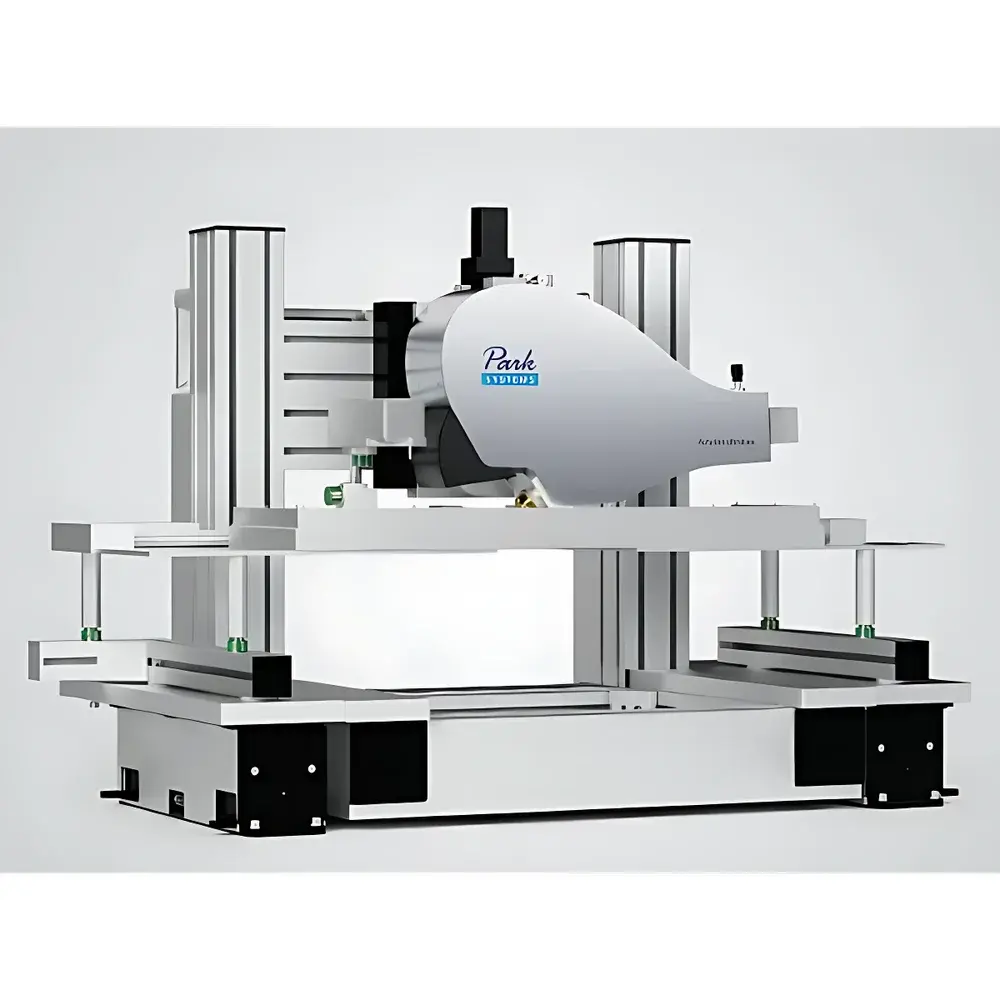
Accurion UltraBAM Brewster Angle Microscope
| Brand | Accurion |
|---|---|
| Origin | Germany |
| Model | Accurion UltraBAM Brewster Angle Microscope |
| Interface Compatibility | Standard Langmuir Trough Systems |
| Imaging Speed | 20–35 fps |
| Lateral Resolution | ≤2 µm |
| Brewster Angle Range | 52°–57° |
| Vertical Positioning | Motorized Precision Z-Stage |
| Vibration Isolation | Active Optical Table Integration |
| Quantitative Reflectivity Calibration | Yes |
| Anisotropy Detection | Motorized Rotating Analyzer |
| Field of View | Wide-Area (Compatible with Large-Surface Langmuir Troughs) |
| Data Format | AVI + Metadata-Embedded TIFF (Including Trough Parameters) |
Overview
The Accurion UltraBAM Brewster Angle Microscope is a purpose-engineered optical instrument for label-free, real-time, quantitative imaging of molecular monolayers and adsorbed films at air/liquid interfaces. Operating on the physical principle of Brewster angle reflectance microscopy, it exploits the polarization-dependent reflectivity minimum that occurs when p-polarized light strikes a dielectric interface at the Brewster angle—where the reflected and refracted beams are orthogonal. At this condition, reflectivity from the interface becomes highly sensitive to minute changes in surface mass density, molecular orientation, and interfacial refractive index. Unlike fluorescence or total internal reflection microscopy, UltraBAM requires no exogenous labeling, enabling non-invasive observation of native lipid, polymer, peptide, or surfactant films during dynamic processes such as compression, expansion, photoisomerization, or phase transition. Its optical architecture is optimized for Langmuir trough integration, supporting both standard and custom-built trough systems with synchronized acquisition of interfacial pressure (π), area (A), and time-resolved microstructural data.
Key Features
- Real-time, full-field focus imaging without axial scanning—enabled by telecentric wide-angle optics and depth-invariant illumination geometry
- Lateral resolution of ≤2 µm across the entire field of view, validated per ISO 19038 for optical surface metrology
- Motorized rotating analyzer for quantitative detection of in-plane optical anisotropy, revealing long-range orientational order in Langmuir monolayers
- Adjustable incident angle (52°–57°) to accommodate varying subphase refractive indices (e.g., aqueous buffers, organic solvents, ionic liquids)
- Integrated high-speed CMOS camera (20–35 fps) with on-board gain control and hardware-triggered synchronization to trough motor and pressure transducer
- Active vibration isolation platform compliant with ISO 20486 Class B specifications for nanoscale interfacial imaging
- Motorized precision Z-stage (sub-micron repeatability) for optimal focus maintenance during prolonged isobaric or isothermal experiments
- Native support for major Langmuir trough control software via TCP/IP and DLL-based API integration
Sample Compatibility & Compliance
The UltraBAM is validated for use with standard hydrophilic dielectric substrates—including fused silica, borosilicate glass, and calcium fluoride—and compatible with common Langmuir trough materials (Teflon, Delrin, stainless steel). It supports monolayer studies under physiologically relevant conditions (pH 4–10, ionic strength up to 500 mM NaCl, temperature range 15–45 °C). All optical components comply with IEC 61000-6-3 (EMC emissions) and IEC 61000-6-2 (immunity). Reflectivity calibration routines adhere to ASTM E2594-21 for quantitative surface optical characterization. The system architecture supports audit-trail generation and user-access logging, facilitating GLP-compliant documentation workflows per FDA 21 CFR Part 11 requirements when deployed in regulated QC environments.
Software & Data Management
Accurion’s BAMControl software provides synchronized acquisition of reflectivity maps, trough parameters (surface pressure π, area A, temperature), and time-stamped metadata. Each exported image (TIFF) embeds EXIF-style headers containing π, dπ/dA, frame timestamp, analyzer angle, and incident angle. Real-time AVI export supports post-acquisition kymograph analysis and particle tracking (via Fiji/ImageJ plugin compatibility). Batch processing tools enable automated quantification of domain area fraction, boundary curvature, and anisotropy vector fields. Raw data files are stored in vendor-neutral HDF5 format, ensuring long-term archival integrity and third-party analysis interoperability.
Applications
- Monitoring structural evolution during monolayer collapse, phase separation, and domain coalescence
- Quantifying adsorption/desorption kinetics of proteins, polymers, and nanoparticles at fluid interfaces
- Tracking photoinduced isomerization (e.g., azobenzene derivatives) and subsequent monolayer reorganization
- Characterizing Langmuir-Blodgett transfer fidelity onto solid supports
- Studying interfacial rheology-coupled phenomena, including Marangoni elasticity and dilatational modulus estimation
- Validating molecular dynamics simulations of amphiphile packing and tilt-angle distributions
FAQ
What interfaces can the UltraBAM image without contrast agents?
It images air/water, air/organic solvent, oil/water, and solid/liquid interfaces—provided the substrate is optically transparent and dielectric.
Can UltraBAM resolve sub-monolayer coverage?
Yes—its calibrated reflectivity sensitivity enables detection of surface mass changes down to ~0.01 ng/cm², corresponding to <5% monolayer coverage for typical phospholipids.
Is the system compatible with custom-built Langmuir troughs?
Yes—hardware trigger I/O and software SDK support integration with third-party trough controllers via TTL, RS-232, or Ethernet protocols.
Does UltraBAM meet regulatory requirements for pharmaceutical interfacial characterization?
When configured with audit-trail mode and electronic signature modules, it supports 21 CFR Part 11 compliance for GMP-relevant applications such as surfactant formulation QC.
How is lateral resolution verified?
Using NIST-traceable USAF 1951 resolution targets imaged under identical optical conditions; resolution is reported as the smallest resolvable group element per ISO 12233 Annex D.






