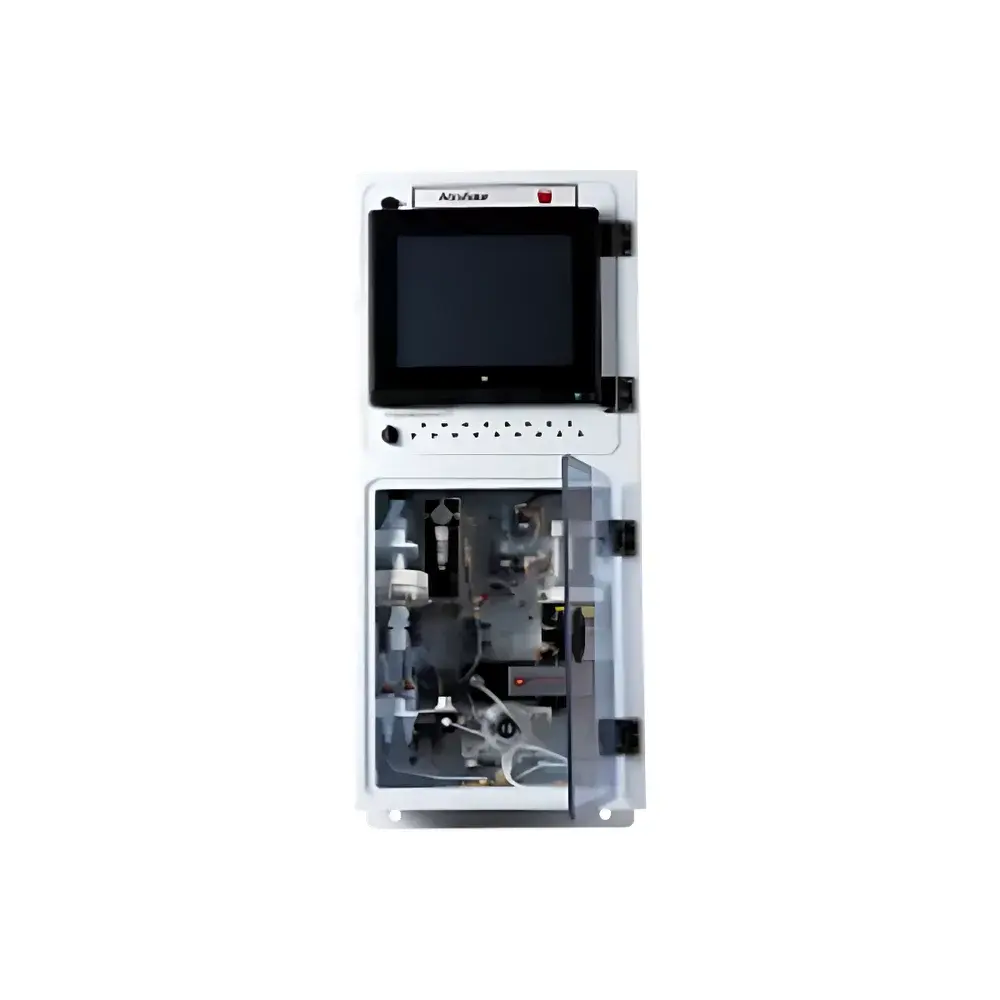
AccuSizer Mini Online Liquid Particle Counter
| Brand | Pharmsteri (Intertek) |
|---|---|
| Origin | USA |
| Model | AccuSizer Mini |
| Detection Principle | Single Particle Optical Sensing (SPOS) with LE/LS/FX/FX-Nano Sensor Options |
| Particle Size Range | 0.15–400 µm (configurable by sensor) |
| Concentration Range | Up to 1×10⁶ particles/mL (FX/FX-Nano with auto-dilution) |
| Resolution | 512 channels |
| Minimum Detectable Size | 150 nm (FX-Nano) |
| Sample Handling | Direct, one-step, or two-step automated dilution |
| Compliance | Designed for GLP/GMP environments |
| Interface | PLC-compatible digital I/O |
| Power | 100–240 VAC, 3-phase, C14 inlet |
| Pneumatic Supply | 3.5–5.6 kg/cm² (50–80 psi) |
| Liquid Inlet/Outlet Pressure | 0.2–2.1 kg/cm² (3–30 psi) / zero-backpressure discharge |
| Dimensions | 863.6 × 355.6 × 279.4 mm (34 × 14 × 11 in) |
Overview
The AccuSizer Mini Online Liquid Particle Counter is an industrial-grade, real-time particle monitoring system engineered for continuous, unattended operation in semiconductor manufacturing and high-value nanomaterial production environments. It employs Single Particle Optical Sensing (SPOS) — a calibrated, first-principles optical detection method that individually resolves and sizes each particle passing through the sensing zone via light extinction (LE), light scattering (LS), or focused-beam-enhanced detection (FX/FX-Nano). Unlike ensemble techniques such as dynamic light scattering (DLS) or laser diffraction, SPOS delivers absolute particle count and size distribution at ultra-low concentrations (down to single-digit particles per milliliter) with quantifiable traceability to NIST-traceable PSL standards. Its primary application lies in Large Particle Count (LPC) monitoring of chemical mechanical polishing (CMP) slurries — where particles >0.15 µm critically impact wafer yield through surface scratching. The system is deployed at point-of-use (POU) locations pre- and post-filtration to validate filter integrity, optimize replacement cycles, and enforce process control limits aligned with SEMI F39 and ISO 14644-1 Class 1–5 cleanroom specifications.
Key Features
- Modular sensor architecture supporting LE, FX, and FX-Nano configurations — enabling tailored detection ranges from 0.15 µm (FX-Nano) to 400 µm (LE) without hardware replacement
- Automated, programmable dilution system (direct, one-step, or two-step) optimized for highly concentrated CMP slurries up to 1×10⁶ particles/mL
- 512-channel high-resolution sizing binning ensures statistical robustness for low-abundance LPC populations — critical for detecting outliers beyond the main distribution tail
- Integrated sample mixing chamber and self-cleaning sensor flow path minimize carryover and maintain measurement repeatability across shifts
- Industrial I/O interface (24 VDC digital inputs/outputs) for seamless integration with PLC-based process control systems and enterprise LIMS/SCADA platforms
- Compliance-ready architecture: firmware and data handling protocols support ALCOA+ principles; optional 21 CFR Part 11-compliant software modules available for GMP-regulated operations
Sample Compatibility & Compliance
The AccuSizer Mini is validated for aqueous and non-aqueous suspensions including silicon dioxide, cerium oxide, and alumina-based CMP slurries; nanoemulsions; conductive inks; and biopharmaceutical colloidal formulations. Its sensor fluidics are chemically resistant to common slurry additives (e.g., oxidizers, chelating agents, surfactants) and compatible with standard semiconductor-grade deionized water rinse protocols. All configurations meet CE marking requirements for electromagnetic compatibility (EMC) and low-voltage directive compliance. For regulated environments, the system supports IQ/OQ documentation packages and can be qualified per ASTM E2457 (Standard Practice for Validation of Particle Counting Systems) and ISO 21501-4 (Calibration of Light Scattering Particle Counters). Data integrity safeguards include time-stamped audit logs, user-access controls, and immutable raw-data storage.
Software & Data Management
The AccuSizer Mini operates with proprietary WinSE software — a Windows-based platform offering real-time dashboard visualization, configurable alarm thresholds (e.g., >500 particles/mL @ >1.0 µm), trend analysis, and automated report generation (PDF/CSV). Historical datasets are stored in SQLite or SQL Server databases with built-in backup scheduling. When deployed in validated environments, optional Part 11-compliant modules provide electronic signatures, role-based permissions, and full audit trails for all configuration changes, calibration events, and result exports. Raw pulse data (intensity vs. time) is preserved alongside processed histograms, enabling retrospective re-analysis without loss of resolution. Integration APIs (RESTful JSON over HTTP) allow bidirectional communication with MES and SAP QM modules for automatic non-conformance flagging.
Applications
- CMP slurry qualification and release testing at POU — verifying LPC compliance prior to tool delivery
- Filtration efficiency validation across membrane grades (e.g., 0.1 µm vs. 0.05 µm) using differential counting before/after filter housing
- Root-cause analysis of yield excursions linked to transport-induced aggregation or pump shear degradation
- Stability monitoring of nanosuspensions during storage and transfer — detecting early-stage flocculation not visible via DLS
- Process validation for single-use bioprocessing systems where extractables or leachables may introduce sub-micron contaminants
FAQ
How does SPOS differ from dynamic light scattering (DLS) for LPC detection?
SPOS provides absolute number-based concentration and individual particle sizing; DLS yields intensity-weighted hydrodynamic diameter averages and cannot resolve low-concentration outliers or multimodal distributions with statistical confidence.
Can the AccuSizer Mini operate continuously for 7×24 production monitoring?
Yes — its solid-state optical design, passive thermal management, and automated cleaning cycle enable uninterrupted operation for >6 months between maintenance intervals under typical CMP slurry duty cycles.
Is calibration traceable to national standards?
All factory calibrations use NIST-traceable polystyrene latex (PSL) reference materials certified per ISO 17025; on-site verification kits include 0.5 µm, 1.0 µm, and 3.0 µm PSL standards with certificate of analysis.
What level of IT infrastructure is required for LIMS integration?
Minimal — the instrument exposes OPC UA and Modbus TCP endpoints; no local server installation is needed. Data ingestion into LIMS requires only standard network routing and firewall port configuration (TCP 4840 for OPC UA).
Does the system support remote diagnostics and firmware updates?
Yes — secure SSH access and encrypted firmware update packages are supported via authenticated TLS 1.2 connections; remote support sessions require explicit operator consent and session logging.
Related Products