
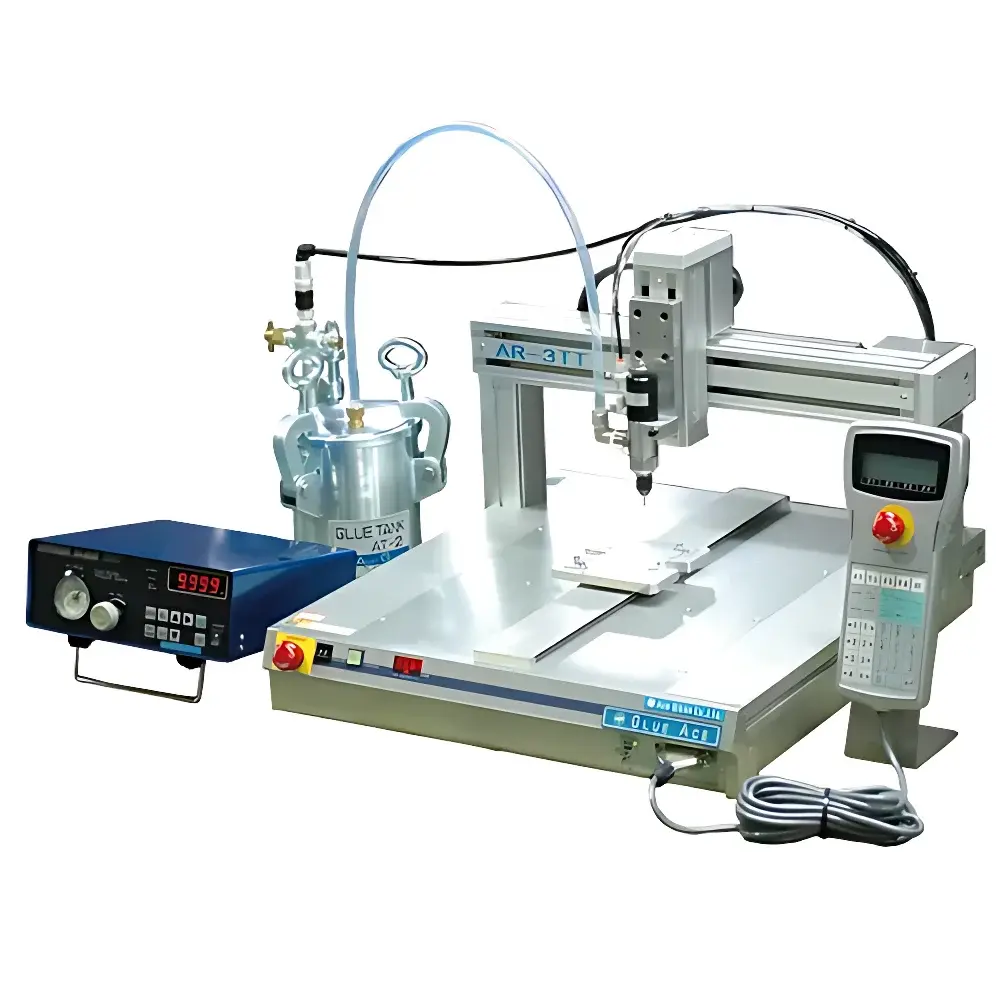
ACE GIKEN AR-3TT 3-Axis Precision Liquid Dispensing System for Cell Reactor Integration
| Brand | ACE GIKEN |
|---|---|
| Origin | Japan |
| Model | AR-3TT |
| Construction Material | SUS314 Stainless Steel |
| Sterilization Method | Vacuum-Compatible Design |
| Working Envelope (X×Y×Z) | 200×200×50 mm (standard) / 400×400×50 mm (optional) |
| Max Load Capacity | 10 kg (platform), 2 kg (tooling) |
| Positional Repeatability | ±0.02 mm on all axes |
| Maximum Speed | 300 mm/s (X/Y/Z, except Z-axis at 280 mm/s in 50-mm stroke configuration) |
| Drive Mechanism | Ball Screw (φ10 mm, Rolled C10 Grade) with Pulse Motor Servo Control |
| Program Storage | 64 programs, 3,000 teach points |
| I/O Interface | 16-input / 16-output digital I/O |
| Power Supply | AC 100 V |
| Net Weight | 18.5 kg (200-mm version) / 37.5 kg (400-mm version) |
| Dimensions (W×D×H) | 330×338.5×407.3 mm (200-mm) / 530×538.5×457.3 mm (400-mm, Z=100 mm) |
Overview
The ACE GIKEN AR-3TT is a high-precision, three-axis liquid dispensing system engineered for reproducible, automated fluid deposition in life science and bioengineering applications—particularly within controlled cell culture environments such as modular bioreactors, microfluidic assay platforms, and scaffold-based tissue engineering workflows. Unlike general-purpose industrial dispensers, the AR-3TT integrates mechanical rigidity, vacuum-compatible construction (SUS314 stainless steel frame and wetted components), and sub-50 µm positional repeatability to support sterile, low-contamination liquid handling under cleanroom or ISO Class 5–7 conditions. Its core architecture employs closed-loop pulse motor servo control across X, Y, and Z axes, coupled with C10-grade rolled ball screws (φ10 mm), enabling deterministic motion trajectories essential for patterned hydrogel deposition, localized cytokine spotting, or sequential reagent layering in 3D cell constructs. Designed for seamless integration into automated cell reactor ecosystems, the AR-3TT operates without requiring external pneumatic sources or high-voltage interfaces—making it compatible with standard laboratory power infrastructure and adjacent instrumentation.
Key Features
- Three-axis Cartesian motion system with independent pulse motor servo control for X, Y, and Z axes—ensuring synchronized, jitter-free trajectory execution.
- Vacuum-compatible mechanical design using SUS314 stainless steel throughout structural and fluid-path-adjacent components, supporting sterilization via vacuum cycles per ISO 14644-1 cleanroom protocols.
- Positional repeatability of ±0.02 mm across all axes—validated under static load conditions up to 10 kg on the platform and 2 kg on the tooling interface—critical for repeatable dispensing onto micro-patterned substrates or multi-well plates.
- Dual working envelope options: 200 × 200 × 50 mm (compact footprint, 18.5 kg) and 400 × 400 × 50 mm (expanded area, 37.5 kg), both configurable with optional Z-axis extension to 100 mm.
- Integrated 16-input / 16-output digital I/O interface for hardware-level synchronization with external triggers—including peristaltic pumps, solenoid valves, stage heaters, or environmental sensors in cell reactor control loops.
- Teach pendant–based programming interface with support for point-to-point, linear, circular, and contour-based dispensing paths; optionally extendable via PC-based offline editor software for advanced path scripting and batch parameterization.
Sample Compatibility & Compliance
The AR-3TT accommodates a broad spectrum of biologically relevant liquids—including aqueous buffers, viscous hydrogels (e.g., alginate, collagen I, Matrigel™), growth factor solutions, and crosslinking agents—via interchangeable dispensing modules (syringe, jetting, or coaxial nozzles, sold separately). Its non-porous, electropolished SUS314 surfaces resist biofilm adhesion and facilitate cleaning validation per ASTM E2613-21 (Standard Guide for Cleaning Validation in Biotechnology). The system conforms to electrical safety requirements under JIS C 61010-1 and supports operational qualification (OQ) documentation packages aligned with GLP and GMP Annex 11 principles. While not intrinsically rated for use inside Class A laminar flow hoods, its vacuum-compatible construction allows post-sterilization installation into ISO-certified biosafety cabinets or integrated bioreactor enclosures.
Software & Data Management
The AR-3TT’s embedded controller stores up to 64 distinct dispensing programs, each containing up to 3,000 teach points—supporting complex multi-layer deposition sequences required for organoid maturation or gradient hydrogel fabrication. All motion parameters (acceleration profiles, dwell times, speed ramps) are programmable and retained in non-volatile memory. Optional PC-based editing software provides CSV-based path import/export, real-time trajectory simulation, and audit-trail logging compliant with FDA 21 CFR Part 11 requirements when deployed with time-stamped user authentication and electronic signature modules. No cloud connectivity or proprietary runtime dependencies are introduced—ensuring full data sovereignty and compatibility with air-gapped lab networks.
Applications
- Precise spatial patterning of extracellular matrix proteins onto micropatterned PDMS or glass substrates for guided stem cell differentiation studies.
- Automated layer-by-layer deposition of thermoresponsive hydrogels in bioreactor-integrated bioprinting workflows.
- High-fidelity dispensing of CRISPR-Cas9 ribonucleoprotein complexes into single-cell suspension cultures prior to microencapsulation.
- Sequential addition of inducers and inhibitors across multi-well plates during dynamic 3D spheroid screening assays.
- Calibration traceability support for volumetric dispensing validation per USP and ISO/IEC 17025-accredited QC laboratories.
FAQ
Is the AR-3TT compatible with sterile processing environments?
Yes—the entire structural frame and mounting interfaces are fabricated from vacuum-rated SUS314 stainless steel and can undergo validated vacuum sterilization cycles. Wetted parts require separate validation based on selected dispensing module materials.
Can the AR-3TT be integrated with third-party bioreactor control systems?
Yes—its isolated 16-in/16-out digital I/O interface supports TTL- or dry-contact-level signaling for synchronization with PLCs, LabVIEW DAQ systems, or bioreactor SCADA platforms.
What is the minimum dispensing volume achievable with this system?
Minimum volume is determined by the connected dispensing module (e.g., syringe pump resolution or piezoelectric jetting frequency), not the motion system itself. The AR-3TT’s ±0.02 mm repeatability enables sub-nanoliter positional accuracy when paired with appropriate fluidic hardware.
Does the system support G-code or other industry-standard motion languages?
No—the native instruction set is proprietary, but the optional PC editor supports CSV-based coordinate import, enabling conversion from G-code or Python-generated trajectories via external preprocessing.
Is technical documentation available in English with regulatory references?
Yes—full English-language operation manuals, mechanical drawings, I/O pinouts, and OQ/PQ protocol templates are provided, including references to ISO 13485:2016, ASTM F2971-22, and IEC 62304:2015 where applicable.





