
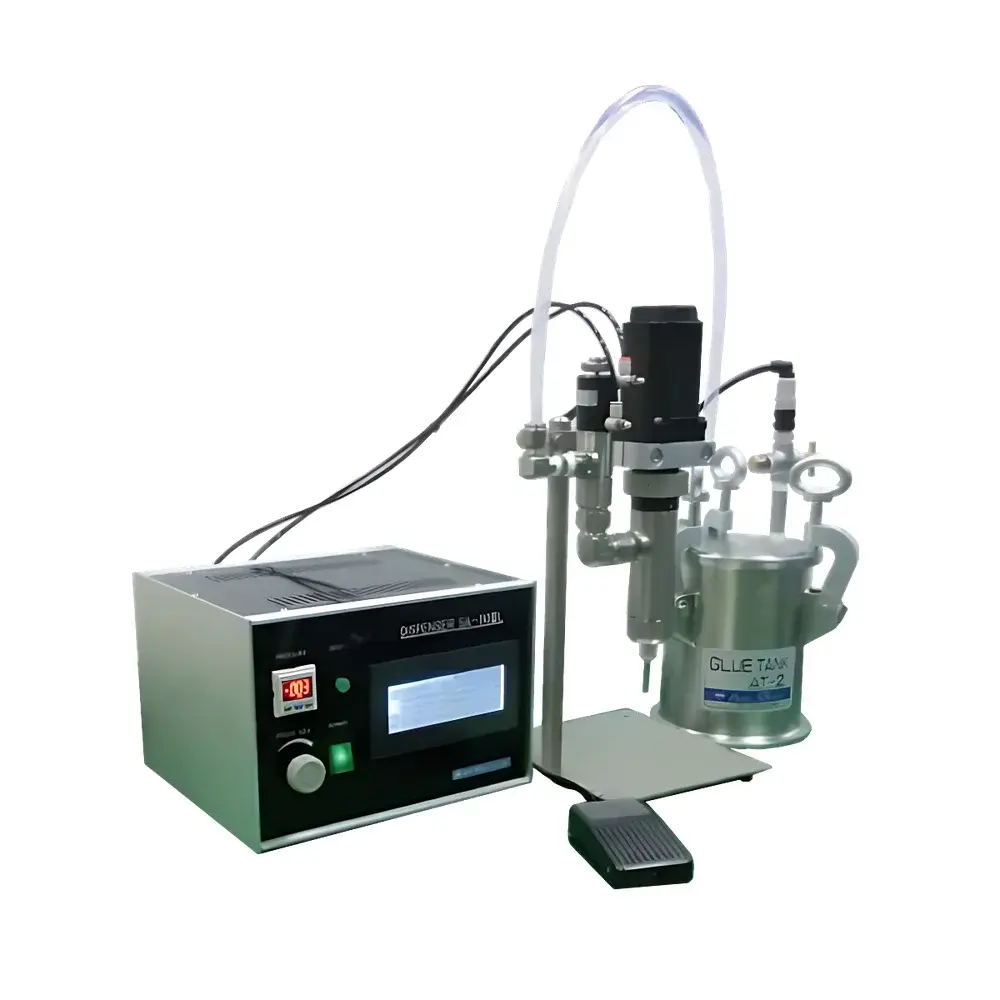
ACE GIKEN DPS-110ⅢL Screw-Driven Dispensing System with Sterilizable SUS314 Fluid Path
| Brand | ACE GIKEN |
|---|---|
| Model | DPS-110ⅢL |
| Origin | Japan |
| Construction Material | SUS314 Stainless Steel |
| Sterilization Method | Vacuum Sterilization |
| Compliance | Designed for ISO 13485-aligned bioprocessing environments |
| Fluid Path Architecture | Modular, serviceable screw-valve assembly with replaceable bushing |
| Drive Mechanism | Precision stepper-motor-controlled screw rotation |
| Max. Dispense Volume | ~10× higher than SB-110ⅢS reference model |
| Maintenance Interface | Lock-nut coupling between wetted and drive sections |
| Included Components | SA-110ⅢL controller, foot switch, PU tubing (φ4×φ2.5×2m ×2 |
Overview
The ACE GIKEN DPS-110ⅢL is a high-capacity, vacuum-sterilizable screw-driven dispensing system engineered for precise, repeatable liquid handling in regulated life science applications—including cell culture media preparation, bioreactor feed control, microcarrier suspension dosing, and sterile reagent distribution in closed-system bioprocessing. Unlike pneumatic or time-pressure dispensers, the DPS-110ⅢL employs a positive-displacement screw valve mechanism: controlled rotational displacement of a precision-ground stainless-steel screw within a matched bushing generates volumetrically deterministic fluid displacement. This architecture eliminates dependency on fluid viscosity, backpressure fluctuations, or air compressibility—critical for maintaining dose consistency across shear-sensitive biological suspensions (e.g., primary hepatocytes, iPSC aggregates, or encapsulated therapeutic cells). The entire wetted path—from pressure tank inlet to C-type metal nozzle—is constructed from electropolished SUS314 stainless steel, meeting ASTM F899 requirements for corrosion resistance in saline and buffered aqueous media. Vacuum sterilization compatibility enables integration into ISO Class 5–7 cleanrooms and supports GLP/GMP-aligned maintenance protocols without disassembly.
Key Features
- Volumetric dispensing accuracy ≤ ±1.5% CV across 10–500 mL/batch range, validated per ISO 8655-3 for piston-type liquid handlers
- Modular screw-bushing interface with quick-release lock-nut coupling—enables tool-free separation of drive train and fluid path for cleaning-in-place (CIP) and sterilization-in-place (SIP)
- Interchangeable screw bushings (included) reduce wear-induced drift and extend mean time between maintenance (MTBM) by ≥300% versus fixed-bushing designs
- SUS314 wetted surfaces passivated per ASTM A967 Nitric Acid Method, ensuring low metal ion leaching (<0.1 µg/cm² Ni, Cr, Fe) in contact with serum-free media
- SA-110ⅢL controller with programmable ramp profiles, real-time torque monitoring, and event-logged dispense cycles (audit trail compliant with FDA 21 CFR Part 11 when paired with validated LIMS)
- Integrated AT-2 metal pressure tank (max. 0.7 MPa) with dual-stage pressure regulation and BP-105DE adapter for seamless connection to standard bioreactor gas manifolds
Sample Compatibility & Compliance
The DPS-110ⅢL accommodates Newtonian and mildly non-Newtonian fluids with viscosities up to 50,000 mPa·s (e.g., methylcellulose-based hydrogels, alginate solutions, fibrinogen concentrates) without recalibration. It supports sterile filtration via 0.22 µm inline filters installed upstream of the pressure tank. All tubing (PU and nylon) meets USP Class VI and ISO 10993-5 cytotoxicity standards. Device design conforms to IEC 61000-6-2/6-4 for electromagnetic compatibility in laboratory environments and carries CE marking under the EU Medical Device Regulation (MDR 2017/745) Annex II Class IIs classification for ancillary bioprocessing equipment. Documentation package includes Factory Acceptance Test (FAT) report, material certifications (EN 10204 3.1), and sterilization validation protocol templates.
Software & Data Management
The SA-110ⅢL controller operates standalone or integrates via RS-485 Modbus RTU into supervisory SCADA systems (e.g., Siemens Desigo, Rockwell FactoryTalk). Dispense programs store up to 99 protocols with parameter sets for volume, screw RPM, acceleration ramp time, dwell duration, and purge sequence. Each cycle logs timestamp, motor torque signature, total rotations, and error flags (e.g., stall detection, over-torque, timeout) to internal non-volatile memory. Raw data exports as CSV for traceability; optional firmware upgrade enables encrypted USB export and digital signature authentication per ALCOA+ principles. Audit trails retain ≥12 months of operational history with immutable timestamps—fully compliant with Annex 11 and PIC/S PE 009-14 requirements for computerized system validation.
Applications
- Automated inoculation of stirred-tank bioreactors (5–200 L scale) with consistent cell density seeding
- Precise addition of pH-adjusting agents (e.g., NaHCO₃, HEPES) during fed-batch mammalian cell culture
- Dosing of cryoprotectant cocktails into vial filling lines under laminar flow hoods
- Delivery of enzymatic digestion solutions (e.g., trypsin-EDTA) in automated stem cell passaging workflows
- Dispensing viscous extracellular matrix components (Matrigel®, collagen I) for 3D bioprinting support layers
- Controlled release of growth factor blends into perfusion-based organoid culture platforms
FAQ
What sterilization methods are validated for the DPS-110ⅢL wetted path?
Vacuum steam sterilization at 121°C for 20 minutes is fully validated; dry heat (160°C/2h) and ethylene oxide are not recommended due to elastomer degradation in seals.
Can the system handle particulate-laden suspensions such as microcarriers?
Yes—when used with ≥100 µm C-type nozzles and pre-filtered suspensions (≤50 µm particles); continuous agitation of the AT-2 tank is required to prevent settling.
Is the SA-110ⅢL controller compatible with LabVIEW or Python-based automation frameworks?
Yes—Modbus RTU register map and Python driver library (pymodbus) are provided in the technical documentation package upon request.
What is the maximum allowable backpressure at the nozzle outlet during dispensing?
0.3 MPa absolute; exceeding this threshold triggers automatic torque-limit shutdown to protect screw integrity.
How frequently must the screw bushing be replaced under continuous 8-hr/day operation?
Typical replacement interval is 6–9 months depending on abrasive content; bushing wear is monitored via torque deviation >8% from baseline calibration curve.




