
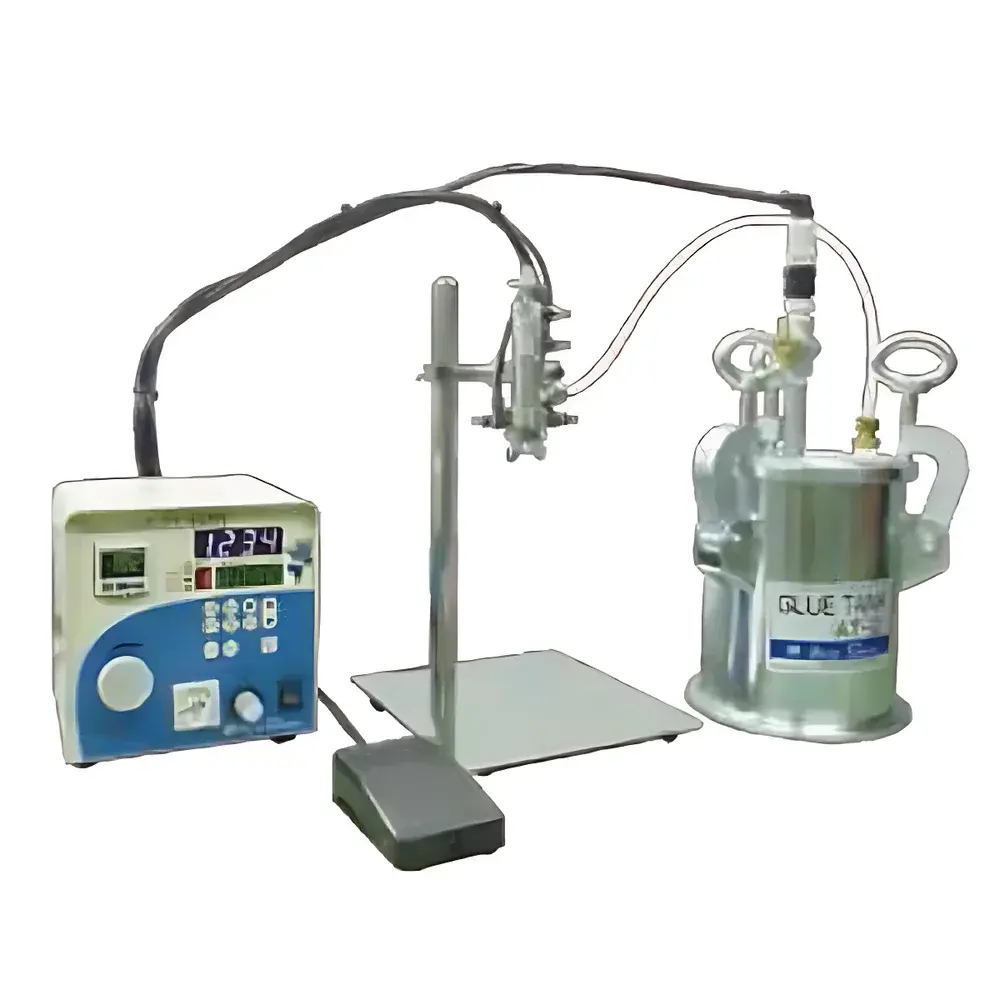
ACE GIKEN DPS-800SPⅡ雾状喷射粘合剂分配系统
| Brand | ACE GIKEN |
|---|---|
| Origin | Japan |
| Manufacturer Type | Authorized Distributor |
| Origin Category | Imported |
| Model | DPS-800SPⅡ |
| Housing Material | SUS314 Stainless Steel |
| Sterilization Method | Vacuum Sterilization |
| Control Architecture | Microprocessor-Based Dual-Parameter Independent Adjustment (Liquid Pressure, Atomizing Air Pressure, Dispense Duration) |
| Valve Core Technology | Balpet® Precision Metering Valve Platform |
| Integration Interface | TTL/24 VDC I/O Terminals |
| Hose Compatibility | PU Tubing (φ4×φ2.5 mm, φ6×φ4 mm), Nylon Tubing (φ8×φ6 mm) |
| Nozzle Options | Interchangeable Internal/External Atomization Nozzles (Custom Sizing Available) |
| Regulatory Compliance | Designed for ISO 13485-aligned bioprocess environments |
| Sterility Assurance | Compatible with vacuum-based depyrogenation and terminal sterilization protocols |
Overview
The ACE GIKEN DPS-800SPⅡ is a microprocessor-controlled precision aerosol dispensing system engineered for consistent, non-contact delivery of low-viscosity functional fluids—including medical-grade adhesives, silicone oils, hydrophobic coatings, and cell culture-compatible bioadhesives—in finely atomized mist form. Unlike conventional positive-displacement or time-pressure dispensers, the DPS-800SPⅡ employs a patented Balpet® valve architecture that eliminates internal elastomer contact with fluid pathways, thereby preventing cross-contamination, residue buildup, and pressure-induced flow hysteresis. Its core operational principle relies on controlled pneumatic atomization: liquid is metered via precise pressure-duration modulation, then sheared into sub-50 µm droplets by co-axial high-velocity air flow—enabling uniform surface coverage without pooling, bridging, or thermal degradation. Designed specifically for integration into sterile biomanufacturing workflows, the system meets structural and material requirements for use in Class A/B cleanrooms and supports vacuum-based sterilization validation per ISO 11140-1 and EU Annex 1 guidelines.
Key Features
- Microprocessor-based SA-800SP controller with independent digital adjustment of liquid supply pressure (0–0.7 MPa), atomizing air pressure (0–0.5 MPa), and dispense duration (10–999 ms) — enabling reproducible CV < 2.5% across 100–500 µL spray cycles
- Balpet® valve platform constructed entirely from SUS314 stainless steel and ceramic-coated actuation components — eliminating internal sealing elastomers and ensuring long-term chemical compatibility with alcohols, ketones, cyanoacrylates, and aqueous bioadhesives
- Vacuum-compatible housing and fluid path design — validated for repeated vacuum sterilization (≤10 mbar, 121°C, 20 min) without dimensional drift or seal failure
- Dual-tube configuration option for rapid maintenance — separates liquid and atomizing air pathways to prevent condensation-induced clogging and simplify cleaning validation
- Micrometer-adjustable nozzle assembly (optional) — provides ±0.5 µm positional repeatability for localized deposition on microfluidic chips, biosensor substrates, or 3D-bioprinted scaffolds
- Standard 24 VDC TTL I/O interface — supports synchronization with PLCs, robotic arms (e.g., UR, KUKA), and real-time process monitoring systems via discrete start/stop, status feedback, and error signaling
Sample Compatibility & Compliance
The DPS-800SPⅡ accommodates fluids with dynamic viscosities ranging from 1 to 50 mPa·s and surface tensions between 20–35 mN/m — including UV-curable acrylates, medical-grade silicones (e.g., Dow Corning 3-4173), fibrin sealants, and hyaluronic acid derivatives. All wetted materials comply with USP Class VI and ISO 10993-5 cytotoxicity standards. The SUS314 construction resists chloride-induced pitting in saline-rich environments and withstands repeated exposure to 70% ethanol and hydrogen peroxide vapor (VHP). System documentation includes full traceability of material certifications, sterilization cycle logs, and IQ/OQ templates aligned with FDA 21 CFR Part 11 and EU GMP Annex 15 requirements.
Software & Data Management
While the SA-800SP controller operates via front-panel keypad and LED display (no embedded OS), it supports external data logging through RS-232 serial output (ASCII protocol) and analog 0–10 V feedback signals. Integration-ready firmware enables timestamped event logging (dispense count, pressure deviations, timeout alerts) compatible with LabArchives ELN, DeltaV DCS, and Siemens Desigo CCMS platforms. Audit trails are maintained locally in non-volatile memory with write-protection — fulfilling ALCOA+ principles for regulated bioprocess applications under GLP and GMP frameworks.
Applications
- Precision coating of microelectrode arrays and flexible biosensors with conductive polymer dispersions
- Non-contact application of anti-fouling hydrogels onto organ-on-chip membranes
- Uniform misting of collagen/fibrin matrices in automated 3D bioprinting support baths
- Localized deposition of photo-initiators onto photopolymerizable hydrogel scaffolds
- Surface functionalization of diagnostic microplates with antibody capture layers
- Low-shear dispensing of enzyme solutions onto immobilized enzyme reactors
FAQ
Is the DPS-800SPⅡ suitable for sterile fill-and-finish operations?
Yes — when paired with vacuum-sterilized Balpet® valves (BP-107DN-SP/II-SP) and SUS314 tubing, the system complies with ISO 13485 manufacturing controls and supports aseptic transfer validation.
Can the system handle shear-sensitive biologics such as growth factors?
It is not recommended for undiluted proteins or fragile exosomes due to pneumatic shearing; however, diluted formulations (<1 mg/mL) in viscous carriers (e.g., 2% methylcellulose) have demonstrated retention of bioactivity post-dispensing.
What nozzle sizes are available for fine-pattern deposition?
Standard internal/external nozzles range from 50 µm to 200 µm orifice diameter; custom tapered nozzles down to 25 µm are available upon request with flow calibration certificates.
Does ACE GIKEN provide installation qualification (IQ) documentation?
Yes — factory-issued IQ/OQ packages include mechanical drawings, material certifications, pressure decay test reports, and sterilization cycle verification records.
How often does the Balpet® valve require recalibration?
No periodic recalibration is required; performance verification is conducted annually using NIST-traceable pressure transducers and gravimetric dispensing tests per ASTM D1475.




