
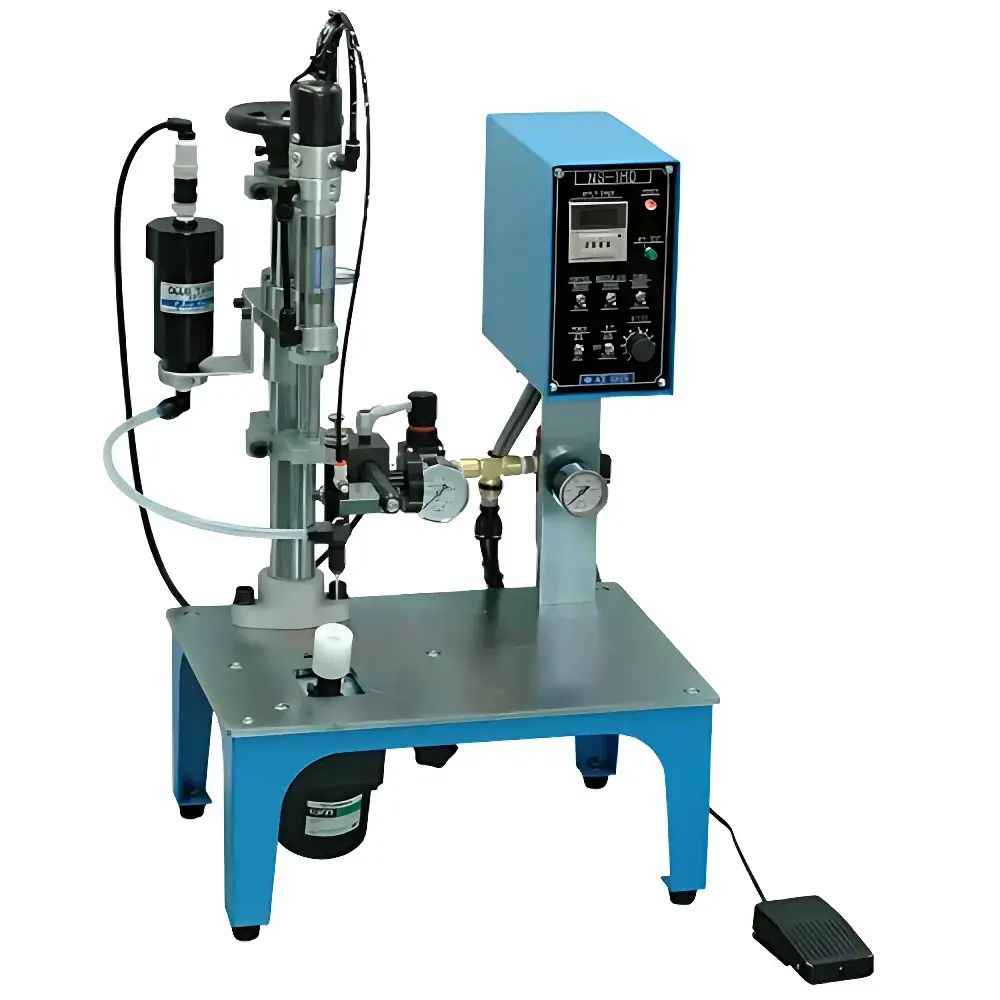
ACE GIKEN NS-1MD Standard Rotary Coating System for Precision Circumferential Deposition
| Brand | ACE GIKEN |
|---|---|
| Origin | Japan |
| Manufacturer Type | Authorized Distributor |
| Origin Category | Imported |
| Model | NS-1MD |
| Material | SUS314 Stainless Steel |
| Sterilization Method | Vacuum-Compatible Design |
| Maximum Workpiece Diameter (Horizontal) | φ200 mm |
| Maximum Workpiece Diameter (Angled Mode) | φ60 mm |
| Maximum Swivel Diameter (Horizontal) | φ230 mm |
| Maximum Swivel Diameter (Angled Mode) | φ100 mm |
| Maximum Workpiece Height | 45 mm |
| Maximum Workpiece Weight | 4 kg |
| Applicable Viscosity Range | 1–100,000 cP |
| Nozzle Stroke | 50 mm |
| Adapter Rotation Speed | 0–120 rpm (variable) |
| Angular Adjustment Range | 0°–30° |
| Oven Clearance Height | 50–110 mm |
| Positioning Accuracy (Radial Runout) | ±0.2 mm |
| Process Cycle Time | ≤2 s per deposition point |
| Power Supply | AC 100 V, 50/60 Hz |
| Operating Air Pressure | 0.4–0.5 MPa (dry air) |
| Net Weight | ~25 kg |
Overview
The ACE GIKEN NS-1MD Standard Rotary Coating System is an engineered solution for high-precision, repeatable circumferential deposition of functional coatings—such as hydrogels, extracellular matrix proteins, bioinks, or sensor-compatible polymers—onto cylindrical or annular substrates used in cell reactor development, microcarrier-based bioprocessing, and 3D tissue scaffold fabrication. Based on controlled rotational kinematics and synchronized vertical nozzle actuation, the system implements a deterministic coating trajectory governed by Couette-type flow dynamics at the meniscus interface. Unlike dip- or spray-based methods, this system ensures uniform line-width control, minimal material waste (<3% overspray), and laminar fluid delivery under low-shear conditions—critical for preserving biomolecular integrity and cell viability during surface functionalization. Its vacuum-compatible stainless steel (SUS314) construction enables integration into sterile-grade cleanroom workflows and supports post-deposition vacuum drying or sterilization cycles compliant with ISO 13485 and ASTM F2971 standards.
Key Features
- Precision rotary motion control: Adjustable adapter rotation speed (0–120 rpm) with electronic feedback ensures consistent angular velocity across viscosity ranges from 1 to 100,000 cP.
- Multi-axis positioning system: Integrated horizontal, vertical, and angular (0°–30°) adjustment mechanisms enable reproducible coating on both internal and external curved surfaces—including microcarriers, hollow fiber modules, and tubular bioreactor inserts.
- Vacuum-ready architecture: Entire chamber-accessible components are fabricated from electropolished SUS314 stainless steel, rated for vacuum environments up to 10⁻² Pa, facilitating terminal sterilization via vacuum-assisted hydrogen peroxide (VHP) or ethylene oxide (EtO) protocols.
- Modular workpiece adaptability: Interchangeable fixture adapters support rapid reconfiguration between substrate geometries (e.g., φ200 mm discs, φ60 mm vials, or custom mandrels), enabling flexible small-batch production aligned with GLP-compliant process validation requirements.
- Low-inertia nozzle actuation: 50 mm linear stroke with sub-millisecond response time ensures precise start/stop deposition without satellite droplet formation—validated using high-speed imaging at 1,000 fps under ISO 8502-3 surface cleanliness conditions.
Sample Compatibility & Compliance
The NS-1MD accommodates substrates ranging from polymeric microcarriers (100–300 µm) to macro-scale cylindrical bioreactor components (up to φ230 mm swivel diameter). It supports aqueous, solvent-based, and shear-thinning bioink formulations without clogging, thanks to its non-contact, pressure-regulated dispensing module (compatible with BP-107DN pressurized reservoirs and AT-01P(B) air tanks). All wetted parts comply with USP Class VI biocompatibility testing. The system meets mechanical safety requirements per IEC 61000-6-2 (EMC immunity) and IEC 61000-6-4 (EMC emissions), and its operational envelope aligns with ISO 14644-1 Class 5 cleanroom specifications when installed with HEPA-filtered air supply.
Software & Data Management
While the NS-1MD operates via intuitive manual controls (no embedded microprocessor), its mechanical repeatability supports full traceability when integrated into broader laboratory automation ecosystems. All motion parameters—including rotation speed, angular offset, nozzle height, and cycle timing—are manually logged per batch in accordance with FDA 21 CFR Part 11 Annex 11 guidelines. Optional analog signal outputs (0–10 V) allow synchronization with external PLCs or data acquisition systems for real-time monitoring of air pressure, rotational encoder pulses, and actuation triggers—enabling audit-ready process records for GMP biomanufacturing environments.
Applications
- Surface functionalization of hollow-fiber bioreactor cartridges with collagen IV or fibronectin for adherent cell expansion.
- Patterned deposition of alginate-gelatin bioinks onto rotating mandrels for vascular graft fabrication.
- Uniform coating of microcarriers with heparin-binding peptides to enhance hMSC attachment efficiency.
- Controlled application of antimicrobial polymer layers onto catheter prototypes under ISO 10993-5 cytotoxicity test conditions.
- Preparation of calibration standards for optical biosensors requiring radially symmetric refractive index gradients.
FAQ
Is the NS-1MD suitable for aseptic processing?
Yes—the SUS314 construction and vacuum compatibility permit integration into isolator-based aseptic filling lines; however, full sterility assurance requires validation of the chosen sterilization method (e.g., VHP or gamma irradiation) against your specific coating formulation.
Can it handle non-Newtonian bioinks?
Yes—its variable-speed rotation and pressure-controlled dispensing accommodate shear-thinning behavior typical of hyaluronic acid or nanocellulose-based bioinks, provided viscosity remains within the 1–100,000 cP operational envelope.
What documentation is supplied for regulatory submissions?
ACE GIKEN provides Factory Acceptance Test (FAT) reports, material certifications (EN 10204 3.1), and dimensional compliance drawings; IQ/OQ protocols are available upon request for GMP facility qualification.
Is remote operation supported?
No—the system is manually operated to maintain full operator control over critical deposition parameters; however, analog I/O ports enable third-party SCADA integration for centralized monitoring.
Does it support multi-fluid deposition?
No—the NS-1MD is configured for single-fluid, single-point deposition; dual-nozzle variants (e.g., NS-2MD) require separate quotation and engineering review.







