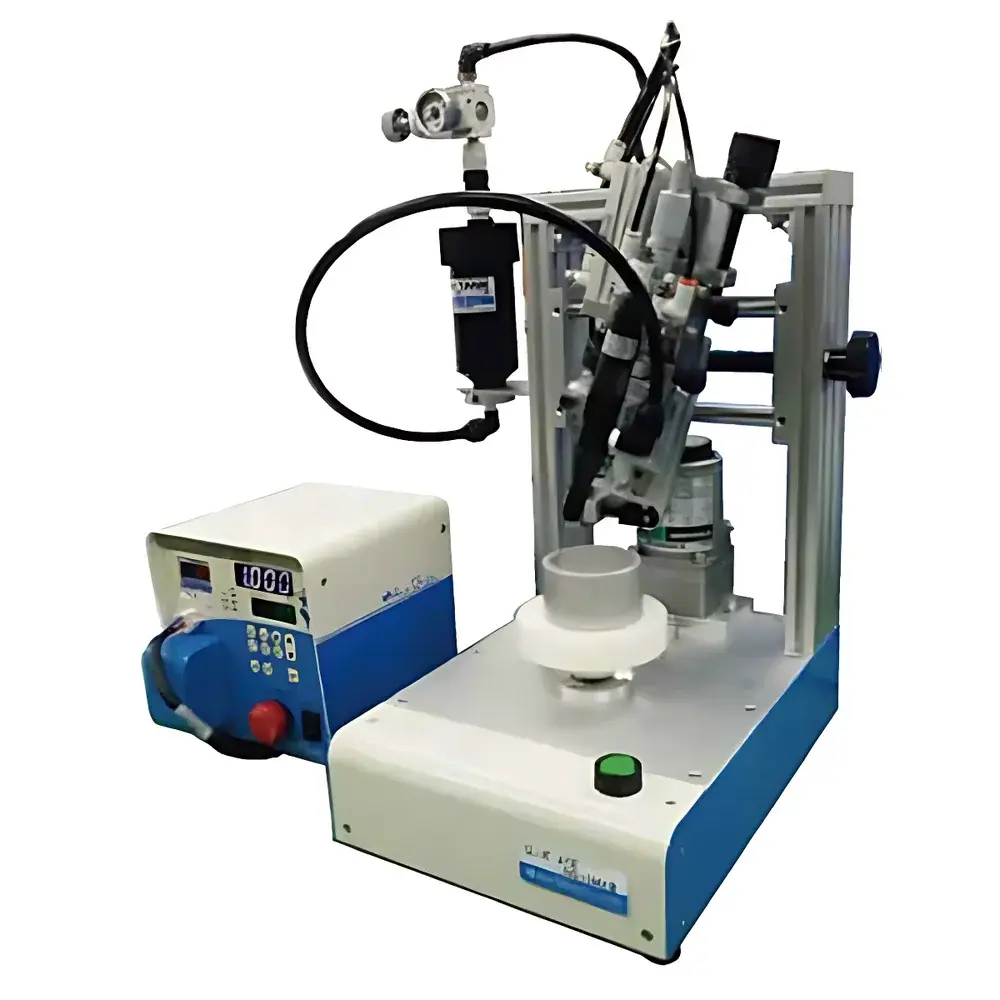
ACE GIKEN NS-1MXIII Compact Rotary Dispensing Coater
| Brand | ACE GIKEN |
|---|---|
| Origin | Japan |
| Manufacturer Type | Authorized Distributor |
| Origin Category | Imported |
| Model | NS-1MXIII |
| Housing Material | SUS314 Stainless Steel |
| Sterilization Method | Vacuum-Compatible Design |
| Maximum Workpiece Diameter | φ100 mm |
| Maximum Workpiece Height | 50 mm |
| Weight Capacity | 1 kg |
| Rotary Runout Precision | ±0.1 mm |
| Vertical Stroke (Dispenser) | 50 mm (Pneumatic Cylinder) |
| Rotational Speed Range | 7.2–112 rpm (50 Hz) / 7.2–128 rpm (60 Hz), Digital Control |
| Dispenser Tilt Angle Adjustment | 0–30° (Manual) |
| Micro-Positioning Range (Vertical) | 0–25 mm (Micrometer-Driven) |
| Horizontal (Radial) Adjustment Range | 0–50 mm |
| Power Supply | AC 100 V, 50/60 Hz |
| Air Supply Pressure | 0.4–0.5 MPa (Dry Compressed Air) |
| Standard Accessories | Digital Timer, Tachometer, Interchangeable Workholding Adapters |
Overview
The ACE GIKEN NS-1MXIII is a compact, benchtop rotary dispensing coater engineered for high-precision circumferential coating of micro-components in life science and bioengineering applications. Utilizing a controlled rotational motion coupled with synchronized vertical nozzle actuation, the system deposits uniform fluid lines—such as adhesives, lubricants, or functional biomaterials—along cylindrical, conical, or toroidal surfaces. Its core mechanism relies on Couette-type relative motion between the rotating workpiece and a position-stabilized dispensing tip, enabling reproducible line-width control without contact or shear-induced deformation. Designed explicitly for low-volume, multi-variant production environments—including cell reactor assembly, microfluidic device fabrication, and diagnostic cartridge manufacturing—the NS-1MXIII meets stringent requirements for process traceability, repeatability, and cleanroom compatibility. The stainless steel (SUS314) construction and vacuum-compatible architecture support integration into sterilized workflows compliant with ISO 13485 and GMP-aligned biomanufacturing protocols.
Key Features
- Compact footprint (H490 × W300 × D350 mm) optimized for laminar flow hoods and biosafety cabinets.
- Micrometer-integrated pneumatic Z-axis actuator (0–25 mm fine adjustment) ensures sub-0.1 mm nozzle positioning repeatability.
- Digital speed controller with selectable 50/60 Hz operation delivers stable rotational speeds from 7.2 to 128 rpm, minimizing torque-induced runout (±0.1 mm radial deviation).
- Manually adjustable dispenser tilt (0–30°) and orthogonal X/Y alignment (0–50 mm range) enable conformal coating on external, internal, and stepped cylindrical geometries up to φ100 mm × 50 mm H.
- Interchangeable workholding adapters facilitate rapid reconfiguration across part families—critical for prototyping and small-batch bioreactor component finishing.
- Integrated digital timer and tachometer provide real-time process monitoring without external instrumentation.
- Designed for compatibility with standard liquid dispensing systems (e.g., Valprett BP-105DS-C feed tank + AT-01P(B) regulator) using dry compressed air (0.4–0.5 MPa).
Sample Compatibility & Compliance
The NS-1MXIII accommodates substrates ranging from polymer microtubes and glass capillaries to metal sensor housings and silicone elastomer gaskets—common materials in cell culture reactors and point-of-care diagnostics. Its SUS314 chamber resists corrosion from aqueous buffers, ethanol-based disinfectants, and low-viscosity biopolymers (e.g., gelatin, hyaluronic acid derivatives). Vacuum-compatible design allows post-coating degassing or integration with downstream plasma treatment stations. While not certified as standalone medical devices, the unit supports processes aligned with ISO 10993-5 (cytotoxicity testing) sample preparation and ASTM F2736 (microfluidic device bonding) validation protocols. All mechanical adjustments are lockable to maintain configuration integrity during GLP/GMP audits.
Software & Data Management
The NS-1MXIII operates as a stand-alone electromechanical platform with no embedded firmware or proprietary software. All operational parameters—including rotation duration, speed setpoint, and dispensing timing—are manually configured via front-panel controls and recorded in paper-based or LIMS-linked batch records. This architecture eliminates cybersecurity vulnerabilities and simplifies 21 CFR Part 11 compliance: operators document settings directly on controlled forms, with timestamps and dual signatures. Optional analog output signals (0–10 V) can interface with PLC-based supervisory systems for basic OEE tracking in regulated pilot-line environments.
Applications
- Edge-sealing of PDMS-glass microreactors prior to cell seeding.
- Applying hydrophobic barriers on diagnostic strip substrates for lateral flow assay development.
- Depositing conductive silver paste onto cylindrical electrodes used in implantable biosensors.
- Coating inner walls of centrifuge tube caps with silicone grease to ensure vacuum integrity.
- Functionalizing microcentrifuge vial threads with UV-curable adhesives for leak-proof assembly.
- Preparing circular patterned hydrogels on Petri dish rims for spatially controlled co-culture experiments.
FAQ
What types of fluids are compatible with the NS-1MXIII?
Viscosities ranging from 10 to 50,000 mPa·s—including water-based buffers, silicone oils, cyanoacrylates, and thermoplastic elastomer dispersions—can be processed when paired with appropriate positive-displacement or time-pressure dispensing modules.
Can the NS-1MXIII be validated for ISO 13485 production environments?
Yes—its mechanical adjustability, absence of undocumented software, and stainless-steel construction support IQ/OQ documentation; users must establish in-house PQ protocols for specific fluid-substrate combinations.
Is vacuum sterilization supported out-of-the-box?
The unit’s sealed housing and non-porous SUS314 surfaces are vacuum-compatible, but full-cycle sterilization requires external vacuum oven integration per ISO 17665-1.
Does it support automated recipe recall?
No—parameter retention is manual; repeat runs require operator re-entry of speed, timing, and positional settings.
What maintenance intervals are recommended?
Lubrication of linear guides every 500 operating hours; inspection of pneumatic seals and micrometer threads quarterly; calibration of tachometer annually against NIST-traceable reference.