
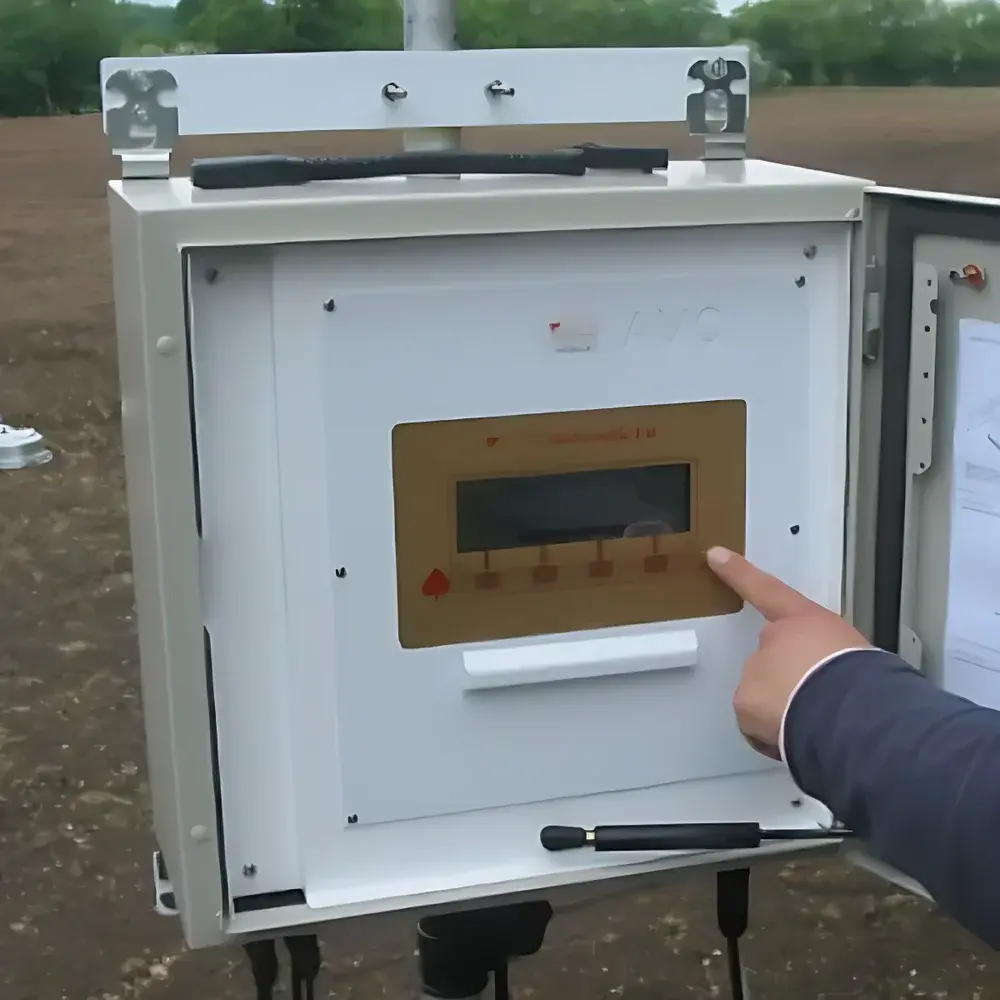
ACE-Net Multi-Channel Soil Respiration Monitoring System
| Brand | ADC Bio |
|---|---|
| Origin | United Kingdom |
| Model | ACE |
| Configuration | Master Control Unit + Up to 30 ACE Sensor Nodes |
| Power | Low-Voltage DC via Single Cable (No Pneumatic Tubing) |
| Max Network Radius | 200 m |
| Compliance | Designed for GLP-Compliant Field Deployment |
| Data Storage | Internal SD Card (No PC Required) |
| Interface | Local LCD + Keypad on Both Master and ACE Units |
| Optional Modules | O₂ Sensor, Hyperspectral Imaging Module, Thermal IR Imaging Module, ECODRONE® UAV Integration |
Overview
The ACE-Net Multi-Channel Soil Respiration Monitoring System is an engineered field-deployable platform designed for high-temporal-resolution, spatially distributed measurement of soil CO₂ efflux—the primary indicator of heterotrophic and autotrophic respiration in terrestrial ecosystems. Unlike conventional closed-chamber or single-point systems reliant on centralized air pumps and complex pneumatic manifolds, ACE-Net employs a distributed architecture grounded in low-power digital signal transmission and decentralized gas sensing. Each ACE node integrates a non-dispersive infrared (NDIR) CO₂ sensor, temperature and humidity compensation circuitry, and a programmable microcontroller, enabling autonomous chamber-based flux calculation via the modified Hsieh–Goulden–Hollinger (HGH) algorithm or steady-state linear regression. The system operates on the principle of dynamic closed-chamber or open-path differential measurement—configurable per node—allowing rigorous separation of biotic (root/microbial) and abiotic (diffusion-driven) CO₂ transport components. Its core innovation lies in eliminating pneumatic infrastructure: all power, synchronization, command execution, and data telemetry occur over a single twisted-pair cable between the Master control unit and each ACE node. This architecture ensures sub-second response latency, minimal thermal drift, and immunity to condensation-induced sensor drift or tubing occlusion—critical for multi-season, unattended operation across heterogeneous terrain.
Key Features
- Distributed network topology supporting up to 30 independently configurable ACE sensor nodes within a 200-meter radius from the Master unit
- Zero-pneumatics design: no air pumps, no tubing, no pressure regulators—reducing mechanical failure points and power demand by >75% versus traditional systems
- Self-contained operation: integrated LCD display and keypad on both Master and each ACE node enable local configuration, real-time diagnostics, and manual trigger without external computing devices
- Onboard SD card storage (FAT32 formatted) with timestamped, CRC-protected binary logging; supports ≥12 months of 15-minute interval measurements per node
- Modular chamber interface: supports interchangeable transparent (photosynthetically active) and opaque (dark) chambers for net ecosystem exchange (NEE) and total soil respiration (Rs) differentiation
- Native integration with industry-standard soil sensors: direct analog/digital input for Campbell Scientific, Decagon, or METER Group soil temperature (PT100/1000) and volumetric water content (capacitance/TDR) probes
Sample Compatibility & Compliance
ACE-Net is validated for deployment in mineral soils, organic peats, agricultural loams, forest humus, and arid desert crusts—provided surface roughness remains within ±5 mm tolerance for chamber sealing integrity. All firmware and data handling routines comply with ISO 14064-2 (Greenhouse Gas Accounting) requirements for flux uncertainty propagation and metadata tagging. The system supports audit-ready data export in CF-compliant NetCDF-4 format, including embedded georeferencing (WGS84), instrument calibration history, and environmental context tags (e.g., PAR, air T/RH, precipitation event flags). For regulatory applications, optional firmware modules provide 21 CFR Part 11–compliant electronic signatures, user access logs, and immutable audit trails—fully traceable to individual node timestamps and operator credentials.
Software & Data Management
Field data are stored locally and may be retrieved via SD card swap or USB-C direct readout. ADC Bio provides the ACE-Net Manager desktop application (Windows/macOS/Linux) for post-hoc quality control, gap-filling using soil temperature–CO₂ flux Arrhenius models, and spatial interpolation (inverse distance weighting, kriging). Raw NDIR voltage outputs, chamber pressure transients, and auxiliary sensor streams are retained at full 10 Hz sampling resolution, enabling retrospective reprocessing with updated calibration coefficients or alternative flux algorithms (e.g., Rs = f(Tsoil, θv, pH)). All exported datasets include ISO 8601 timestamps, UTC/GMT alignment, and SI-unit–normalized variables (µmol CO₂ m⁻² s⁻¹, °C, m³ m⁻³, kPa). Cloud sync (AWS S3-compatible) and API endpoints (REST/JSON) are available under enterprise licensing for integration into institutional LIMS or carbon accounting dashboards.
Applications
- Long-term eddy-covariance validation and footprint-scale partitioning of soil vs. canopy respiration
- Spatiotemporal analysis of respiratory hotspots across soil texture gradients, land-use boundaries, or fire-recovery transects
- Controlled perturbation studies: nitrogen deposition, drought simulation, tillage intensity, or mycorrhizal inoculation effects on Rs
- Model-data fusion: parameterization and benchmarking of biogeochemical models (e.g., CENTURY, DAYCENT, CLM) using high-resolution in situ flux time series
- Carbon budget reconciliation in protected areas, agroecosystems, and permafrost-affected tundra where spatial heterogeneity dominates uncertainty budgets
- Integration with ECODRONE® UAV platforms for synchronized above-canopy spectral reflectance (NDVI, PRI), thermal emissivity, and atmospheric boundary layer profiling
FAQ
What is the maximum cable length between Master and an individual ACE node?
Standard deployment supports ≤100 m per segment using shielded twisted-pair (Cat5e or better); custom configurations with repeater-enabled firmware extend to 200 m with signal integrity maintained.
Can ACE nodes operate autonomously without the Master unit?
Yes—each ACE node functions as a standalone soil respiration logger with internal clock, battery management, and SD logging; Master adds network orchestration, time synchronization, and centralized command dispatch.
How does ACE-Net handle condensation inside the chamber during high-humidity conditions?
Chambers feature passive desiccant-lined baffles and thermal equilibration fins; firmware applies dew-point correction to NDIR baseline drift using concurrent RH and Tchamber readings.
Is calibration traceable to NIST standards?
Yes—factory calibration uses NIST-traceable CO₂ reference gases (±0.5% certified uncertainty); field recalibration kits (span/zero) are available with documented chain-of-custody certificates.
Does the system support remote firmware updates?
Firmware updates require physical SD card insertion; however, diagnostic telemetry (voltage, temperature, memory usage, sensor health flags) is transmitted continuously to the Master for proactive maintenance alerts.







