
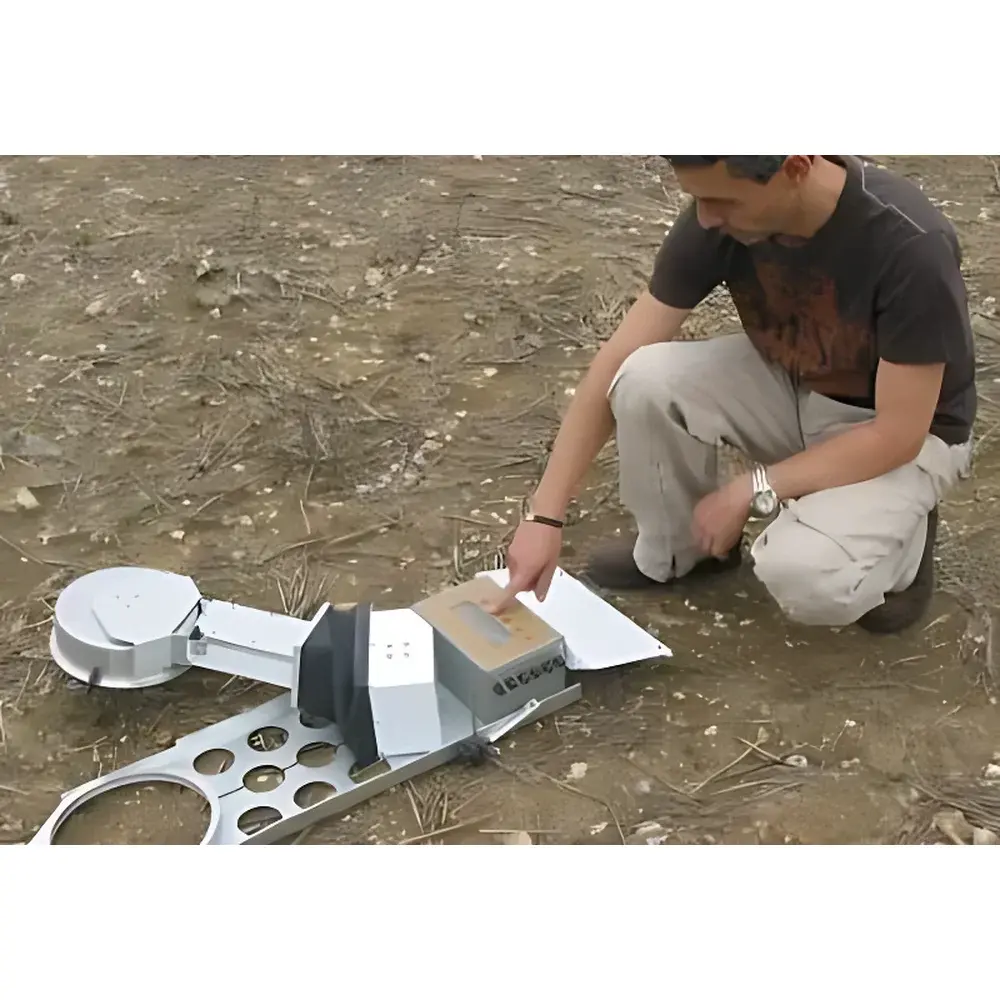
ACE Soil Carbon Flux Monitoring System
| Origin | United Kingdom |
|---|---|
| Manufacturer Type | Authorized Distributor |
| Origin Category | Imported |
| Model | ACE |
| Pricing | Upon Request |
Overview
The ACE Soil Carbon Flux Monitoring System is an engineered field-deployable platform designed for high-temporal-resolution, non-invasive quantification of soil CO2 efflux—the net carbon dioxide exchange between soil and atmosphere. Grounded in closed- or open-path infrared gas analysis (IRGA), the system measures real-time CO2 concentration gradients across a sealed or ventilated soil chamber to calculate flux rates (µmol CO2 m−2 s−1) via Fick’s law of diffusion and mass balance modeling. As a core component of terrestrial carbon cycle research, it supports long-term monitoring under natural conditions without requiring centralized gas analyzers or complex pneumatic infrastructure—eliminating transport delay, condensation artifacts, and pressure-induced measurement drift common in distributed multi-point systems. Its design prioritizes ecological integrity: automated chamber closure minimizes physical disturbance to soil microstructure and biogeochemical gradients, while low-power operation enables unattended deployment across seasonal cycles in remote ecosystems.
Key Features
- Integrated on-chamber IRGA: Each aluminum alloy chamber houses a factory-calibrated, temperature-compensated NDIR CO2 sensor (0–600 ppm range, ±2 ppm accuracy), eliminating sample line artifacts and reducing response time to <1.5 seconds.
- Autonomous chamber actuation: Motorized lid opens during inter-measurement intervals to restore ambient gas exchange and minimize chamber-induced microclimate effects; closes precisely for measurement cycles programmable from 15 min to 24 h.
- Modular power architecture: Supports dual-mode operation—standalone (12 V, 1.0 Ah internal battery) or extended-field (external 40 Ah lead-acid battery + optional solar/wind charging), delivering >28 days of continuous logging at 30-min intervals.
- Unified human interface: Backlit 240 × 64 pixel LCD with five tactile buttons enables full configuration, real-time data viewing, and flash memory management—no laptop or software installation required in situ.
- Multi-parameter environmental co-monitoring: Simultaneous acquisition of PAR (0–3000 µmol m−2 s−1, silicon photodiode), up to six thermocouple-based soil temperature profiles (±0.2 °C), and four FDR-based volumetric water content sensors (0–100 %, ±2 %).
Sample Compatibility & Compliance
The ACE system is validated for use across diverse pedological contexts—including forest floor litter layers, agricultural topsoil, tundra organic horizons, and restored grassland substrates—without requiring soil excavation or sensor embedding. Chamber geometry (23 cm diameter, 2.7 L closed volume / 1.0 L open volume) ensures representative areal integration while maintaining laminar flow dynamics under controlled gas flow (100–500 mL min−1, ±2 % FS accuracy). All electronics conform to IP67 ingress protection; connectors utilize waterproof 3-pin industrial-grade housings. Data acquisition meets GLP-aligned traceability requirements: timestamps are hardware-synchronized, and all raw sensor outputs—including CO2, temperature, humidity, and PAR—are logged with metadata (chamber state, flow rate, battery voltage) to internal flash memory. RS232 serial output (19200 baud) supports integration into ISO/IEC 17025-compliant laboratory information management systems (LIMS).
Software & Data Management
While fully functional as a stand-alone instrument, the ACE supports post-hoc data retrieval via USB-to-serial adapter or SD card export (FAT32 formatted). Logged files follow ASCII-delimited structure with UTC timestamps, enabling direct import into MATLAB, R, Python (pandas), or Excel for flux calculation using standard algorithms (e.g., linear/nonlinear regression of [CO2] vs. time). For networked deployments, the central control unit (CCU) manages up to 32 ACE nodes over shielded twisted-pair cabling (max. 100 m per node), with hot-pluggable connectivity and automatic node enumeration. CCU firmware implements CRC-16 error checking on all command/data packets and maintains local buffer redundancy to prevent data loss during transient power interruption. No proprietary drivers or cloud dependency is required—data ownership remains fully with the user.
Applications
- Soil respiration kinetics across diel and seasonal scales
- Root–microbe–substrate interactions in rhizosphere carbon turnover studies
- Validation of eddy-covariance tower footprints and model parameterization (e.g., RothC, CENTURY)
- Impact assessment of land-use change, drought stress, or nutrient amendment on microbial metabolic activity
- Greenhouse and growth chamber carbon budget auditing
- Ecophysiological profiling of decomposer communities in litterbag experiments
- Baseline monitoring for carbon sequestration verification in soil carbon credit programs
FAQ
Does the ACE system require external calibration gases during field operation?
No. The integrated IRGA is factory-calibrated with NIST-traceable CO2 standards and features automatic zero/span compensation using internal reference cells—no field recalibration is needed for typical deployments up to 12 months.
Can the ACE measure both soil and leaf respiration simultaneously?
Not concurrently within one chamber—but the same hardware platform supports interchangeable soil chambers and leaf cuvettes; users may reconfigure units for either application without firmware changes.
What is the maximum cable length between an ACE node and the central control unit?
100 meters per node using standard 22 AWG shielded twisted pair (STP); signal integrity is maintained via differential RS485-compatible logic embedded in the CCU firmware.
Is the system compatible with third-party meteorological stations?
Yes. Analog voltage inputs (0–5 V) on the CCU allow synchronous logging of external air temperature, precipitation, or wind speed when interfaced via custom adapter circuits.
How is data integrity ensured during extended power outages?
All ACE units write to non-volatile flash memory with wear-leveling; the CCU includes a supercapacitor-backed real-time clock and retains last-known sensor states for gap-filling reconstruction upon power restoration.
Related Products







