
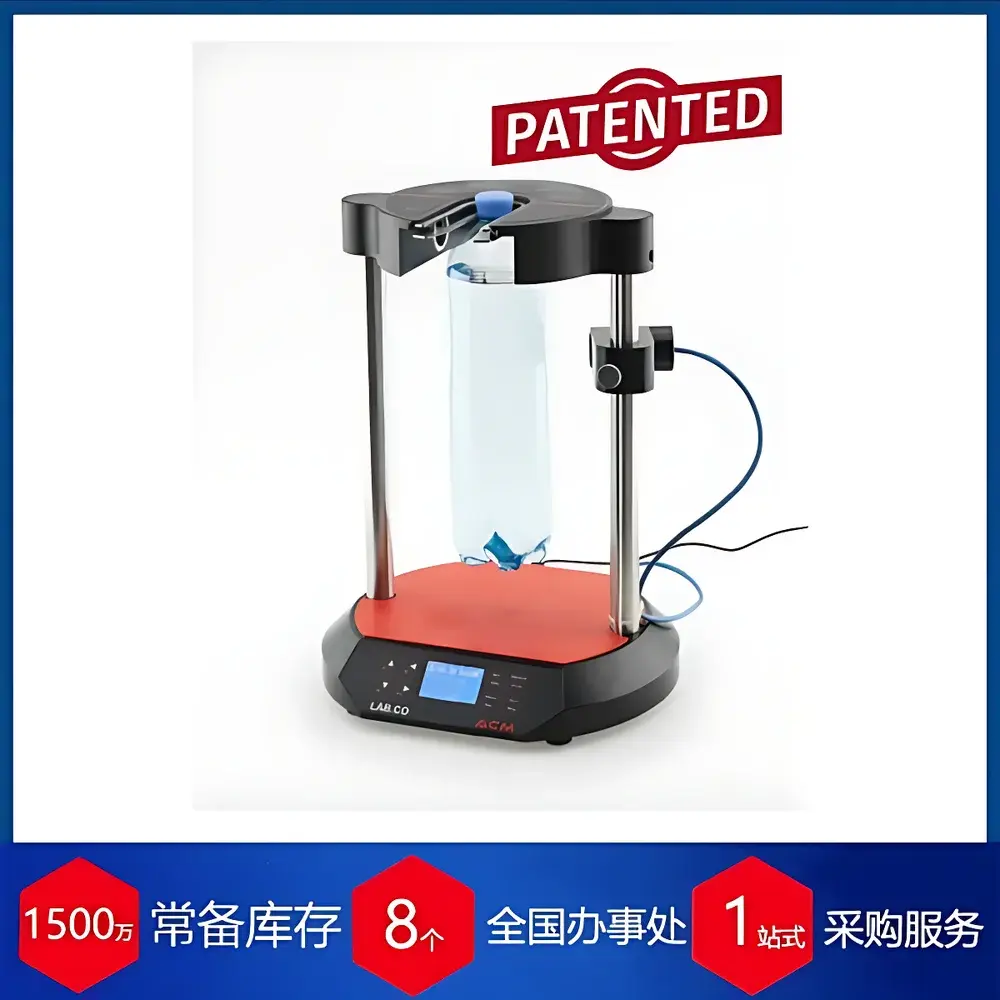
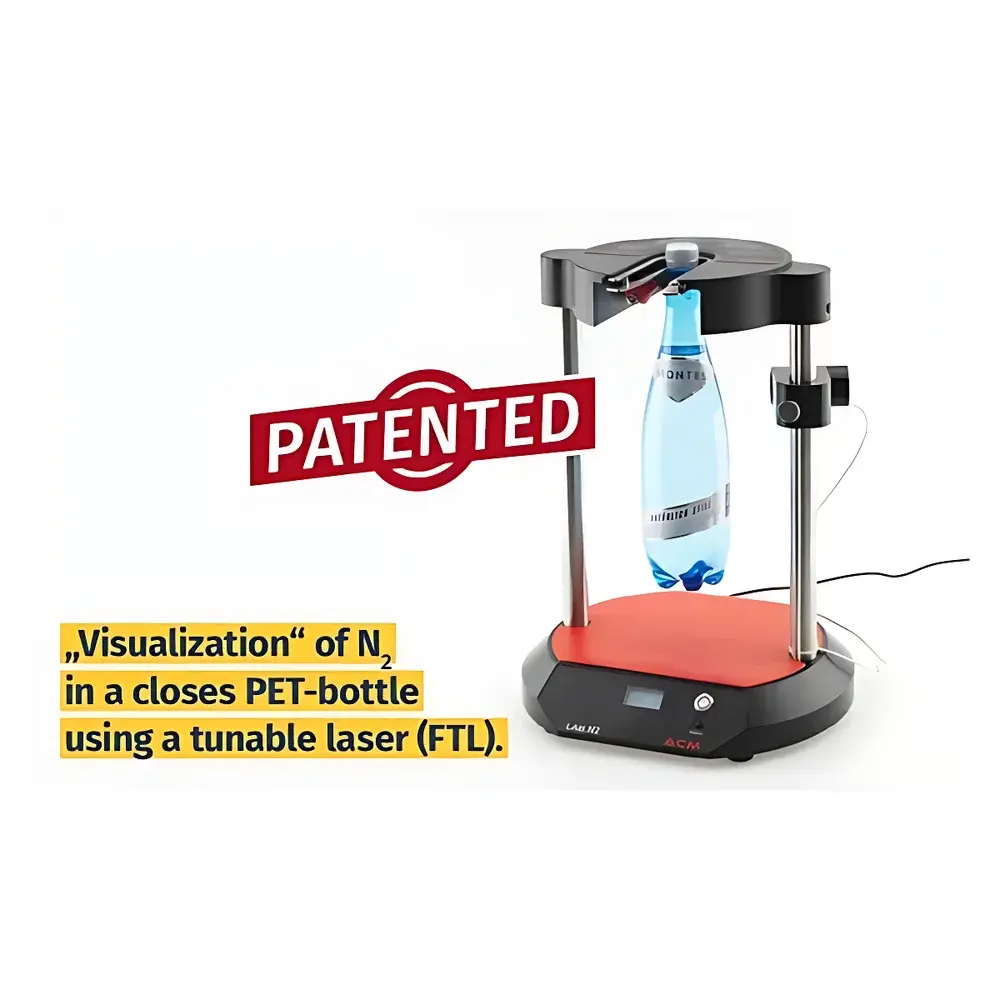
ACM LAB.N2 Non-Invasive Nitrogen Pressure Analyzer for Sealed Beverage Containers
| Brand | ACM |
|---|---|
| Origin | Austria |
| Model | LAB.N2 |
| Measurement Range | 0–3 bar |
| Accuracy | ±0.05 bar |
| Repeatability | ±0.02 bar |
| Measurement Time | ≤60 s |
| Data Interface | ACM QUATROL System Integration |
| Power Supply | 24 VDC, 1.5 A |
| Dimensions | Ø32 cm × H56 cm |
| Weight | 8.20 kg |
Overview
The ACM LAB.N2 is a purpose-built, non-invasive pressure analyzer engineered specifically for quantitative nitrogen (N₂) headspace pressure measurement in sealed, non-carbonated beverage containers—primarily PET and glass bottles containing still juices, purified water, or non-sparkling wines. Unlike conventional invasive methods requiring needle puncture, gas extraction, or container venting, the LAB.N2 employs a patented optical-acoustic resonance detection principle. It induces and monitors low-energy mechanical oscillations in the bottle wall induced by controlled pneumatic excitation, correlating resonant frequency shifts to internal absolute pressure with high physical fidelity. This physics-based approach eliminates sample compromise, preserves sterility and shelf-life integrity, and enables true longitudinal monitoring of the same unit throughout storage or aging studies—critical for stability testing, shelf-life validation, and process consistency verification in regulated beverage manufacturing environments.
Key Features
- Non-destructive, contactless pressure measurement: No needle penetration, no gas leakage, no contamination risk—preserves sample integrity and regulatory compliance.
- Full compatibility with standard PET and glass bottles, including those equipped with tamper-evident or motion-activated closures; no bottle modification or opening required.
- High-speed single-cycle analysis: Delivers traceable pressure readings within ≤60 seconds per sample, supporting high-throughput QC workflows.
- Zero-moving-parts architecture: No actuators, valves, or consumables—ensures long-term operational reliability and eliminates routine mechanical maintenance.
- Stable thermal design: Integrated temperature compensation algorithms mitigate ambient drift, ensuring consistent performance across typical laboratory (15–30 °C) and production-floor environments.
- Robust industrial-grade enclosure: IP54-rated housing with stainless-steel base plate and vibration-damped foot mounts for stable operation on shared lab benches or near filling lines.
Sample Compatibility & Compliance
The LAB.N2 supports standard 250 mL to 1,500 mL beverage containers with nominal diameters between 55 mm and 105 mm. Verified compatibility includes common PET bottle geometries (e.g., standard round, oval, and contoured profiles) and borosilicate glass bottles (e.g., ISO 8537-compliant wine and juice formats). The system complies with EN 61326-1 (EMC for laboratory equipment) and meets essential requirements of the EU Machinery Directive 2006/42/EC. While not certified as a medical device, its measurement traceability aligns with ISO/IEC 17025 principles when operated under documented SOPs. Data outputs support GLP/GMP-aligned record-keeping when integrated with ACM QUATROL software, which provides full audit trails, user access control, and electronic signature capability compliant with FDA 21 CFR Part 11 Annex 11 requirements.
Software & Data Management
The LAB.N2 operates exclusively via ACM’s proprietary QUATROL software platform—a Windows-based application designed for analytical instrumentation in food and beverage QA/QC laboratories. QUATROL provides real-time pressure visualization, automated batch logging (including timestamp, operator ID, bottle ID, and environmental conditions), and configurable pass/fail thresholds based on product-specific specifications (e.g., ≤0.2 bar for still water, 0.8–1.5 bar for nitrogen-flushed premium juices). Export options include CSV, PDF reports, and direct SQL database writes for LIMS integration. All measurement events—including calibration logs, firmware updates, and user login sessions—are time-stamped and cryptographically hashed to ensure data integrity and regulatory defensibility.
Applications
- Stability testing of nitrogen-flushed still beverages during accelerated aging and real-time shelf-life studies.
- In-process verification of nitrogen dosing accuracy post-filling and capping in high-speed bottling lines.
- Root-cause analysis of premature cap lift, seal failure, or bulging in PET containers due to excessive headspace pressure.
- Validation of inert gas blanketing efficacy in low-oxygen packaging strategies for oxidation-sensitive products (e.g., apple juice, green tea infusions).
- Supplier qualification and incoming raw material inspection—measuring nitrogen retention performance across different bottle resin grades and closure types.
- Regulatory submission support: Generating reproducible, auditable pressure datasets for EFSA, FDA, or national food safety authority dossiers.
FAQ
Does the LAB.N2 require calibration with reference pressure standards?
Yes—initial factory calibration is performed using NIST-traceable deadweight testers. Users must perform quarterly verification using ACM-certified reference bottles (part no. REF-LABN2-VERIF) or an external digital pressure calibrator meeting ISO 6789-2 Class AA tolerance.
Can the LAB.N2 distinguish between nitrogen and other gases in the headspace?
No—it measures total absolute headspace pressure, not gas composition. However, in nitrogen-flushed non-carbonated systems, N₂ constitutes >99.5% of the headspace; thus, measured pressure is functionally equivalent to nitrogen partial pressure under controlled process conditions.
Is the system compatible with automated sample handling or robotic arms?
Not natively—but the QUATROL API (RESTful JSON over TCP/IP) enables integration with third-party PLCs or robotic platforms for unattended batch loading via custom middleware.
What environmental conditions affect measurement accuracy?
Ambient temperature gradients >2 °C/min or relative humidity >85% RH may introduce minor baseline drift. For GLP-grade results, operation within 20–25 °C and 40–60% RH is recommended, with acclimation time ≥15 minutes prior to first measurement.
How is firmware updated, and is version history retained?
Firmware updates are delivered via encrypted ACM-signed .ufw files through QUATROL. Each update is logged with date, version number, checksum, and operator credentials—accessible via the “System Audit” module.
Related Products



